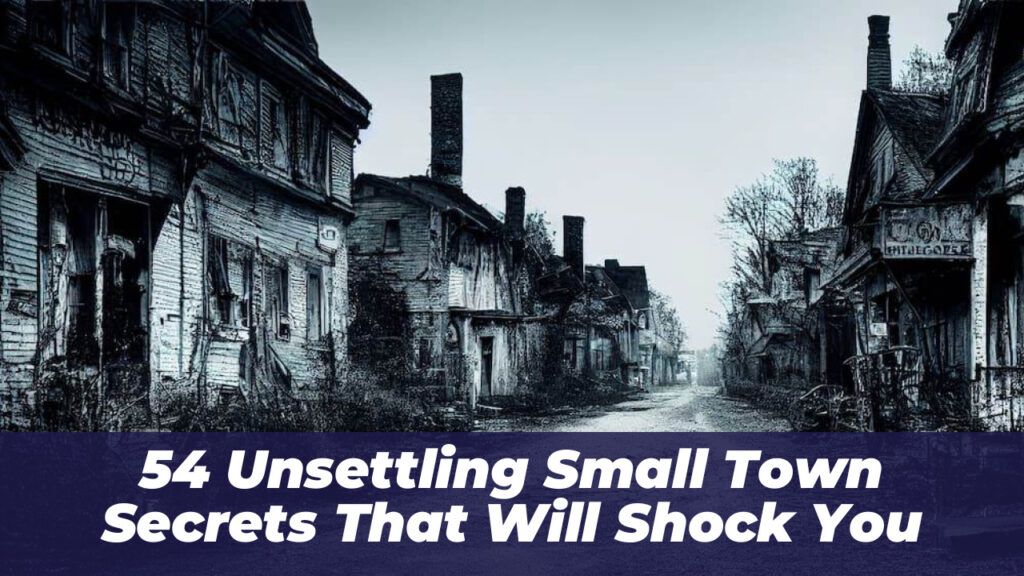
The Myth of Small-Town Tranquility: Why Secrecy Thrives in Silence
There is a pervasive, comforting narrative that safety is inherently found in the stillness of a small town. We romanticize tree-lined streets, unlocked front doors, and a community that serves as a collective guardian. Yet, historical records and sociological studies suggest a far more complex reality. In these settings, the absence of urban anonymity does not necessarily prevent darkness; rather, it forces it to become more sophisticated and deeply rooted.
When a community is small enough that everyone knows your business, the only way to preserve a secret is to bury it metaphorically or literally. From the smoldering, abandoned streets of Centralia, Pennsylvania, to suburban enclaves where model citizens maintained decades-long deceptions, small towns often provide the most fertile ground for the unimaginable.
The Anatomy of a Secret: Why Quiet Places Conceal the Most
The Social Claustrophobia Trap
Small towns operate on a sociological phenomenon of overlapping social circles. In a metropolitan environment, your physician, your neighbor, and your child’s teacher are likely strangers to one another. In a small town, these roles are often occupied by the same individuals. This social claustrophobia creates a high-pressure environment where the desire to maintain a “good name” becomes a primary survival mechanism. In this context, silence is not merely a preference; it functions as a currency used to protect the status quo.
The Surveillance of Routine
In the absence of the diverse distractions found in larger cities, the community itself becomes the focal point of daily attention. Limited public spaces turn neighbors into involuntary observers. When daily routines are common knowledge, any deviation is noted immediately. Paradoxically, this high-level surveillance forces those harboring dark secrets to become masters of camouflage, blending into the mundane until the weight of their actions becomes impossible to contain.
Unsettling Realities: From Historical Scars to Modern Concealment
The following categories outline the archetypes of small-town secrecy, moving beyond mere urban legends to reflect the psychological and structural conditions that allow such narratives to persist.
Historical Scars and Institutional Failures
History is replete with towns defined by events that permanently altered their trajectory. Whether it is the underground coal fire in Centralia that rendered a town uninhabitable or the environmental negligence in Libby, Montana where the health risks of asbestos were suppressed for decades these cases demonstrate how collective silence can be weaponized by both corporate interests and local leaders to hide catastrophic failures.
The “Respectable” Facade
The most unsettling secrets often involve those who hold positions of authority. The “pillars of the community” mayors, educators, and local law enforcement often possess the most social capital, which they can leverage to suppress dissent or hide illicit activities. When the person responsible for upholding the law or maintaining the moral fabric of a town is the primary source of its corruption, the community’s ability to self-correct is severely compromised.
Architectural Concealment
The physical landscape of a small town often serves as a silent accomplice. Renovations revealing hidden bunkers, unmarked graves beneath foundations, or soundproofed outbuildings suggest a history of deliberate concealment. In many instances, the structures themselves are designed or modified to protect the secrets of their inhabitants, turning private property into a fortress against the prying eyes of the neighborhood.
The Cultural Oddities
Certain communities foster unique behaviors that, while not always criminal, operate outside the norms of modern society. Whether due to geographic isolation, strict adherence to tradition, or a shared, unspoken pact to exclude outsiders, these towns often create an internal logic that is impenetrable to those on the outside. These environments demonstrate how isolation can foster a culture where the truth is secondary to the preservation of the group’s internal identity.
The Psychological Toll of the “Glass House”
Living in a small town can feel like residing in a glass house. The pressure to maintain a favorable reputation leads to extreme concealment and, frequently, “generational silence.” When a community’s identity is fragile, residents may prioritize the protection of local reputations over the pursuit of justice. This collective effort to ignore the truth is what allows secrets to fester, turning minor indiscretions into decades-long cover-ups.
The reality of these environments is often more visceral and challenging than any fictional portrayal. The paradox remains: the very qualities we seek community, familiarity, and connection are the exact mechanisms that allow these shocking secrets to survive. While we crave the closeness of a tight-knit society, we must acknowledge that this intimacy comes with a price. True privacy is difficult to maintain when your neighbors are constant observers, and the drive to protect a collective image often outweighs the necessity of transparency. In these quiet corners of the world, the loudest secrets are frequently the ones that are never spoken aloud.