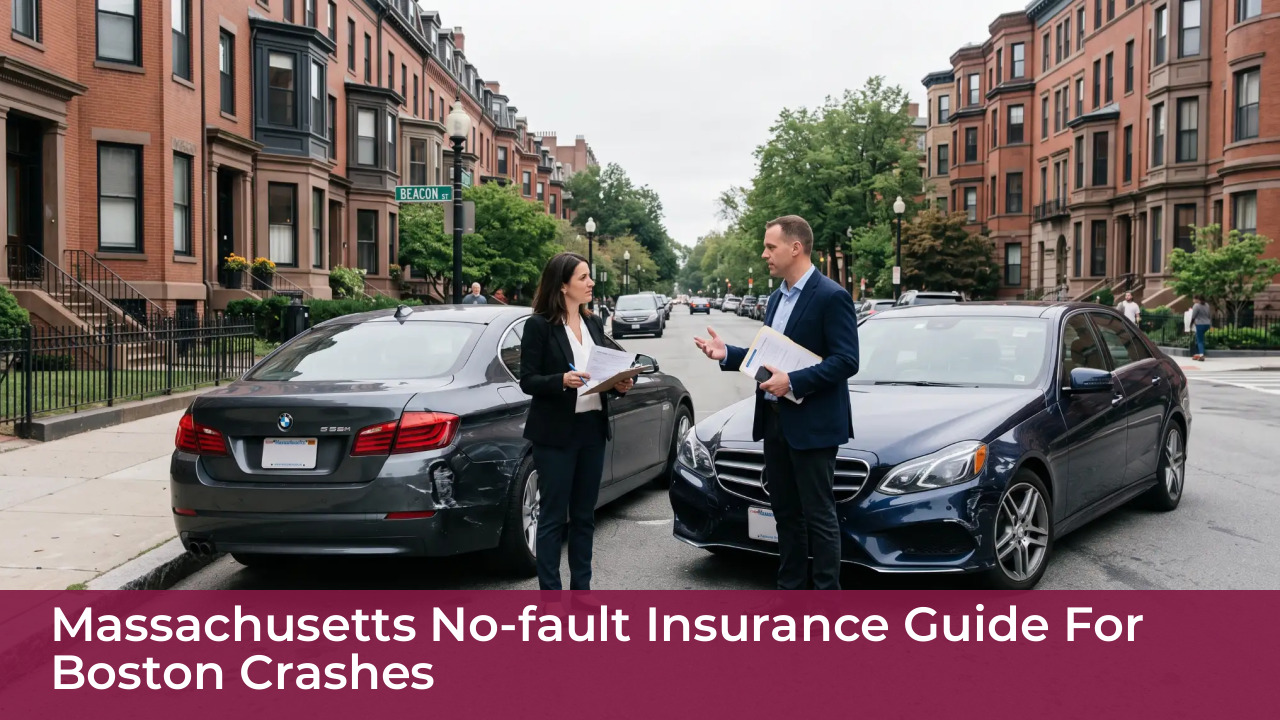
The phrase no-fault insurance stands as one of the most misunderstood concepts in American jurisprudence. For drivers navigating the congested streets of Boston, this confusion leads to costly mistakes after a collision. Many motorists assume no-fault means accountability vanishes entirely, or that nobody can ever be held legally responsible for a crash. In reality, the system alters the mechanism for paying initial medical bills and lost wages rather than forgiving reckless driving.
- Decoding the Massachusetts No-Fault Insurance Myth
- Personal Injury Protection Mechanics and Limits
- Navigating the Intersection of PIP and Private Health Insurance
- Crossing the Tort Threshold to Sue for Pain and Suffering
- Compulsory Coverage Minimums and Financial Protection
- Property Damage and Fault Determination
- Boston-Specific Accident Protocols and Reporting Deadlines
- Additional Strategic Insights for Motorists
- Frequently Asked Questions
- Does no-fault insurance mean my rates will not increase after an accident?
- What happens if my medical bills exceed the ,000 PIP limit?
- Can I still recover damages if I was partially at fault for a Boston crash?
- What steps should I take immediately at the scene of a Boston collision?
- How do insurance companies calculate lost wages under PIP?
- Are rideshare vehicles like Uber and Lyft covered by Massachusetts no-fault rules?
- Conclusion
Massachusetts operates under a modified no-fault framework governed by state statutes. When a collision occurs within city limits or on surrounding metropolitan expressways, your own insurance carrier steps in to cover immediate financial losses. Understanding how this structure interacts with personal injury protection, health insurance coordination, and property damage liability protects your financial wellbeing.
Decoding the Massachusetts No-Fault Insurance Myth
Every motor vehicle registered in the Commonwealth must carry Personal Injury Protection, commonly known as PIP. Under Massachusetts General Laws Chapter 90, Section 34M, your own insurance policy pays your medical expenses, replacement services, and a portion of lost wages regardless of who caused the accident. This mechanism exists to bypass lengthy fault investigations, ensuring injured parties receive immediate medical attention without waiting for liability determinations.
However, this system applies strictly to personal injuries. Property damage claims, vehicle repairs, and collisions involving commercial trucks or public transit follow traditional fault-based rules. Separating injury compensation from property damage creates a dual-track process that frequently overwhelms drivers who attempt to manage claims without legal guidance.
Statutory regulations governing Commonwealth motorists aim to reduce court congestion. By shifting minor injury claims out of the courtroom and into administrative insurance processing, the judicial system preserves resources for complex litigation. Yet, this efficiency requires drivers to understand their exact rights and filing obligations from the moment an impact occurs.
Personal Injury Protection Mechanics and Limits
Personal Injury Protection provides a crucial financial safety net, but its statutory limits are fixed. The standard PIP policy covers up to $8,000 per person per accident. Within this financial boundary, benefits are allocated to specific recovery needs:
- Reasonable and necessary medical, surgical, X-ray, and dental services
- Ambulance fees, hospital stays, and prescribed rehabilitation therapies
- Up to 75 percent of gross lost wages if injuries prevent employment
- Replacement services for household duties you cannot perform due to injury
Because the $8,000 ceiling encompasses both medical bills and wage replacements, funds deplete rapidly during severe accidents. A single emergency room visit involving diagnostic imaging and specialist consultations can exhaust the initial PIP allocation within days. Modern healthcare pricing in regional medical centers means that $8,000 serves merely as a temporary buffer rather than complete financial coverage.
Navigating the paperwork associated with PIP payouts requires diligence. Insurers frequently scrutinize medical bills, demanding documentation to prove treatment is both reasonable and necessary. Drivers who miss submission deadlines or fail to supply proper medical records face delayed reimbursements or outright claim denials.
Navigating the Intersection of PIP and Private Health Insurance
Coordination of benefits represents a major source of anxiety for Boston crash victims. Massachusetts law enforces a specific payment hierarchy when an injured motorist carries private health insurance. Under MGL c. 90 § 34A, PIP automatically covers the first $2,000 of medical expenses. Once that initial $2,000 threshold is reached, your private health insurance assumes primary responsibility for subsequent medical treatment.
Remaining PIP funds stay available to cover health insurance co-payments, deductibles, and eligible lost wages. This coordination prevents double recovery while ensuring that medical providers receive payment. However, medical billing departments often send bills to the wrong entity, triggering billing loops that stress recovering patients.
Managing out-of-pocket costs requires active oversight of all medical explanations of benefits. If your private health insurance refuses to pay for accident-related care due to pre-authorization failures or network restrictions, PIP funds can bridge the gap until the dispute resolves. Coordinating these payments successfully prevents medical debt collectors from contacting you while you heal.
Crossing the Tort Threshold to Sue for Pain and Suffering
While PIP handles economic losses up to $8,000 without regard to fault, recovering non-economic damages like pain and suffering requires crossing the statutory tort threshold. Under Massachusetts General Laws Chapter 231, Section 6D, a crash victim cannot sue the at-fault driver for pain and suffering unless specific legal criteria are met.
The financial hurdle requires reasonable and necessary medical expenses to exceed $2,000. Alternatively, the claimant must satisfy one of several verbal exceptions written into the statute. Meeting the financial minimum sounds simple, but medical coding rules and insurance adjustments mean bills must genuinely reflect $2,000 in incurred costs rather than billed charges.
Verbal exceptions eliminate the financial hurdle entirely if the injury involves specific physical trauma. Proving these conditions requires comprehensive medical documentation from licensed physicians. The following table outlines the statutory pathways required to bypass the no-fault restriction and pursue a third-party bodily injury lawsuit:
| Statutory Threshold Type | Legal Requirement | Documentation Needed |
|---|---|---|
| Medical Expense Hurdle | Incurred medical expenses exceeding $2,000 | Itemized hospital bills, treatment records, receipts |
| Fracture Exception | Any documented bone fracture | X-ray reports, orthopedic surgeon notes |
| Disfigurement | Permanent and serious disfigurement | Photographic evidence, plastic surgeon evaluations |
| Impairment | Loss of sight, hearing, or substantial bodily function | Specialist functional capacity evaluations |
| Death | Fatality resulting from the collision | Death certificate, autopsy report, probate appointment |
Compulsory Coverage Minimums and Financial Protection
Every vehicle registered in the Commonwealth must maintain compulsory liability insurance. Effective July 1, 2025, legislative updates under St. 2024, c. 275, § 4 increased bodily injury liability minimums to provide stronger protection for motorists. Understanding these baseline numbers helps evaluate whether your current policy is adequate.
The updated compulsory coverage requirements include:
- Bodily Injury Liability: $25,000 per person and $50,000 per accident
- Property Damage Liability: $30,000 per accident
- Uninsured Motorist Bodily Injury: $25,000 per person and $50,000 per accident
- Personal Injury Protection: $8,000 per person per accident
Despite these statutory minimums, legal experts advise purchasing higher policy limits. In a major metropolitan environment like Boston, a severe multi-car collision on the Interstate 93 corridor quickly generates medical bills that eclipse $25,000. Carrying higher limits, alongside optional underinsured motorist coverage, shields personal assets from predatory lawsuits if an accident exceeds state minimums.
Property Damage and Fault Determination
A frequent point of confusion involves the split nature of Massachusetts insurance law. While personal injuries are handled through no-fault PIP rules, property damage follows a traditional fault-based model. When your vehicle sustains damage in a Boston traffic collision, financial recovery depends entirely on proving the other motorist caused the crash.
Massachusetts utilizes a modified comparative negligence rule under MGL c. 231, Section 85. Under this doctrine, you can recover damages for vehicle repairs and rental cars only if your share of fault does not exceed 50 percent. If insurance adjusters determine you were 51 percent or more responsible for the collision, you recover nothing for your property damage.
Proving liability in urban environments requires tangible evidence. Dashcam footage, eyewitness accounts, police diagrams, and traffic camera recordings establish fault. Insurance carriers evaluate these details closely before approving rental car reimbursements or authorizing body shop repairs for dented fenders and smashed chassis components.
Boston-Specific Accident Protocols and Reporting Deadlines
Driving in Boston presents distinct challenges, from navigating historic, winding streets to managing complex rotary intersections and MBTA transit interface zones. When a crash occurs amidst this congestion, knowing the correct emergency reporting protocols prevents legal complications.
If an accident occurs on major state highways or parkways, the Massachusetts State Police handle the response. For municipal streets and neighborhood intersections, the Boston Department of Police manages the scene. Regardless of which agency responds, drivers must adhere to strict reporting deadlines mandated by state regulators.
Statutory timelines leave zero room for error:
- 5 Days: You must complete and file the Registry of Motor Vehicles (RMV) Crash Operator Report (Form CRA) if property damage exceeds $1,000 or anyone is injured.
- 3 Years: The personal injury statute of limitations dictates the deadline to file a formal lawsuit in court.
- 2 Years: Claims involving municipal entities or public transportation authorities require tort claim presentment notices within a much tighter window.
Additional Strategic Insights for Motorists
Beyond the baseline rules of no-fault protection, understanding how insurance adjusters evaluate claims provides a distinct tactical advantage. Insurers employ sophisticated software algorithms to review medical billing codes, looking for inconsistencies or patterns of overtreatment. Maintaining a continuous chain of medical care immediately following a Boston crash prevents adjusters from arguing that your injuries stem from an unrelated incident.
, uninsured and underinsured motorist coverages represent critical elective add-ons in Massachusetts. Given that thousands of motorists drive across the state line from neighboring jurisdictions with lower liability requirements, encountering an uninsured driver on routes like Storrow Drive or the Massachusetts Turnpike remains a constant risk. Investing in robust optional coverage limits safeguards your household from uncompensated losses.
Finally, keeping a comprehensive physical and digital binder containing police report numbers, insurance adjuster contact details, repair estimates, and lost wage documentation streamlines the eventual settlement process. Organization reduces administrative friction and accelerates financial recovery when dealing with corporate insurance adjusters.
Frequently Asked Questions
Does no-fault insurance mean my rates will not increase after an accident?
No. No-fault refers strictly to how medical bills are paid, not fault determinations for rate-setting. If your insurance company determines you were more than 50 percent at fault for the crash, your policy is subject to surcharge points under the Massachusetts Safe Driver Insurance Plan.
What happens if my medical bills exceed the $8,000 PIP limit?
Once your $8,000 PIP allocation is exhausted, your medical bills transition to your private health insurance policy. If you cross the tort threshold through severe injuries or medical expenses exceeding $2,000, you can also seek compensation for those excess medical costs from the at-fault driver’s liability insurance.
Can I still recover damages if I was partially at fault for a Boston crash?
Yes, provided your share of fault is 50 percent or less under the modified comparative negligence rule. Your total property damage recovery is reduced by your exact percentage of fault. If you are assessed at 51 percent or more responsibility, recovery is completely barred.
What steps should I take immediately at the scene of a Boston collision?
Ensure all occupants are safe, call 911 to request emergency responders and police documentation, exchange insurance details with other involved drivers, capture photographs of vehicle damage and road conditions, and seek immediate medical evaluation.
How do insurance companies calculate lost wages under PIP?
PIP covers up to 75 percent of your gross weekly lost wages if a licensed physician confirms your injuries prevent you from performing your occupational duties. You must supply employer verification forms and pay stubs to substantiate the wage claim.
Are rideshare vehicles like Uber and Lyft covered by Massachusetts no-fault rules?
Yes, transportation network company vehicles operating in Boston carry specialized commercial insurance policies that integrate state no-fault requirements, though coverage limits shift depending on whether the driver is logged into the app, en route to a passenger, or actively transporting a rider.
Conclusion
Navigating the aftermath of a Boston automobile crash requires a firm grasp of Massachusetts no-fault mechanics, PIP limits, and fault-based property rules. By tracking your medical expenses, honoring strict RMV reporting deadlines, and understanding tort thresholds, you protect your rights and financial standing. Evaluate your policy limits today to ensure your coverage matches the realities of driving in the Commonwealth.