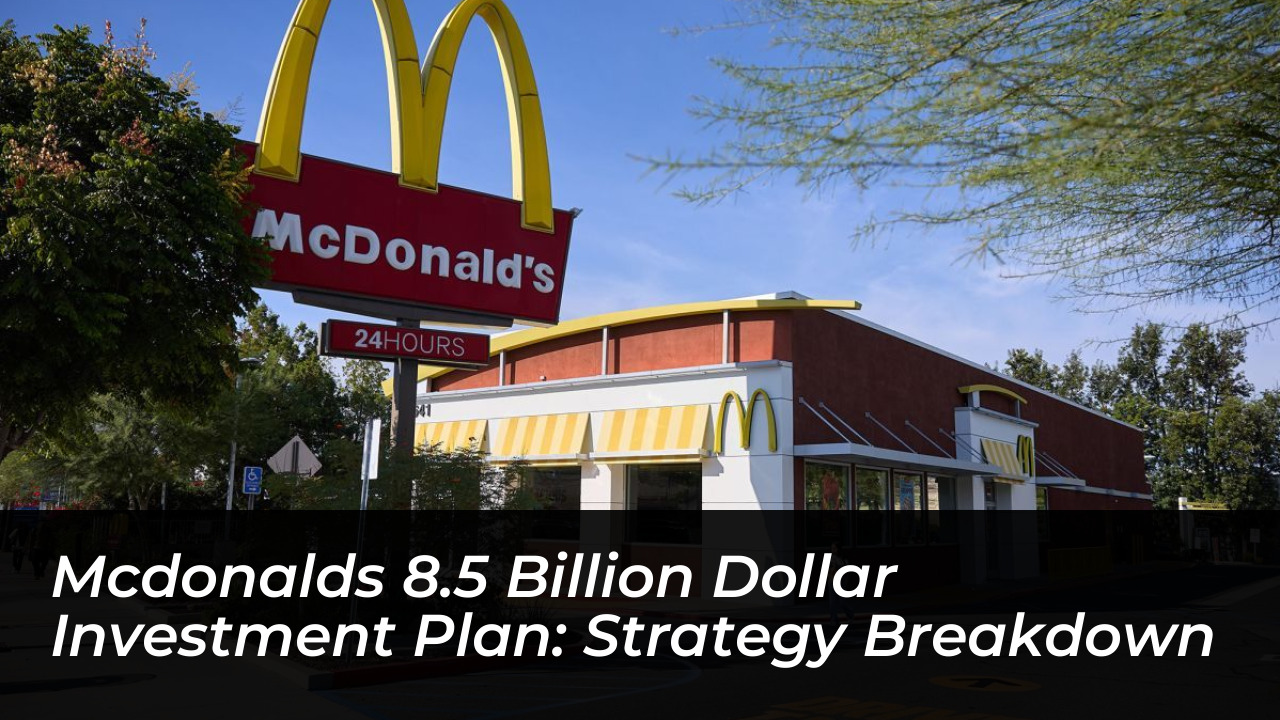
McDonald’s plans an 85 billion dollars investment to revamp operations and safeguard its fast-food market dominance across its global footprint of roughly 46,000 restaurants. The corporation is channeling capital into comprehensive operational overhaures, advanced technological integration, and targeted franchise support. This sweeping initiative, designated as the McDonald’s Next strategy, targets slowing sales growth, rising operational friction, and mounting pressure from aggressive competitors in the quick-service restaurant sector.
- Introduction to the Operational Overhaul
- Financial Breakdown and Franchisee Economics
- Capital Allocation and Timeline
- Incremental Costs and Operator Relief
- Technological Integration and ArchIQ Architecture
- Deploying Archy for Drive-Thru Efficiency
- Digital Scales and Retail Media Networks
- Menu Evolution: Targeting Protein Demand and Beverage Growth
- Scaling Hand-Breaded Chicken and Protein Options
- Expanding Beverage and Core Beef Categories
- Workforce Retraining and the Make It Golden Program
- Corporate Margin Expansion and Strategic Cost Controls
- Frequently Asked Questions
- What is the total financial commitment of the McDonald’s Next plan?
- How will Archy and ArchIQ impact store employees?
- Why is McDonald’s focusing so heavily on chicken and protein items?
Introduction to the Operational Overhaul
The multiyear funding strategy protects market dominance amid rising operational friction by modernizing both front-of-house and back-of-house systems. Following a sluggish fiscal period marked by excessive promotions and elevated food costs, leadership aims to elevate unit economics. By combining artificial intelligence, supply chain automation, and high-protein menu adaptations, the brand is positioning itself for sustained, high-margin growth.
Independent franchise holders form the backbone of this ecosystem, meaning corporate strategy relies heavily on operator buy-in. To ensure smooth adoption, leadership has designed a phased capital allocation model that eases financial burdens while driving long-term efficiency gains across every market.
Financial Breakdown and Franchisee Economics
Capital Allocation and Timeline
- Total investment volume scaling through 2036 via the comprehensive McDonald’s Next financial framework.
- Front-loaded support structure through 2030 to assist with urgent technological and physical upgrades.
- Phased capital injection models ensuring stable liquidity buffers for independent restaurant operators globally.
Incremental Costs and Operator Relief
- Estimating remodel burdens and capital outlays, where standard upgrades add roughly $800,000 per restaurant over time on top of standard cosmetic updates.
- Projected cash flow impacts and recovery windows, targeting an estimated increase of $100,000 in annual cash flow per average U.S. restaurant following full implementation.
- Strategic corporate rent relief grants offsetting immediate cost pressures during early installation phases.
Despite initial investor hesitation following the announcement, executives project mid-to-high 20% returns for franchisees. Internal financial models indicate that efficiency gains will help operators recover their capital outlays within a four-year window.
Technological Integration and ArchIQ Architecture
Deploying Archy for Drive-Thru Efficiency
- Language capabilities supporting fluent communication in both English and Spanish with a 90% accuracy rate.
- Labor hour savings per restaurant weekly, freeing up to 50 hours of staff time previously lost to order bottlenecks.
- Advanced speech recognition software reducing order entry errors and accelerating vehicle turnover rates.
Digital Scales and Retail Media Networks
- Order verification processes using digital scales, expanding from 10,000 international locations to 20,000 stores by 2028.
- Monetizing digital menu boards through third-party advertising, creating a high-margin revenue stream akin to modern retail media networks.
- Targeted promotional displays adapting dynamically based on time of day and local weather patterns.
At the center of this tech stack is ArchIQ, an artificial intelligence ecosystem developed in partnership with Google. ArchIQ automates historically labor-intensive tasks such as inventory management, employee scheduling, and real-time order verification, drastically cutting down on administrative friction. The voice-AI component, known as Archy, handles routine customer requests seamlessly.
Menu Evolution: Targeting Protein Demand and Beverage Growth
Scaling Hand-Breaded Chicken and Protein Options
- Capturing market share from category specialists by scaling hand-breaded chicken globally.
- Adapting to consumer habits driven by GLP-1 weight loss medications, catering to millions of users seeking smaller, protein-packed portions.
- Introducing new grilled protein bowls and specialized snack wraps to satisfy shifting dietary trends.
Expanding Beverage and Core Beef Categories
- Global beverage market positioning, targeting a larger slice of the $230 billion industry where the brand currently holds a modest 10% share.
- Reinforcing core beef and fresh-beef Quarter Pounder footprints to outperform rivals relying entirely on frozen beef patties.
- Upgrading equipment for specialized iced coffee and blended beverage lines to drive afternoon traffic.
Market research indicates a massive shift toward protein-heavy diets. To meet this demand, McDonald’s is expanding beyond its core beef offerings into high-protein categories, grilled chicken sandwiches, specialized wraps, egg bites, and protein bowls.
Workforce Retraining and the Make It Golden Program
Operational speed and technological automation will not replace human hospitality. Corporate leadership recognizes that automated conveniences raise customer expectations regarding human interactions. To bridge the execution gap, McDonald’s is launching a sweeping employee training program titled Make It Golden.
The program moves away from traditional instructional manuals toward experience-based learning. Employees participate in sensory training modules designed to understand precise food standards, such as the exact taste profile of a perfectly prepared Big Mac. Chief People Officer Tiffanie Boyd emphasizes that labor hours saved through artificial intelligence will be redirected toward face-to-face customer hospitality rather than workforce reductions.
Corporate Margin Expansion and Strategic Cost Controls
While franchisees invest heavily in physical and technological store upgrades, corporate headquarters is targeting strict internal cost controls. By 2030, McDonald’s targets an operating margin in the low-to-mid 50% range, stepping up significantly from historical baselines.
By streamlining administrative tasks through corporate-level artificial intelligence adoption, leadership ensures that general and administrative expenses scale efficiently while revenue streams diversify through digital media and improved unit volumes.
Frequently Asked Questions
What is the total financial commitment of the McDonald’s Next plan?
An $8.5 billion capital deployment through 2036 with front-loaded support, including $5 billion disbursed through 2030 for rent relief and direct operator aid.
How will Archy and ArchIQ impact store employees?
Reallocating saved labor hours toward hospitality and food preparation while automating administrative tasks like inventory tracking and employee scheduling.
Why is McDonald’s focusing so heavily on chicken and protein items?
Meeting dietary shifts driven by GLP-1 medications and growing overall protein demand by introducing hand-breaded chicken, wraps, and bowls.