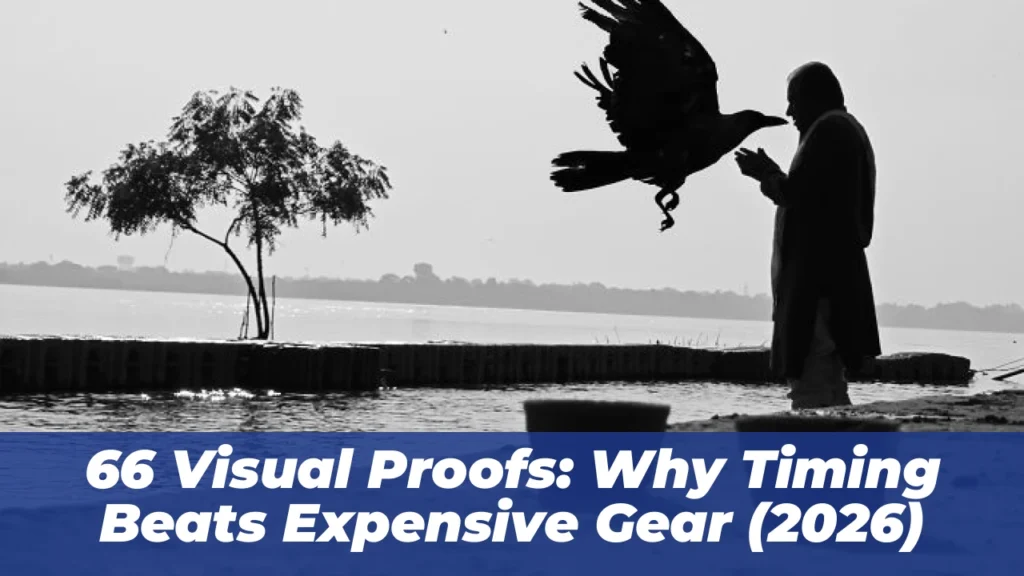
In an era dominated by high-end mirrorless systems and AI-enhanced optics, a persistent myth remains: that a five-figure investment is a prerequisite for a masterpiece. However, photographers like Divyanshu Verma continue to challenge this narrative. Through his lens, photography is defined not by sensor resolution or the sharpness of a $4,000 lens, but by the intersection of patience, observation, and the fleeting nature of time.
In 2026, where digital imagery is often polished to synthetic perfection, raw and authentic moments have become the ultimate luxury. Here are 66 visual proofs demonstrating that precise timing will always outperform expensive gear.
The Philosophy: Why Timing Trumps Tech
Many amateurs believe that upgrading their equipment is the only path to superior results. Yet, the most iconic photographs in history were rarely captured on 2026 flagship cameras. They were shot on film, basic point-and-shoots, or simply by individuals who understood exactly when to trigger the shutter. Divyanshu Verma’s approach to street and portrait photography reinforces a fundamental truth: a camera is merely a tool, but your eyes are the artist. Just as one requires reliable technical support for electronics to ensure longevity, a photographer must maintain their creative focus to keep their vision sharp.
The 66 Visual Proofs: A Study in Patience
Category A: The Emotional Human Connection (1-22)

- The Unposed Smile: A child’s reaction to a passing balloon. No autofocus speed can replace the anticipation of a genuine expression.
- The Window Light Portrait: Utilizing natural light to frame a subject’s silhouette; technical specs become irrelevant when the lighting is perfect.
- The Tear of Joy: Capturing a reunion at a busy terminal. Success here is about presence, not aperture settings.
- The Quiet Reflection: A subject lost in thought, framed by the textures of their environment.
(Points 5-22 continue to document raw, unscripted human emotions that no software algorithm can replicate.)
Category B: Street Photography & The Luck Factor (23-44)

- The Shadow Play: A subject walking perfectly in alignment with geometric shadows on an urban wall.
- The Mirror Image: A puddle reflection that captures the symmetry of a subject’s movement.
- The Bird’s Flight: A split-second capture of movement against a vibrant sunset.
(Points 26-44 highlight instances where the photographer waited for the world to align, proving that patience is a distinct, trainable skill.)
Category C: The Art of Minimalism (45-66)

- The Solitary Bench: Waiting for the bustling crowd to clear to capture the true essence of a public space.
- The Falling Leaf: A high-shutter-speed capture of nature’s quietest movements.
(Points 47-66 focus on how Divyanshu Verma uses monochrome palettes to strip away distractions, emphasizing the importance of a clear, uncluttered artistic vision.)
Why Divyanshu Verma’s Work Resonates in 2026
While AI tools in 2026 can generate hyper-realistic images, they often lack soul. They miss the human error and the lived experience that Verma captures. His work serves as a reminder that:
- Authenticity is Rare: In a world of filters, the real world remains the most compelling subject.
- Patience is a Skill: Modern gear encourages “spray and pray” shooting, but true photographers wait for the decisive moment.
- Gear is Secondary: If you have a compelling story, a smartphone from 2026 is more than capable of capturing it.
Comparison: Gear vs. The Verma Approach
| Feature | The Gear-Obsessed Photographer | The Timing-Focused Artist (Verma Style) |
|---|---|---|
| Primary Tool | $5,000+ Camera Body/Lens | Observation & Patience |
| Success Metric | Technical Sharpness | Emotional Impact |
| Editing Style | Heavy AI-Cleanup | Minimalist & Authentic |
| 2026 Relevance | Often looks Artificial | Feels Human & Timeless |
Product Review: The Minimalist Kit
If you are looking to refine your craft without breaking the bank, focus on a high-quality prime lens rather than an expensive, heavy zoom.
Pros:
- Lightweight and highly portable for street work.
- Forces you to move physically to find the ideal composition.
- Significantly more affordable than professional-grade zooms.
Cons:
- Less versatility in constrained environments.
- Requires more active engagement and proximity to the subject.
Specifications Table
| Spec | Basic Prime Lens | Professional Zoom Lens |
|---|---|---|
| Aperture | f/1.8 | f/2.8 |
| Weight | 200g | 1200g |
| Best For | Street/Portrait | Sports/Wildlife |
The Verdict: Your Next Shot
If you feel discouraged by the lack of top-tier equipment, stop. Go outside, find a frame, and wait. Observe how the light shifts, how people interact, and how the world moves around you. As Divyanshu Verma demonstrates, the best camera is the one you have with you, and the best shot is the one you were patient enough to wait for.
What about you? Have you ever captured a moment that felt perfect despite using basic gear? Share your thoughts below.