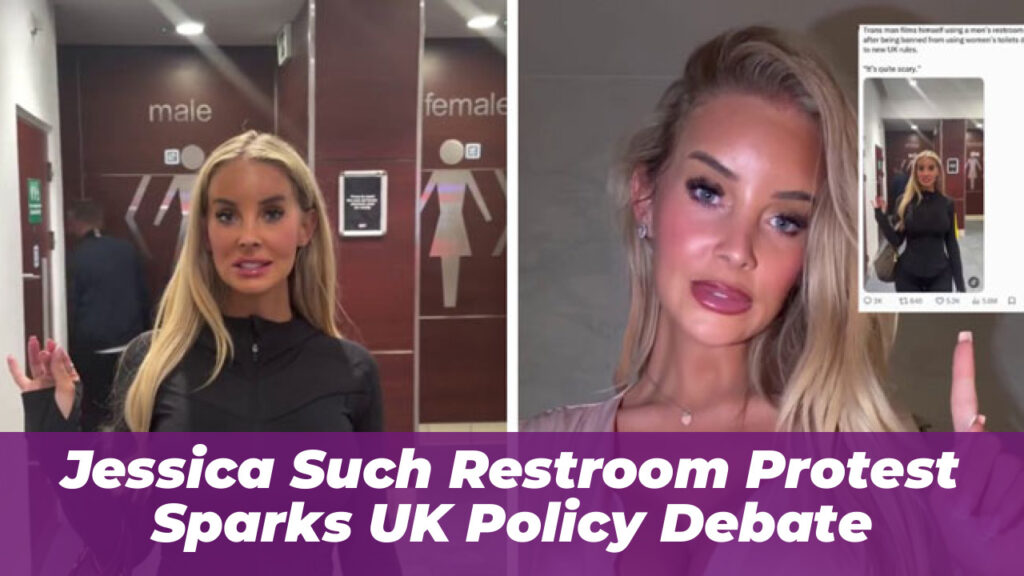
The intersection of public policy and personal identity has once again surfaced in the digital arena, sparked by a social media demonstration that has reignited the debate over single-gender spaces. Following the introduction of UK government guidance in May 2026 regarding restroom access based on biological sex, the policy has become a significant flashpoint for activists and policymakers.
At the center of this controversy is content creator Jessica Such, who challenged the practical application of this guidance by entering a men’s restroom. Her actions and the subsequent viral response underscore the widening divide between legislative intent and the day-to-day realities for transgender individuals.
The Catalyst: A Demonstration of Intent
Jessica Such’s decision to document her entry into a men’s restroom was framed as a protest against the 2026 government directive. The directive encourages businesses and public entities to prioritize biological sex when designating single-gender spaces. By filming the encounter, Such aimed to illustrate what she views as the inherent impracticality of policies that may direct trans women who have lived as women for years into spaces traditionally reserved for men.
The video, which circulated rapidly across social platforms, functioned as a polarizing social experiment. For many viewers, the visual contrast of a trans woman with a feminine presentation entering a male-designated space was the focal point of the protest. It was intended to force a public conversation regarding whether such policies prioritize safety or if they inadvertently create new, uncomfortable, and potentially volatile environments.
The Legislative Backdrop
The UK government’s guidance, issued earlier this year, is rooted in the premise of privacy and comfort for biological women, advocating for the right of businesses to maintain sex-segregated spaces. However, critics argue that the policy lacks the nuance required to address gender identity, creating a dilemma: trans women are increasingly discouraged from using women’s restrooms, yet they face confusion or hostility when utilizing men’s facilities.
This shift in public discourse often mirrors the intensity found in other areas of media culture, similar to the public scrutiny observed in discussions regarding Jada Pinkett Smith: Bio, Career Highlights & Legacy (2026).
The Two-Fold Debate: Safety and Privacy
The reaction to Such’s content remains divided, reflecting a broader societal split:
- The Argument for Biological Segregation: Proponents of the government guidance argue that biological sex is the only objective metric for privacy. From this perspective, the presence of a trans woman in a men’s room is a secondary concern compared to the primary goal of keeping women’s spaces exclusively for biological females.
- The Argument for Inclusion and Safety: Conversely, activists contend that the policy is exclusionary. They argue that forcing trans individuals into environments where they do not fit increases the risk of harassment and public confrontation, rather than serving as a genuine privacy measure.
The Ethical Gray Area: Filming in Restrooms
Beyond the political implications, there is an ethical dimension to this discourse. Critics of the protest have raised concerns regarding the act of filming inside a restroom. Regardless of one’s stance on the policy, the potential invasion of privacy for unsuspecting individuals who were present during the filming has drawn significant backlash.
This raises a critical question: Does the pursuit of a political objective justify the compromise of privacy for those using a public facility? It remains a complex challenge to balance the right to protest with the fundamental expectation of privacy in sensitive spaces.
Conclusion: A Future of Continued Friction
The incident involving Jessica Such is a symptom of a society grappling with the real-world application of gender-critical policies. As institutions navigate this new guidance, the friction between legal mandates and the lived experiences of citizens is likely to persist. Whether this leads to more compassionate policy adjustments or further social polarization remains to be seen.
For now, the debate serves as a testament to how quickly a legislative decision can transform into a deeply personal and public confrontation on the digital stage. Much like the discourse surrounding Alyssa Farah Griffin Reveals Hurtful Comment From Former Boss, these moments highlight how individual experiences often become the primary battleground for broader societal change.