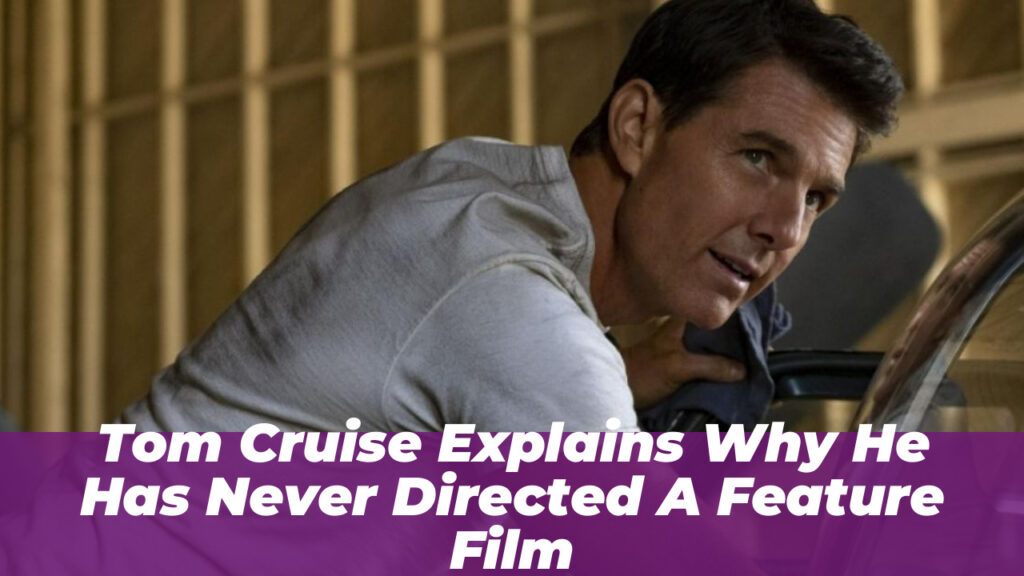
For decades, Hollywood has speculated about why one of the world’s most influential cinematic figures has never taken the helm as a director. Many industry observers assume his intense technical involvement and attention to detail are precursors to a directorial debut. However, Tom Cruise recently dismantled these assumptions during a candid appearance on the “Pardon My Take” podcast.
Contrary to the narrative that he is building toward an auteur project, he revealed his path is a deliberate, strategic choice. By remaining an actor and producer, he maintains a creative breadth that a directorial chair would inherently restrict. His perspective suggests that the myth of his transition to directing is a misunderstanding of his true ambition, which is to serve as the ultimate facilitator of global cinema.
The Collaborative Philosophy
Cruise views his professional life as an ecosystem where his greatest utility lies in his ability to bridge gaps between departments. Rather than focusing on a single vision, he prioritizes the capacity to collaborate with a diverse array of visionary filmmakers. This approach allows him to absorb different creative perspectives while lending his own expertise to the collective success of a production.
He describes his contribution as setting the table for others to thrive. By positioning himself as a producer and lead actor, he provides directors with the resources and the creative freedom they need to execute their best work. This collaborative spirit transforms him into a partner rather than a taskmaster, ensuring that the production benefits from his deep institutional knowledge.
Maximizing Creative Breadth
Staying out of the director’s chair allows Cruise to rotate between various genres and creative teams without being tethered to a single production cycle. This flexibility is vital for someone who thrives on constant engagement with new challenges. He prefers the agility of jumping from one ambitious project to another, maintaining a high volume of output.
By avoiding the bottleneck of directing, he remains active in the development, execution, and marketing phases of his films. This multifaceted involvement ensures that he remains at the pulse of the industry. He believes that limiting his focus to one directorial project would be a disservice to the variety of stories he wishes to help bring to the screen.
Reality of Set Immersion
A hallmark of his on-set presence is his refusal to retreat into the comfort of a private trailer. While many stars use that space to isolate or prepare, he chooses to remain on the floor, absorbing the energy of the crew. This immersion is a calculated effort to understand the intricate machinery of filmmaking.
By spending his downtime observing the lighting technicians, camera operators, and grips, he builds a rapport that transcends his status as a lead actor. This constant presence allows him to act as a bridge between the creative vision of the director and the practical realities faced by the crew. He believes that true filmmaking occurs in the trenches.
Identifying Talent
During his interview, he compared his approach to talent acquisition to the NFL draft process. He looks for potential, drive, and that intangible spark in directors and crew members, often looking past conventional choices to find people with a unique vision. This ability to scout and nurture talent is a core component of his production strategy.
He recognizes that the most successful projects are built on the backs of people who have been given the right platform to shine. By identifying these individuals early, he helps cultivate the next generation of creative leaders. He views his role as a talent scout who ensures the right people are in the right positions to succeed.
Technical Intensity
His commitment to technical accuracy is legendary, often extending into the engineering of the shots themselves. Whether he is working with aerial teams or complex underwater rigs, he insists on understanding the physics of the scene. This technical intensity is what allows him to push the boundaries of what is possible on film.
He does not merely perform; he participates in the design of the action. By engaging with the engineers and pilots, he ensures that the sequences are not only visually stunning but also grounded in a reality that audiences can feel. This level of involvement is a form of creative expression that satisfies his need for precision.
Tom Cruise’s refusal to direct is not a sign of limitation but a testament to his strategic mastery of the film industry. By positioning himself as the ultimate enabler, he exerts more influence over the cinematic landscape than he ever could from the confines of a single director’s chair. His career is a masterclass in collaboration, proving that one can be the heartbeat of a production without needing to call the shots.