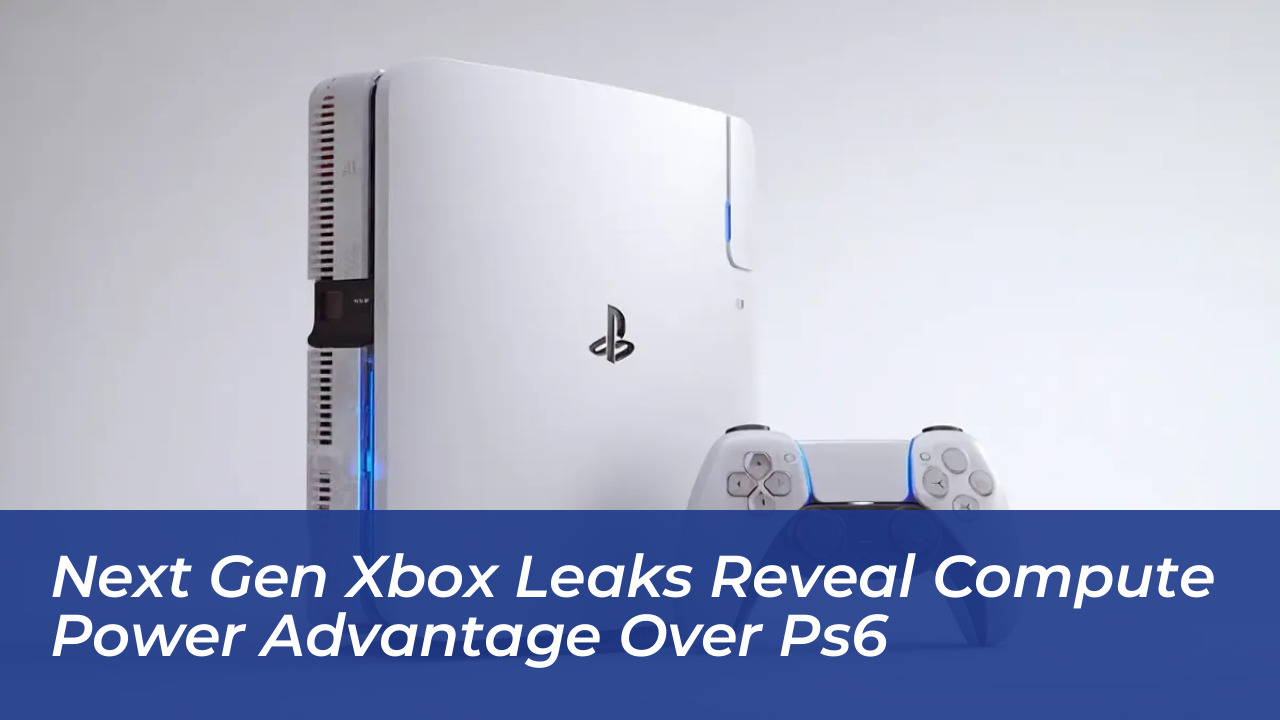
Recent hardware leaks from NeoGAF industry insiders outline a massive performance gap in the upcoming console generation. Both Microsoft and Sony have completed the tape-out blueprint phase for their next-generation systems, locking in core architectural designs for manufacturing submission. Leaked compute figures show that Microsoft’s Project Helix delivers 56 TFLOPS of GPU performance, while the PlayStation 6 reaches 40 TFLOPS. These numbers establish a theoretical 40 percent compute advantage for Microsoft. However, raw compute figures only tell part of the story. While Microsoft holds the raw performance crown, pricing strategies, manufacturing realities, and opposing ecosystem philosophies will ultimately dictate market success for both platforms.
- The Tape-Out Phase and Hardware Specifications
- What Silicon Tape-Out Means for Console Release Timelines
- Comparing the Leaked Numbers: 56 TFLOPS vs 40 TFLOPS
- Architectural Foundations: Zen 6 and RDNA 5
- Moving Beyond Current Generation Hardware
- Proprietary Silicon Additions
- Ecosystem Philosophies: Hybrid PC vs Living Room Console
- Sony and the Traditional Living Room Experience
- Microsoft and the Open Hybrid PC Approach
- The Financial Realities of Component Costs and Retail Pricing
- Bills of Materials and Manufacturing Overheads
- Projected Retail Prices and Subsidy Challenges
- Does Raw Compute Advantage Guarantee Victory?
- Lessons from Historical Performance Gaps
- Conclusion
- Frequently Asked Questions
- What are the leaked TFLOPS numbers for the next-generation consoles?
- When are the PlayStation 6 and Xbox Project Helix scheduled for release?
- Will the next-generation consoles include physical disc drives?
- How do architectural differences affect real-world rendering output?
- Why is the estimated retail price for Project Helix higher than the PlayStation 6?
The Tape-Out Phase and Hardware Specifications
What Silicon Tape-Out Means for Console Release Timelines
A completed silicon tape-out signifies that the architectural layout is final. Neither Microsoft nor Sony can alter the core hardware specifications of their custom System-on-Chip designs at this stage. Minor revisions may occur to fix functional bugs, but the compute units, memory controllers, and cache sizes remain fixed. This essential milestone suggests semiconductor production contracts with TSMC are locked in, pointing toward a consumer release window in late 2027.
Despite industry rumors suggesting potential delays due to global memory shortages and rising component costs, insiders confirm that pushing these production runs back incurs greater financial penalties than absorbing elevated RAM prices. The financial implications of high-speed memory acquisition drive bills of materials upward, forcing manufacturers to carefully balance component selection with target retail prices.
Comparing the Leaked Numbers: 56 TFLOPS vs 40 TFLOPS
A raw comparison of floating-point operations can be misleading when architectural differences exist between competing platforms. Leaked hardware details note that the 40 TFLOPS figure attributed to the PlayStation 6 accounts for advanced dual-issue compute capabilities, a feature that older hardware architectures cannot utilize in the same manner. Without factoring in dual-issue instruction scheduling, raw numbers fail to tell the complete story of real-world rendering output.
Geometry breakdowns reveal why this performance gap exists. Xbox Project Helix relies on a larger silicon die featuring approximately 68 active Compute Units, pushing operating frequencies up to roughly 3.217 GHz under maximum load. Meanwhile, the PlayStation 6 features 52 dual-issue Compute Units, maintaining a GPU clock speed of approximately 3.0 GHz to balance power consumption and thermal limits. Project Helix reportedly features roughly 42 percent more silicon area and 20 percent more memory capacity than its PlayStation rival, accounting for the raw power discrepancy.
Architectural Foundations: Zen 6 and RDNA 5
Moving Beyond Current Generation Hardware
Both next-generation platforms abandon aging hardware foundations in favor of cutting-edge AMD silicon. Moving from the Zen 2 and RDNA 2 architectures found in current systems to AMD Zen 6 CPUs and RDNA 5 graphics brings generational leaps in efficiency, instructions per clock, and ray-tracing performance. Collaborative engineering efforts introduce specialized silicon features designed to handle heavy ray-tracing workloads without tanking frame rates.
Power management also receives a massive overhaul. Advanced power gating allows the silicon to dynamically shift electrical current to specific compute blocks based on immediate software demands. This reduces thermal output during less intensive dashboard tasks while reserving maximum voltage spikes for heavy gaming sequences.
Proprietary Silicon Additions
Radiance Cores provide dedicated hardware acceleration for path tracing, managing ray traversal entirely outside the standard shader pipelines. This dedicated silicon offloads intensive calculations, allowing developers to implement full global illumination and reflections without sacrificing overall frame rates. These hardware additions bridge the gap between traditional rasterization and full path-traced rendering.
Neural Arrays group GPU compute units to function as unified machine learning engines, handling advanced upscaling and frame reconstruction algorithms. Additionally, Universal Compression layers built directly into the silicon pipeline compress data dynamically across all memory types. This software-hardware integration stretches available memory bandwidth without requiring expensive memory bus expansions.
Ecosystem Philosophies: Hybrid PC vs Living Room Console
Sony and the Traditional Living Room Experience
Sony treats the PlayStation 6 as a refined, traditional home console optimized strictly for the living room television experience. This strategy is backed by curated first-party exclusives and a tightly managed software ecosystem. Integration with digital-only distribution models continues to expand, reflecting the gradual cessation of physical disc manufacturing across the industry.
Accompanying hardware initiatives such as the portable Project Canis ecosystem aim to keep players tethered within the PlayStation brand. By offering a companion portable device that syncs seamlessly with the main living room console, Sony maintains a closed garden approach that prioritizes ease of use and streamlined user interfaces.
Microsoft and the Open Hybrid PC Approach
Microsoft structures Project Helix as a hybrid console-PC. Leaked developer guidance highlights Microsoft’s Unified Game Development Kit, which allows developers to build software targeting Windows PCs and run it natively on the living room hardware. Project Helix incorporates support for third-party storefronts such as Steam and the Epic Games Store, breaking down the traditional barrier between closed console environments and open desktop platforms.
Rather than investing heavily in proprietary handheld hardware like its competitor, Microsoft relies on established hardware partners to service the portable gaming segment. This open ecosystem philosophy allows players to bring their existing PC libraries directly to their television screens without rebuying titles.
The Financial Realities of Component Costs and Retail Pricing
Bills of Materials and Manufacturing Overheads
Ambitious hardware specifications come with severe financial penalties. Global shortages of high-speed memory and advanced packaging components have driven estimated bills of materials upward. Industry analysts estimate that the manufacturing cost for these systems sits near $900 to $960 at scale, creating a massive hurdle for consumer pricing models.
Advanced packaging technologies required to stitch together multi-die processors add significant per-unit expenses. TSMC production lines charge premium rates for the advanced nodes necessary to manufacture Zen 6 and RDNA 5 silicon efficiently, leaving hardware manufacturers with narrow margins.
Projected Retail Prices and Subsidy Challenges
PlayStation 6 pricing models point toward a baseline of $699, aligning with the precedent set by the high-end PlayStation 5 Pro. Project Helix faces even higher production overhead due to its larger silicon die and open architecture, with insider estimates placing retail expectations between $999 and $1,200.
Microsoft faces unique subsidy challenges with this generation. Because Project Helix supports open third-party storefronts where Microsoft cannot capture standard software licensing revenue on every transaction, traditional hardware loss-leader subsidies become much harder to justify. Selling hardware at a massive loss only makes sense if the platform holder recoups costs through digital store commissions.
Does Raw Compute Advantage Guarantee Victory?
Lessons from Historical Performance Gaps
Historical precedent proves that the console with the highest floating-point throughput does not automatically dominate the market. During the current generation, the Xbox Series X held a minor raw compute advantage over the base PlayStation 5, yet both systems delivered near-identical performance in the vast majority of multiplatform titles.
Advanced temporal upscaling technologies reduce the visual impact of native resolution disparities. If both Project Helix and the PlayStation 6 rely on sophisticated next-generation upscaling solutions like AMD FSR variations, the visual differences in standard gameplay scenarios may remain difficult for players to spot without specialized pixel-peeping tools.
Conclusion
Hardware leaks indicate that Microsoft’s Project Helix holds a definitive paper advantage in raw compute power, reaching 56 TFLOPS compared to the PlayStation 6 at 40 TFLOPS. However, hardware specifications represent only one piece of a complex puzzle. Pricing strategies, consumer economic pressures, and software ecosystem philosophies will ultimately determine which platform captures the broader market. As we approach the late 2027 release window, the success of these systems will depend less on raw TFLOPS and more on how well manufacturers manage retail pricing and developer adoption.
Frequently Asked Questions
What are the leaked TFLOPS numbers for the next-generation consoles?
Leaks indicate that Microsoft’s Project Helix targets 56 TFLOPS of GPU performance, while the PlayStation 6 reaches 40 TFLOPS, utilizing dual-issue compute capabilities to maximize its output.
When are the PlayStation 6 and Xbox Project Helix scheduled for release?
Both next-generation consoles are currently slated for a consumer release window in late 2027, following the completion of their silicon tape-out phases.
Will the next-generation consoles include physical disc drives?
Industry trends point strongly toward digital-only distribution models, with manufacturers increasingly phasing out physical disc manufacturing for home hardware.
How do architectural differences affect real-world rendering output?
Architectural shifts such as dedicated Radiance Cores for path tracing and Neural Arrays for machine learning upscaling allow next-generation systems to deliver significantly higher visual fidelity than simple TFLOPS comparisons suggest.
Why is the estimated retail price for Project Helix higher than the PlayStation 6?
Project Helix features a larger silicon die, roughly 20 percent more memory capacity, and an open architecture that complicates traditional hardware subsidization models, driving estimated retail prices higher.