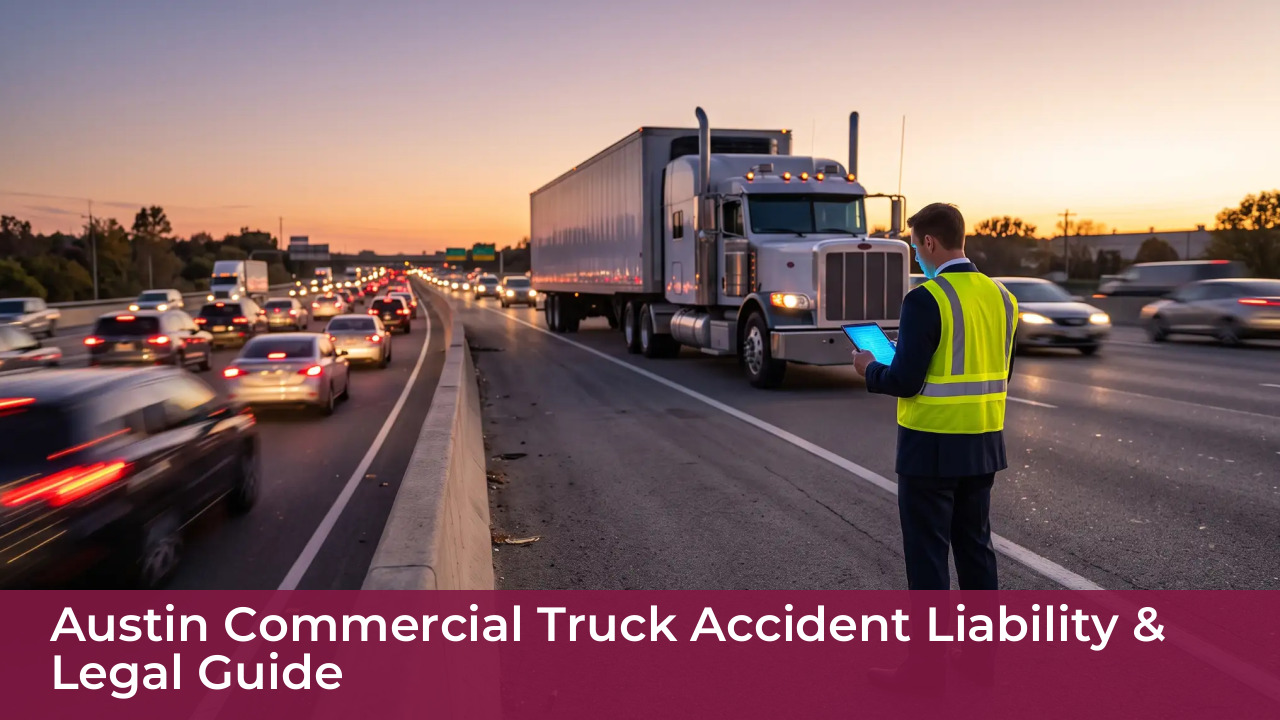
Commercial motor vehicle collisions along central Texas roadways present immense legal, financial, and personal challenges for injured victims. When a massive semi-truck collides with passenger vehicles, the aftermath extends far beyond the immediate trauma at the scene. Establishing liability requires untangling a dense web of corporate ownership, federal safety rules, and multi-tiered employment relationships. Identifying every responsible party forms the foundation of recovering full financial compensation after a catastrophic wreck.
- The Austin Freight Corridor Factor and Jurisdiction
- Identifying Liable Parties in a Commercial Trucking Collision
- Commercial Motor Vehicle Operators
- Motor Carriers and Trucking Companies
- Third-Party Maintenance Providers
- Cargo Loaders and Freight Shippers
- Core Legal Doctrines Governing Commercial Vehicle Accidents
- The Party-to-Evidence Matrix: Mapping Fault in the Supply Chain
- Time-Sensitive Evidence Preservation and Spoliation Letters
- Texas Statutes of Limitations and Procedural Roadmaps
- Frequently Asked Questions
- Who can be held liable in an Austin commercial truck crash?
- What is a spoliation letter and why is it urgent?
- How does the Texas 51 Percent Bar Rule affect my truck accident claim?
- What is the deadline for filing a truck accident lawsuit in Texas?
- Conclusion
Victims often assume that fault rests solely with the individual behind the wheel. However, commercial freight operations rarely involve just one accountable entity. Motor carriers, maintenance providers, freight brokers, and parts manufacturers often share varying degrees of blame. Swift legal intervention in the Austin jurisdiction helps secure fragile digital evidence before trucking companies alter or destroy vital records.
The Austin Freight Corridor Factor and Jurisdiction
Austin functions as a primary commercial shipping hub in the southern United States. High-density corridors such as Interstate 35, US Route 183, State Highway 71, and State Highway 130 carry thousands of heavy transport vehicles daily. This intense traffic volume creates high-risk zones where sudden congestion frequently triggers multi-vehicle pileups and severe rear-end collisions.
Logistics operations along these central Texas routes involve a mix of out-of-state motor carriers, regional freight brokers, and local delivery contractors. When an accident occurs, navigating the jurisdictional landscape within Travis County courts requires specialized knowledge of local court procedures and corporate registration rules. Out-of-state trucking fleets often attempt to move legal proceedings to federal venues, making local counsel essential for keeping claims within state courts.
Commercial operators using Austin bypasses and urban corridors must strictly adhere to federal safety mandates alongside state traffic statutes. Despite these rules, tight delivery schedules frequently incentivize operators to bypass mandatory rest breaks and push equipment past safe operating limits. Pinpointing where the breakdown in safety occurred starts with a comprehensive review of all corporate entities touching the shipping chain.
Identifying Liable Parties in a Commercial Trucking Collision
Commercial truck crash litigation differs fundamentally from standard passenger car accident claims. Multiple entities exercise control over the vehicle, the driver, and the cargo, opening up various avenues for financial recovery.
Commercial Motor Vehicle Operators
The truck driver remains the primary actor whose immediate actions such as distracted driving, speeding, or driving while fatigued frequently trigger the collision. Investigators examine driver logbooks, phone records, and toxicology reports to determine if operator negligence caused the crash.
Motor Carriers and Trucking Companies
Employers holding the operating authority face direct and indirect liability for crashes involving their fleet. Federal Motor Carrier Safety Administration (FMCSA) regulations hold these companies responsible for maintaining safe operations, vetting driver credentials, and enforcing hours-of-service limits.
Third-Party Maintenance Providers
Many transport companies outsource vehicle repairs and routine upkeep to third-party mechanics. If a brake failure, tire blowout, or steering malfunction causes a wreck, the maintenance contractor shares legal fault for failing to perform adequate repairs.
Cargo Loaders and Freight Shippers
Improperly balanced or unsecured cargo frequently causes semi-trucks to jackknife or roll over, especially on the sweeping curves of State Highway 130. Shippers and loading facility operators must distribute weight according to strict federal guidelines to maintain vehicle stability.
Vehicle and component part manufacturers also face liability if a defective steering column, faulty tire tread, or compromised airbag system contributes to the severity of the crash. Additionally, municipal contractors or government entities responsible for dangerous road design or unaddressed construction hazards may share a portion of the fault.
Core Legal Doctrines Governing Commercial Vehicle Accidents
Texas tort law relies on specific legal doctrines to hold corporations accountable for the actions of their personnel and contractors. Understanding these frameworks helps victims hold deep-pocketed logistics companies responsible for devastating collisions.
Under the doctrine of vicarious liability, commonly known as respondeat superior, an employer is legally responsible for the wrongful acts of an employee performed within the scope of employment. If a driver causes a crash while hauling freight for a motor carrier, the parent company shares automatic liability for those actions.
Beyond vicarious liability, motor carriers often face direct liability for their own internal policies. Negligent hiring, training, and retention occur when a company places an unqualified or dangerous driver behind the wheel despite a history of safety violations. Similarly, negligent entrustment applies when a company hands heavy commercial equipment to an operator known to be reckless, impaired, or inadequately licensed.
| Legal Doctrine | Primary Focus | Key Proof Required |
|---|---|---|
| Respondeat Superior | Employer accountability for employee actions | Driver was acting within the scope of employment during the crash |
| Negligent Hiring & Training | Carrier oversight failures | Unchecked background records, missing training certifications |
| Negligent Entrustment | Improper vehicle handover | Carrier knew or should have known the operator was unfit |
| Comparative Negligence | Allocation of fault among parties | Evidence proving defendant responsibility exceeds the 51 percent bar |
Under Chapter 33 of the Texas Civil Practice and Remedies Code, the state applies a modified comparative fault rule known as the 51 Percent Bar Rule. This statute allows an injured victim to recover damages as long as their assigned percentage of responsibility does not exceed 50 percent. If a jury finds the plaintiff 51 percent or more at fault, they recover nothing, making the defense strategy of shifting blame onto the victim a primary hurdle in litigation.
The Party-to-Evidence Matrix: Mapping Fault in the Supply Chain
Proving liability in a complex commercial wreck requires matching specific documents and digital records to each responsible party in the supply chain. This evidentiary mapping connects corporate actions to the ultimate cause of the collision.
- Driver Qualification Files: Used to prove operator negligence and negligent hiring by showing whether the motor carrier checked medical certifications, drug test results, and past driving records.
- Maintenance Logs and Inspection Records: Used to uncover mechanical failure liabilities and assign fault to third-party repair shops or internal fleet maintenance departments.
- Cargo Manifests and Weight Tickets: Used to assess improper loading liabilities, identifying which shipping facility or warehouse stacked and secured the freight.
- Engine Control Module (ECM) and Electronic Logging Device (ELD) Data: Used to track exact speed, braking force, and hours-of-service violations leading up to the impact.
Time-Sensitive Evidence Preservation and Spoliation Letters
Time works against victims in commercial truck crash cases. Electronic logging devices and onboard telematics systems automatically overwrite driving data after short cycles, often within 30 to 60 days. If legal counsel does not act quickly, critical proof regarding driver speed and fatigue vanishes permanently.
Attorneys issue formal spoliation letters to motor carriers immediately following an incident. A spoliation letter legally demands that the company preserve all physical debris, black box data, dashcam footage, and personnel files. Destroying or altering these materials after receiving notice triggers severe court sanctions and creates a legal presumption that the destroyed evidence would have proven the carrier’s liability.
Beyond electronic records, securing physical evidence requires independent investigators to inspect the accident scene before highway crews clear wreckage. Skid marks, gouges in the pavement, and electronic toll tag data help reconstruct the final moments before the crash along congested central Texas routes.
Texas Statutes of Limitations and Procedural Roadmaps
Victims must act within strict legal deadlines to protect their right to recovery. Under Texas Civil Practice and Remedies Code Section 16.003, injured parties have exactly two years from the date of the crash to file a personal injury or wrongful death lawsuit. Missing this deadline permanently bars recovery, regardless of clear evidence proving the trucking company’s fault.
Navigating commercial insurance policy structures requires parsing multi-million-dollar corporate umbrella coverages and primary liability policies. Large transport fleets often maintain layered insurance programs involving multiple carriers and excess policies, each requiring specific notification procedures.
Pursuing full compensation involves a structured roadmap:
- Immediate deployment of independent accident reconstruction specialists to Austin crash scenes.
- Issuance of formal spoliation letters to freeze electronic logging data and maintenance files.
- Comprehensive audits of driver qualification files and hours-of-service records.
- Filing timely claims within Travis County courts before the two-year statutory deadline expires.
Frequently Asked Questions
Who can be held liable in an Austin commercial truck crash?
Liability may extend to the truck driver, the motor carrier company, third-party maintenance contractors, cargo loaders, freight brokers, and vehicle parts manufacturers, depending on what caused the collision.
What is a spoliation letter and why is it urgent?
A spoliation letter is a formal legal demand sent to a trucking company instructing them to preserve electronic data, logs, and physical evidence. It is urgent because electronic logging devices routinely overwrite data within 30 to 60 days.
How does the Texas 51 Percent Bar Rule affect my truck accident claim?
Under this rule, you can recover damages as long as your share of fault is 50 percent or less. If a court finds you 51 percent or more responsible for the collision, you cannot recover any financial compensation.
What is the deadline for filing a truck accident lawsuit in Texas?
You must file a personal injury or wrongful death lawsuit within two years from the date of the accident, according to the Texas statute of limitations.
Conclusion
Commercial truck collisions in Austin involve complex layers of corporate responsibility, federal oversight, and state legal doctrines. Because multiple parties from drivers to shipping companies share potential liability, victims benefit from prompt legal action and aggressive evidence preservation. Utilizing spoliation letters, analyzing electronic telematics data, and navigating Texas comparative fault rules remain essential steps for securing justice and full financial recovery.