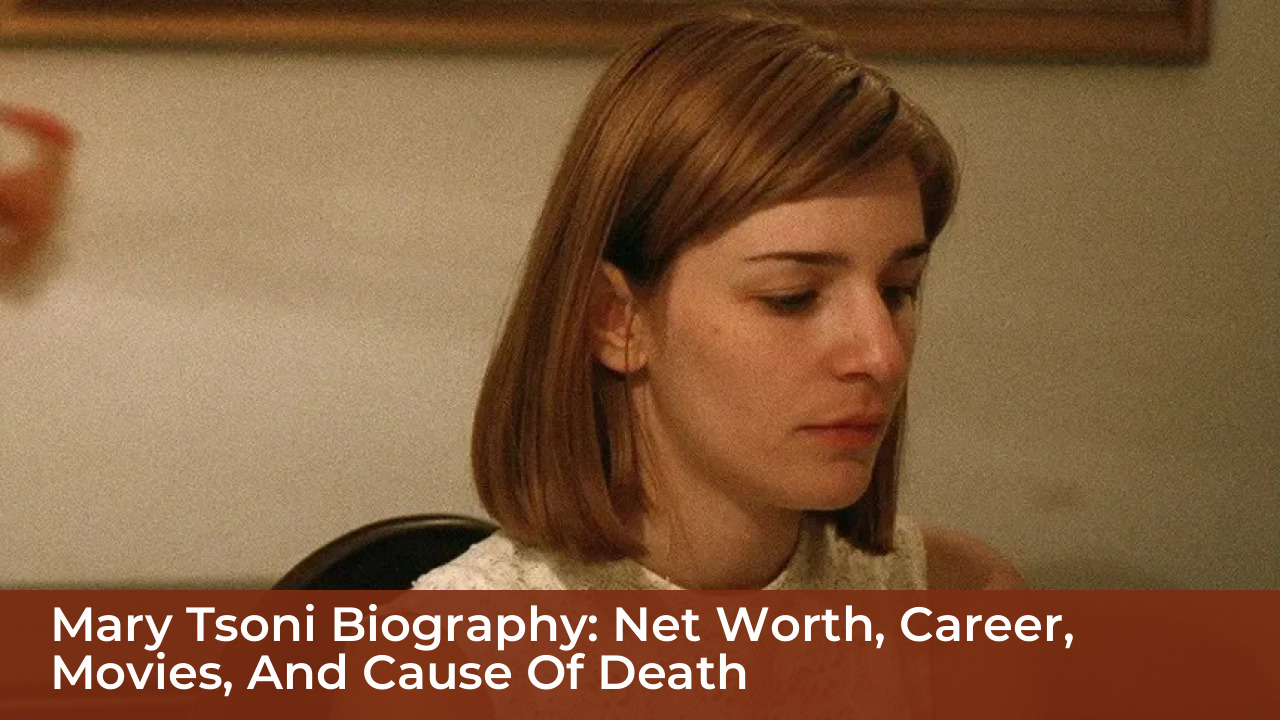
Mary Tsoni left an indelible mark on contemporary European art house cinema and the Athens underground music scene before her untimely passing. Born into a creative environment in Greece, she emerged as a central pillar of the cinematic movement known globally as the Greek Weird Wave. Her raw, uncompromising screen performances and distinctive post-punk vocals defined an era of alternative culture in Athens. Through her groundbreaking work in international award-winning films and independent music projects, she earned a permanent place in modern artistic history.
- Life and Legacy of Mary Tsoni
- Early Life, Background, and Performance Training
- Personal Life, Family Details, and Dispel of Internet Rumors
- The Greek Weird Wave and Dogtooth Breakthrough
- Defining Performance in Yorgos Lanthimos’s Dogtooth
- Comprehensive Filmography and Cinematic Career
- Musical Career and Athens Underground Scene
- Frontwoman for Mary & The Boy
- Discography, Collaborations, and Underground Influence
- Final Years, Cause of Death, and Net Worth
- Circumstances surrounding Her Tragic Death
- Net Worth and Cultural Footprint
- Frequently Asked Questions
- Who was Mary Tsoni?
- What caused Mary Tsoni’s death?
- Did Mary Tsoni win any major awards?
- Was Mary Tsoni married or did she have children?
- What was Mary Tsoni’s net worth?
Life and Legacy of Mary Tsoni
Mary Tsoni built a reputation as an avant-garde artist who pushed boundaries across multiple mediums. She rejected mainstream conventions, favoring projects that explored psychological tension, dark satire, and deep emotional vulnerability. Her contributions to post-2000s Greek culture extend far beyond a single film credit, encompassing pioneering music releases and memorable stage performances.
Cultural historians and film critics frequently cite her as a catalyst for the international breakthrough of independent Greek cinema. By combining rigorous physical training with a natural instinct for subversive storytelling, she created characters that unsettled and fascinated audiences worldwide. Her legacy remains a touchstone for performers seeking to bridge the gap between experimental theatre, independent film, and underground music.
Early Life, Background, and Performance Training
Mary Tsoni was born on June 25, 1987, in Livadeia, Greece, and spent a significant portion of her formative years growing up in Chania, Crete. From a young age, she showed an intense inclination toward the performing arts, channeling her creative energy into rigorous physical training. She enrolled in the prestigious State School of Orchestral Art in Athens, where she honed her technical mastery of movement and spatial awareness. Seeking further refinement, she traveled to London to study at Dance Attic, an institution renowned for producing versatile, physically demanding performers.
This extensive dance foundation directly shaped her acting methodology on screen. Rather than relying solely on spoken dialogue, she communicated complex psychological states through posture, frantic movement, and controlled physical stillness. Directors quickly recognized her unique ability to inhabit uncomfortable, highly physical roles. This distinctive skill set became her hallmark, allowing her to stand out in an era defined by bold, expressionistic storytelling.
Her transition from professional dance to acting and music felt entirely organic within the collaborative environment of the Athens arts community. She understood how to utilize her body as an instrument of narrative expression. This physical discipline proved essential when she caught the attention of visionary directors who required performers capable of navigating extreme, absurdist scripts without hesitation.
Personal Life, Family Details, and Dispel of Internet Rumors
Public interest in the private lives of independent artists often generates inaccurate online speculation. Official public registries confirm that Mary Tsoni held Greek nationality and maintained a private personal life. Despite persistent internet rumors regarding a secret spouse, fiancé, or documented siblings, verified public records and close associates indicate she kept her family life strictly private, with no publicly documented siblings or marriage records.
Biographical entries on various celebrity trivia platforms frequently publish unverified claims about her dating history and immediate relatives. Fact-checking these sources reveals a distinct lack of official documentation regarding a fiancé or children. Tsoni dedicated her short life entirely to her craft, focusing her public persona on her contributions to cinema, theatre, and the post-punk music scene rather than tabloid visibility.
The Greek Weird Wave and Dogtooth Breakthrough
The late 2000s marked a radical shift in Greek cinema, characterized by deadpan delivery, absurd social premises, and visceral examinations of domestic isolation. This movement, dubbed the Greek Weird Wave, captured international film festival attention, and Mary Tsoni stood at its absolute epicenter. Her collaboration with visionary auteur Yorgos Lanthimos redefined the possibilities of independent European filmmaking.
Defining Performance in Yorgos Lanthimos’s Dogtooth
In 2009, Tsoni delivered her career-defining performance as the Younger Daughter in Yorgos Lanthimos’s psychological drama Dogtooth. The film follows a tyrannical set of parents who isolate their adult children from the outside world, creating a bizarre micro-society governed by manipulated language and absurd rules. Tsoni portrayed the younger sister with a volatile mix of childish innocence and emerging feral rebellion, anchoring the film’s most shocking narrative turns.
Her work in the feature earned widespread critical acclaim, culminating in a shared win for the Heart of Sarajevo Best Actress award at the 2009 Sarajevo Film Festival alongside her co-star Angeliki Papoulia. Dogtooth went on to win the Un Certain Regard prize at the Cannes Film Festival and received an Academy Award nomination for Best Foreign Language Film, thrusting Tsoni onto the global cinematic stage.
Critics praised the film for its provocative exploration of control and language. Lanthimos maintained a clinical, detached visual style, leaving the performers to communicate the deep psychological damage inflicted upon the isolated siblings. Tsoni’s background in professional dance proved vital here, as she executed awkward, uninhibited choreography and intense emotional outbursts with absolute conviction.
Comprehensive Filmography and Cinematic Career
While Dogtooth brought international fame, Tsoni cultivated a diverse cinematic resume spanning cult horror, indie drama, and experimental shorts. She entered the film world early, appearing in the 2005 Greek cult horror film Evil (To Kako) directed by Yorgos Nousias, as well as the independent project Die Nordend Strasse that same year.
| Year | Title | Role / Significance |
|---|---|---|
| 2005 | Evil (To Kako) | Early appearance in cult Greek horror cinema |
| 2005 | Die Nordend Strasse | Independent European project |
| 2009 | Dogtooth | Younger Daughter (Heart of Sarajevo Best Actress win) |
| 2009 | Evil: In the Time of Heroes | Continuation of her work in genre filmmaking |
| 2010 | Artherapy | Independent feature exploring artistic expression |
| 2010 | Ta Oporofora tis Athinas | Urban drama highlighting Athenian life |
| 2018 | Motherland | Posthumous cinematic release |
Her willingness to embrace gritty, non-traditional roles made her a favorite among experimental directors. She returned for the sequel Evil: In the Time of Heroes in 2009, demonstrating her range across dark comedy and action-horror. Later projects like Artherapy and Ta Oporofora tis Athinas in 2010 showcased her ability to anchor lower-budget auteur projects with professional gravitas. Her final cinematic contribution arrived posthumously in the 2018 release Motherland.
Musical Career and Athens Underground Scene
Beyond her silver-screen accomplishments, Mary Tsoni was a formidable presence in the Athens underground music scene. She operated as a multi-disciplinary artist, seamlessly balancing film sets with sweaty, high-energy underground gig venues. Her musical output reflected the same uncompromising intensity that defined her acting career.
Frontwoman for Mary & The Boy
In the mid-2000s, Tsoni teamed up with filmmaker and musician Alexandros Voulgaris to form the alternative punk and synth duo Mary & The Boy. Serving as the primary lead vocalist, Tsoni brought a raw, theatrical energy to the band’s dark electronic compositions. The duo captured the alienation and nocturnal anxiety of contemporary urban life in Greece.
Their self-titled debut album, released in 2007, received critical praise across the European underground music circuit. Tsoni’s vocal style combined spoken-word poetry, operatic wails, and deadpan punk delivery. This distinctive sound established Mary & The Boy as pioneers of the Greek synth-punk and alternative electronic movement.
Discography, Collaborations, and Underground Influence
In addition to her core work with Alexandros Voulgaris, Tsoni collaborated with various electronic producers and performance artists, including Greek producer Joalz. These projects explored ambient soundscapes, minimal wave, and experimental noise. Her creative output extended into professional makeup artistry and theatrical stage production within Athens’ independent arts circles.
Her influence on the Athens underground scene persists through the artists she inspired. By refusing to separate her music from her physical performance art, she demonstrated a total commitment to creative expression. Her live shows with Mary & The Boy remain legendary among attendees who witnessed the visceral connection she established with her audiences.
Collaborators frequently noted her work ethic and sharp creative vision. She approached music with the same structural discipline she learned at dance school. Every lyric, movement, and vocal inflection served a distinct emotional purpose within her artistic repertoire.
Final Years, Cause of Death, and Net Worth
The sudden conclusion of Mary Tsoni’s life shocked the international artistic community. Despite her brief time in the public eye, she secured a permanent position in modern cinematic history. Her financial legacy and cultural footprint reflect an artist who achieved significant critical milestones while remaining rooted in the independent sector.
Circumstances surrounding Her Tragic Death
On May 8, 2017, Mary Tsoni passed away at her apartment in the Exarcheia district of Athens at the age of 29, just weeks before her 30th birthday. Medical examiners confirmed that pulmonary edema served as the official cause of death. Her passing prompted an outpouring of grief from filmmakers, musicians, and fans across Europe, who remembered her as a fearless creative force and a kind, dedicated collaborator.
News of her death highlighted the intense pressures faced by independent artists working in underfunded creative markets. Friends and cultural organizations held memorial screenings of Dogtooth and tribute music concerts in Athens to celebrate her vibrant life and immense contribution to modern Greek culture.
Net Worth and Cultural Footprint
Financial estimates place Mary Tsoni’s net worth at approximately $500,000 USD at the time of her passing. This wealth accumulated through international film distribution residuals, theatre performances, music royalties from her work with Mary & The Boy, and commercial makeup artistry projects. While she did not pursue commercial blockbusters, her association with Oscar-nominated cinema ensured steady recognition and financial stability.
Her true wealth, however, lies in her cultural footprint. As a cornerstone of the Greek Weird Wave and an icon of Athens underground music, Mary Tsoni proved that artistic integrity outperforms commercial formula. Her performances continue to inspire new generations of filmmakers and musicians who discover her fearless work on screen and vinyl.
Frequently Asked Questions
Who was Mary Tsoni?
Mary Tsoni was a Greek actress, singer, and dancer best known for starring as the Younger Daughter in Yorgos Lanthimos’s Oscar-nominated film Dogtooth and serving as the lead vocalist for the post-punk band Mary & The Boy.
What caused Mary Tsoni’s death?
Mary Tsoni passed away on May 8, 2017, due to pulmonary edema at her apartment in Exarcheia, Athens, at the age of 29.
Did Mary Tsoni win any major awards?
Yes. She co-won the Heart of Sarajevo for Best Actress at the 2009 Sarajevo Film Festival alongside her co-star Angeliki Papoulia for her performance in Dogtooth.
Was Mary Tsoni married or did she have children?
Official public records and verified biographies indicate she was not married, had no documented fiancé, and focused entirely on her artistic career.
What was Mary Tsoni’s net worth?
Her estimated net worth at the time of her passing was around $500,000 USD, earned through independent cinema, theatre, music releases, and professional makeup artistry.