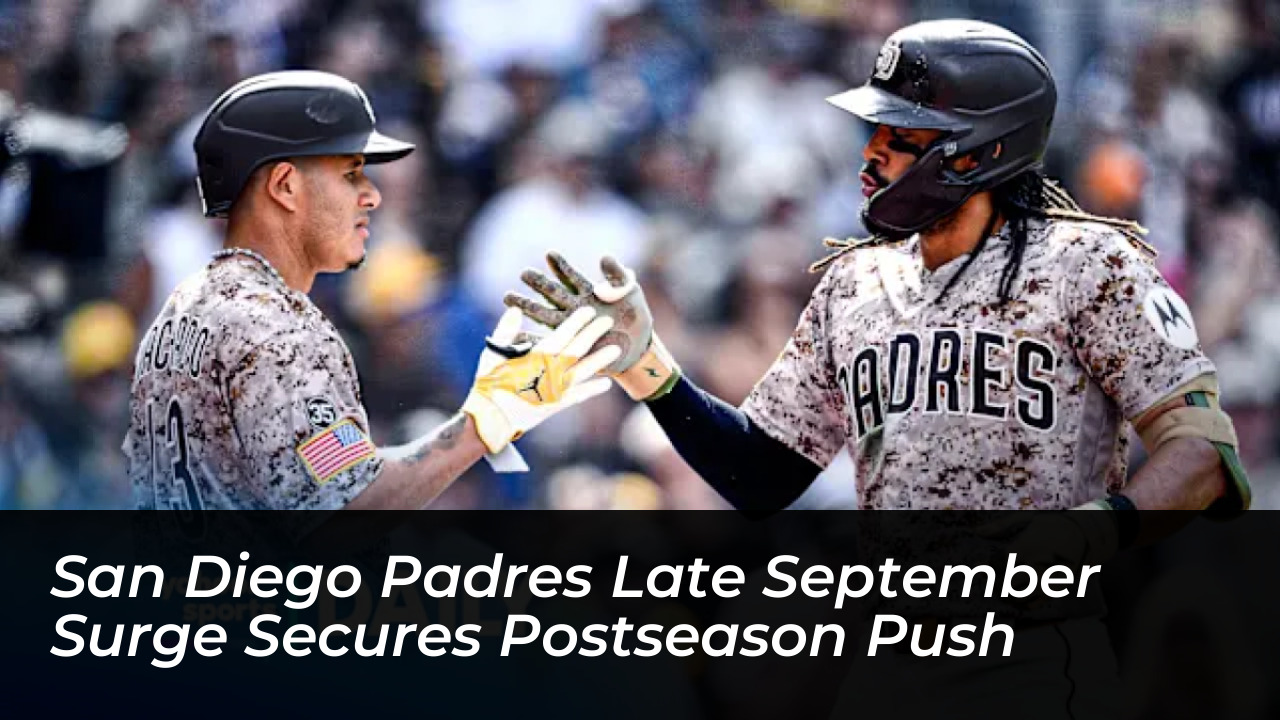
The San Diego Padres have engineered one of the most remarkable transformations in Major League Baseball, surging through late September 2026 to secure their control over a National League postseason berth. Powered by a dominant 13-of-14 winning stretch, manager Craig Stammen’s squad erased early-season inconsistencies and transformed Petco Park into an absolute fortress. National baseball insider Russell Dorsey recently highlighted the club’s momentum, pointing to a lethal combination of resilient starting pitching, shutdown bullpen work, and high-impact offensive contributions from superstars Fernando Tatis Jr. and Jackson Merrill.
- Introduction: The Remarkable Late-Season Transformation
- From Mid-Season Slump to Wild Card Control
- Overcoming Early-Season Inconsistencies
- The High-Stakes Wild Card Race
- Pitching Depth: Stabilizing the Rotation
- Mid-Season Acquisitions Making an Impact
- Veteran Consistency on the Mound
- Shutdown Bullpen and the Mason Miller Factor
- The Rise of Bradgley Rodriguez
- Late-Inning Execution
- Offensive Resurgence Led by Core Stars
- Fernando Tatis Jr. Leading the Charge
- Jackson Merrill and the Depth Factor
- Strategic Outlook for October Baseball
- Preparing for the Wild Card Battlefield
- Why the Padres Are a Dangerous Matchup
Introduction: The Remarkable Late-Season Transformation
Major League Baseball seasons are long, grueling marathons that test the depth and resolve of every franchise. For the San Diego Padres, the 2026 campaign featured a dramatic shift in the National League playoff picture as the team dominated the final week of September. Petco Park transformed into an intimidating environment for opposing squads, roaring with energy as the Friars rattled off win after win.
This late-season surge did not happen by accident. Starting rotation stability, bullpen dominance anchored by Mason Miller, and explosive offensive output from Fernando Tatis Jr. fueled the turnaround. Manager Craig Stammen kept the clubhouse focused during moments of adversity, steering the roster toward peak performance right when the calendar flipped to autumn.
From Mid-Season Slump to Wild Card Control
Overcoming Early-Season Inconsistencies
A few months ago, the narrative surrounding San Diego centered on frustration, injuries, and a sluggish offense that lagged far behind lofty preseason expectations. Following a sub-.500 record of 48-50 on July 18, the Padres needed a radical change in momentum to save their season. The early-season pitching injuries forced unproven arms into high-leverage roles, resulting in blown leads and defensive lapses.
The catalyst behind the ensuing 36-19 surge completely flipped the script for the franchise. The front office tightened defensive alignments, while the coaching staff simplified hitting approaches. Players stopped trying to hit home runs on every pitch and focused on quality at-bats, allowing the natural talent of the roster to shine through a relentless brand of baseball.
The High-Stakes Wild Card Race
The battle for postseason seeding involves a high-stakes chess match with perennial contenders like the Chicago Cubs and Philadelphia Phillies. San Diego pulled into a dramatic three-way tie in the standings at 85-69, yet divisional tie-breakers keep the club fighting for every single win down to the wire. Every pitch carries immense weight as the standings shift on a nightly basis.
Navigating divisional tie-breakers and capitalizing on missteps by the Arizona Diamondbacks during the final homestand gave San Diego a distinct psychological edge. While the D-backs struggled to maintain traction, losing five of their last seven games, the Padres capitalized on every error. Petco Park became a theater of tension as fans tracked out-of-town scoreboards alongside live action on the field.

Pitching Depth: Stabilizing the Rotation
Mid-Season Acquisitions Making an Impact
Early-season rotation health nearly derailed the club’s championship aspirations, forcing general manager A.J. Preller to scour the trade market for reinforcements. The mid-season acquisitions of Casey Mize and Robbie Ray proved essential in stabilizing a depleted pitching staff. These veteran arms absorbed heavy workloads and gave the bullpen much-needed rest during a brutal stretch of the schedule.
Robbie Ray managed high walk rates by pitching effectively around traffic during critical starts, leaning on his extensive experience to navigate jams. Whenever trouble brewed, he relied on his wipeout slider to induce double plays. Mize paired crisp command with aggressive pitch sequencing, proving that his change of scenery unlocked a new level of competitive maturity.
Veteran Consistency on the Mound
Behind the trade acquisitions, established veterans found another gear. Michael King, Walker Buehler, and Nick Pivetta found their rhythm to deliver deep, high-quality outings on a consistent basis. King utilized his sweeping breaking ball to baffle right-handed hitters, while Buehler mixed his fastballs with pinpoint control in the strike zone.
Reducing the strain on the relief corps heading into the final stretch of the regular season allowed manager Craig Stammen to manage his bullpen with surgical precision. When starters routinely pitch into the seventh inning, the entire pitching apparatus functions smoothly. This newfound durability transformed a glaring weakness into one of the team’s greatest strengths.
Shutdown Bullpen and the Mason Miller Factor
The Rise of Bradgley Rodriguez
Behind the starting arms, the Padres bullpen remains an absolute nightmare for opposing hitters in the late innings. Reliever Bradgley Rodriguez emerged as a premier high-leverage weapon, posting a stellar 1.95 ERA over 60 innings of work. His ability to navigate high-stress situations without buckling earned him the absolute trust of the coaching staff.
Rodriguez relies heavily on a triple-digit four-seam fastball paired with a devastating changeup that effectively neutralizes left-handed batters. Opponents hit a minuscule .143 against his secondary offerings. Hitters simply cannot sit on his velocity while respecting the late-breaking movement of his off-speed repertoire.
Late-Inning Execution
The combination of Adrián Morejón and closer Mason Miller locks down high-leverage situations with ruthless efficiency. Morejón cuts through opposing batting orders with a sharp cutter and high spin rate, bridging the gap from the middle relievers to the ninth inning. Once the ball reaches Mason Miller, the game is essentially over for the opposition.
Having a reliable relief core fundamentally alters opposing managerial strategies in the late innings. Opposing skippers know they must manufacture runs early because staging a ninth-inning comeback against Miller is nearly impossible. This psychological pressure forces rival hitters to expand their strike zones out of sheer desperation.
Offensive Resurgence Led by Core Stars
Fernando Tatis Jr. Leading the Charge
Offensive consistency plagued the Friars during the summer months, but core contributors stepped up in a major way during the September push. Fernando Tatis Jr. bounced back spectacularly from a quiet power stretch earlier in the year, providing elite production at the plate and elite defense in the outfield. His range in right field regularly robs opponents of extra-base hits.
Tatis vaulted past his prior home run totals and added crucial base-stealing ability at the top of the lineup. Pitchers cannot afford a single lapse in concentration when he stands on base. His aggressive base running forces wild pitches and defensive miscommunication, igniting big innings out of nowhere.
Jackson Merrill and the Depth Factor
Despite chasing pitches outside the zone at times, young center fielder Jackson Merrill provides immense offensive upside, blasting 26 home runs to anchor the middle of the order. Merrill handles high-pressure moments with the poise of a ten-year veteran, routinely delivering clutch hits when the team needs them most.
Depth pieces like Ty France, who recently launched a career-high 21st home run, alongside Xander Bogaerts and Jake Cronenworth lengthen the batting order significantly. Opponents cannot simply pitch around the top tier of the lineup when the bottom half poses an equal threat. This balanced attack makes the San Diego batting order a nightmare to navigate.
Strategic Outlook for October Baseball
Preparing for the Wild Card Battlefield
Entering the final series of the regular season, the Padres hold all the tools necessary to make a deep October run. Solving elite opposing pitching remains the primary hurdle for a lineup prone to occasional long scoreless droughts. To combat this tendency, the coaching staff emphasizes early patience and working deep into pitch counts.
Manager Craig Stammen emphasizes focus, execution, and peak operational efficiency as the team prepares for the final weekend at Petco Park. Every defensive alignment and pitching matchup is scrutinized to extract maximum value. The team understands that small details dictate outcomes in short playoff series.
Why the Padres Are a Dangerous Matchup
Summarizing how a red-hot bullpen, stabilized rotation, and lengthened batting order create a terrifying opponent for any playoff contender. San Diego features the exact ingredients needed for postseason success: elite closing pitching, dynamic base runners, and power bats capable of changing a game with one swing.
As the postseason arrives, the Padres enter the bracket not as a lucky participant, but as a legitimate championship threat. If the pitching staff maintains its current trajectory and the bats continue to deliver clutch hits, San Diego will dictate the terms of engagement on baseball’s biggest stage.