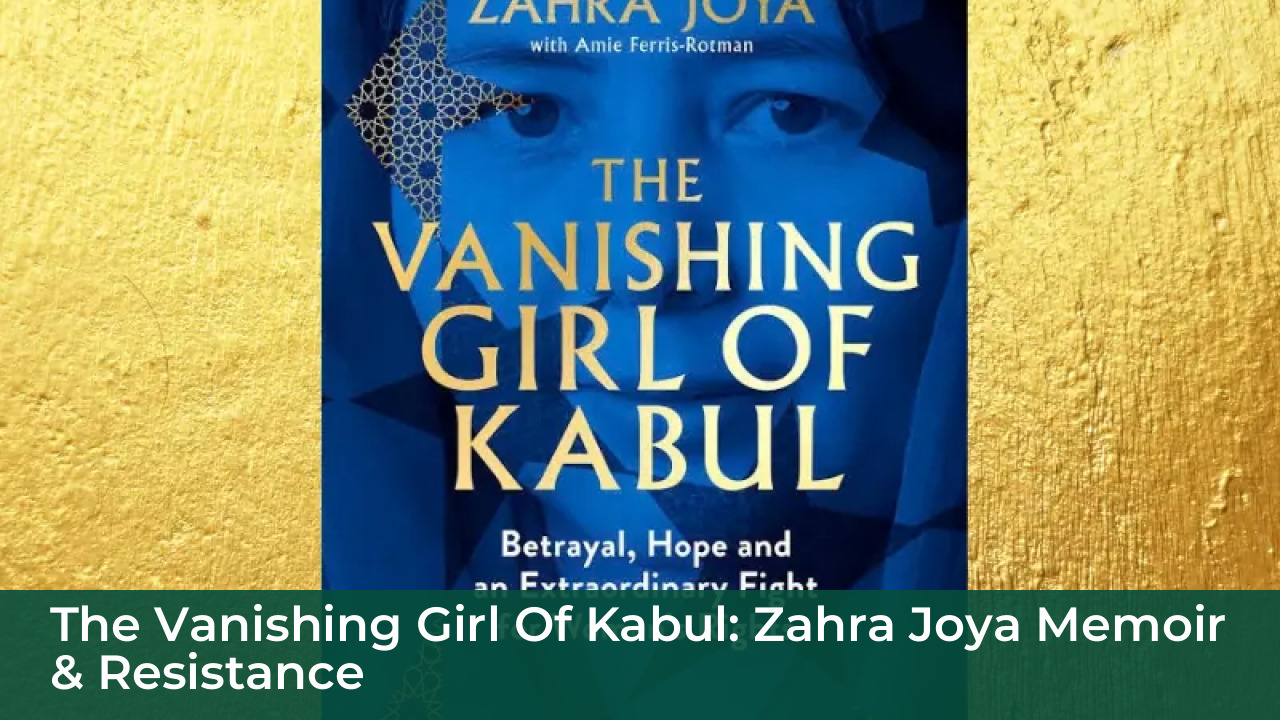
Zahra Joya stands as a vital voice for millions of silenced women inside Afghanistan. Her new memoir, The Vanishing Girl of Kabul: Betrayal, Hope and an Extraordinary Fight for Women’s Rights, bridges personal survival, historical documentation, and the relentless pursuit of truth under extremist rule. Published by Robinson in the United Kingdom on July 23, 2026, the 283-page book offers an unfiltered look at what it means to report from the shadows. The launch event at London’s Daunt Books drew international acclaim, including praise from Nobel Peace Prize laureate Malala Yousafzai. Yousafzai highlighted the book as an essential record of endurance against institutionalized gender discrimination. The memoir will hit shelves in the United States and other English-speaking markets on October 6, 2026.
- From Childhood Disguise to Exile Journalism
- Anatomy of an Underground Newsroom
- Managing Risk in Hostile Environments
- Misogyny as Policy and Press Suppression
- The Weaponization of Censorship
- Navigating Perilous Labors in Modern Journalism
- The Global Impact of Exile Literature
- Frequently Asked Questions
- When was The Vanishing Girl of Kabul published?
- Who authored the memoir?
- How does Rukhshana Media protect its reporters inside Afghanistan?
- What is the primary focus of Rukhshana Media?
- Conclusion
The global reception of this literary work signals a renewed international focus on the ongoing humanitarian crisis in Central Asia. As governments and international bodies grapple with diplomatic engagement strategies regarding the current regime, personal testimonies cut through political abstraction. They provide undeniable evidence of human rights abuses occurring on a mass scale. Reviewers and human rights advocates emphasize that the book serves as a vital historical artifact, preserving the names, faces, and testimonies of individuals whom the ruling authorities actively attempt to erase from public consciousness.

From Childhood Disguise to Exile Journalism
Joya’s personal history mirrors the broader trauma of her nation. Growing up under the first Taliban regime in the late 1990s, she disguised herself as a boy simply to attend school. That daily act of defiance planted the seeds for a lifelong commitment to journalism and gender equity. When international forces withdrew in August 2021, Joya faced imminent danger and fled to London, where she now directs her newsroom from safe exile. Rather than silencing her, displacement amplified her mission to expose injustice.
She founded Rukhshana Media, naming the organization in honor of a young Afghan woman stoned to death by extremists for fleeing a forced marriage. Rukhshana Media operates as a critical journalistic lifeline. It remains Afghanistan’s primary news organization dedicated entirely to documenting the lived experiences, systemic oppression, and quiet acts of resistance practiced by women. Through this platform, hidden stories of survival bypass local censorship and reach international audiences.
The journey from an underground student in a patriarchal society to an internationally recognized media founder underscores the transformative power of education. Joya frequently recounts how her early clandestine schooling shaped her worldview. She learned early that information functions as a form of self-defense. By passing these lessons down through her reporting, she builds a bridge for the next generation of dissidents.
Anatomy of an Underground Newsroom
Reporting inside Taliban-controlled territory requires extreme clandestine protocols. Joya manages her reporting staff under severe security constraints designed to prevent detection by state intelligence. The operational framework relies on three fundamental pillars of digital and physical security:
- Absolute Anonymity: Every staff member and contributor uses a strict pseudonym to shield their real identity from local authorities.
- Isolated Operations: Reporters work entirely alone inside the country, forbidden from meeting colleagues, attending group gatherings, or sharing physical sources.
- Centralized Communication: Field reporters report exclusively and directly to Joya in London through encrypted channels to minimize digital footprints.
These rigid protocols protect journalists from brutal retaliation, imprisonment, or execution. If the ruling regime discovers a source or an underground reporter, the penalties are catastrophic. Yet, despite the mortal danger, ordinary women inside Afghanistan continue to reach out, desperate for the global community to hear their stories.
Managing Risk in Hostile Environments
Maintaining an intelligence-grade security network from a European newsroom presents unique logistical hurdles. Editors must vet every incoming piece of information through rigorous verification channels to prevent disinformation while protecting anonymous sources. The psychological toll on the London-based editorial team is immense, as they carry the constant burden of knowing a single digital breach could endanger lives on the ground.
Financial sustainability represents another critical challenge for underground media networks. Traditional advertising revenue is non-existent within Afghanistan, and foreign grant funding often comes with restrictive bureaucratic red tape. Rukhshana Media relies heavily on philanthropic donations, reader support, and international press freedom grants to keep its reporting infrastructure operational.
Misogyny as Policy and Press Suppression
Amie Ferris-Rotman, co-author of the memoir and founder of Sahar Speaks, emphasizes that the assault on women in Afghanistan is not an isolated cultural quirk or a temporary administrative policy. Instead, it operates as a calculated instrument of state governance. Authoritarian regimes weaponize gender oppression to crush broader civil liberties and consolidate absolute power.
Political leaders utilize systemic misogyny to actively chill free speech and dismantle independent media infrastructures. When half a population vanishes from public view, education, and employment, accountability dies alongside basic human rights. Independent journalism serves as the final barrier against absolute information blackouts. Without journalists documenting these decrees, the world risks normalizing totalitarian policies that strip women of legal personhood.
The Weaponization of Censorship
The suppression of female voices extends far beyond classroom bans and workplace restrictions. The regime enforces strict dress codes, limits freedom of movement, and bans women from public parks and recreational spaces. These measures aim to completely sever women from public life:
- Total prohibition of secondary and university education for females.
- Mandatory male chaperones for any travel exceeding short distances.
- Systemic elimination of women from government, judicial, and professional sectors.
- Comprehensive bans on female beauty salons, community centers, and public gathering spots.
Navigating Perilous Labors in Modern Journalism
Joya often invokes a classical Persian literary motif to describe her daily operational challenges. In the 10th-century epic poem, the hero Rostam must endure seven perilous labors to save his homeland from monstrous invaders. Today, gathering news inside Afghanistan demands a similar toll of endurance, sacrifice, and psychological resilience.
Despite the immense obstacles, the feedback from readers sustains the mission. Joya receives regular messages from women inside Afghanistan and across the global diaspora. These readers confirm that reading about the resistance of their peers provides tangible hope amid total darkness. Exile journalism bridges the geographical divide, ensuring that displaced citizens remain connected to their homeland’s struggle for liberation.
The Global Impact of Exile Literature
Memoirs written by exiled dissidents function as historical armor against revisionism. Authoritarian regimes rely on silence, censorship, and manufactured narratives to legitimize their rule. Books like The Vanishing Girl of Kabul dismantle these official fabrications by recording the testimonies of witnesses and survivors.
International publishing houses hold a profound responsibility in amplifying silenced voices and maintaining global accountability. By bringing these narratives to mainstream markets, publishers ensure that geopolitical fatigue does not eclipse human rights abuses. As the book enters international markets, its legacy will be measured not only by sales figures, but by its capacity to inspire solidarity and action.
Frequently Asked Questions
When was The Vanishing Girl of Kabul published?
The memoir was published in the United Kingdom by Robinson on July 23, 2026. The United States release is scheduled for October 6, 2026.
Who authored the memoir?
The book was written by Zahra Joya, founder of Rukhshana Media, in collaboration with journalist and Sahar Speaks founder Amie Ferris-Rotman.
How does Rukhshana Media protect its reporters inside Afghanistan?
The newsroom uses strict security protocols, including absolute anonymity via pseudonyms, isolated field operations, and centralized, encrypted communication channels routed directly to London.
What is the primary focus of Rukhshana Media?
Rukhshana Media is Afghanistan’s first and only news organization dedicated entirely to documenting the lives, struggles, and human rights violations experienced by Afghan women.
Conclusion
The publication of Zahra Joya’s memoir marks a pivotal moment for international journalism and human rights advocacy. By detailing the mechanics of underground reporting and exposing misogyny as state policy, the book ensures that the plight of Afghan women remains visible to the global community. Through courage, careful security architecture, and unwavering literary resolve, exiled journalists continue to pierce the information blackouts imposed by authoritarian rule, keeping the hope of freedom alive for millions.