
Discover the fascinating life of Yayoi Kusama. From her early mental health struggles to creating the iconic Infinity Mirror Rooms and polka dot pumpkins, explore her incredible journey.
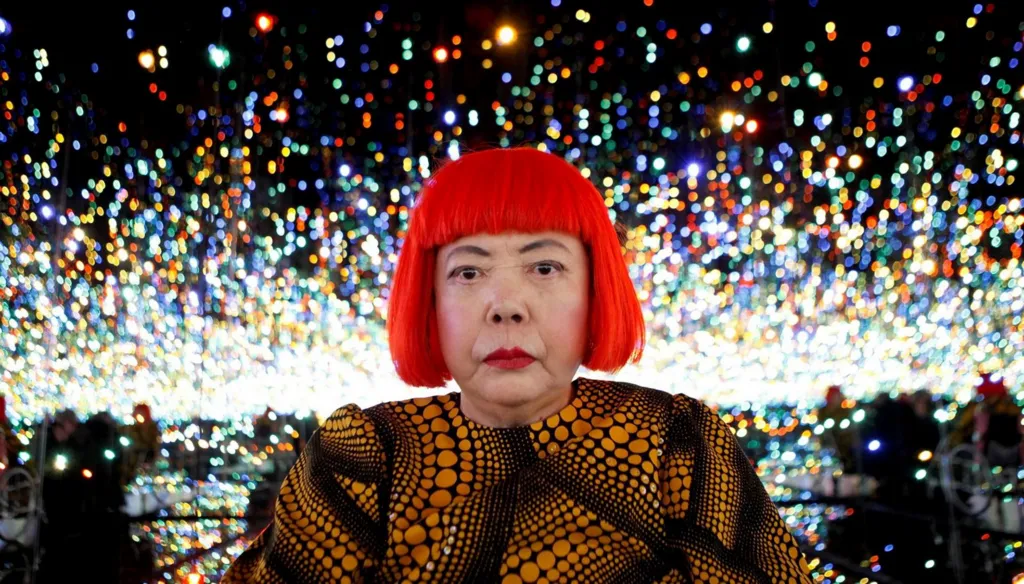
If you’ve been on Instagram at any point in the last decade, chances are you’ve seen her work. A room filled with endless twinkling lights, giant yellow pumpkins covered in black dots, or maybe a striking woman with a bright red bob.
Yayoi Kusama is arguably the most famous contemporary Japanese artist in the world. But behind the vibrant colors and endless polka dots is a deeply moving story of trauma, resilience, and the healing power of art.
Let’s dive into the life of the woman who literally painted her way through pain to become a global superstar. And maybe, we can learn a little something about turning our own struggles into something beautiful.
The Early Years: Talking Flowers and Childhood Trauma
Born in Matsumoto, Japan, in 1929, Kusama’s early life was anything but a fairytale. Her family was wealthy, managing successful plant nurseries, but her home life was incredibly toxic. She grew up with an abusive mother and a philandering father.
To make matters worse, as a young girl, she started experiencing intense hallucinations. She would look at the fields of flowers in her family’s nursery, and suddenly, the flowers would start talking to her.
How does a child cope with that? For Kusama, the answer was a sketchbook. She began drawing exactly what she saw. Despite her mother’s constant attempts to stop her from creating art, Kusama kept drawing. It was her escape.
Escaping to New York: The Birth of the Polka Dot Princess
By her early 20s, Kusama knew she had to get out of a stagnant, postwar Japan if she wanted to be a serious artist. Her family hated the idea. But in 1957, she stitched one million yen into her clothes and boarded a plane to New York City.
She was relentless. According to a Japanese newspaper from that time, she was churning out up to 70 works of paint and ink every single day.
In the 1960s, she became a massive figure in the New York avant-garde scene. She and US artist Louis Abolafia became famous for staging wild “happenings” in Central Park. They even held a “spiritual wedding” where they stripped naked to announce Abolafia’s mayoral campaign. She was bold, fearless, and completely unapologetic.
Art as Therapy: Finding Peace in Tokyo
But the hustle of New York eventually took its toll. By the 1970s, Kusama’s mental health severely deteriorated. She was battling severe panic attacks, worsening hallucinations, and even survived suicide attempts.
Realizing she needed help, she moved back to Japan. In 1977, she made a decision that would save her life: she checked herself into a psychiatric hospital in Tokyo that offered art therapy.
She has lived there ever since.
Having this safe, stable environment allowed her to focus entirely on her work. She bought a studio right across the street from the hospital. In a 2018 interview with The Guardian, she explained her intense routine:
“When I arrive at my studio in the morning, I put on my work clothes and start to paint straight away, and I work right up until dinner time. I don’t rest. I am an insomniac. Even now, if an idea comes to me in the middle of the night, I pick up my sketchbook and draw.”
Actionable Takeaway: Kusama’s story is a powerful reminder of how creative outlets—whether it’s painting, writing, or just doodling—can be a legitimate tool for managing mental health and anxiety.
The Instagram Era: Infinity Mirror Rooms & Global Stardom
For a while, the mainstream art world kind of forgot about Kusama. But in the 1990s, interest in her work exploded again.
She started building on an idea she first created in 1965 (Infinity Mirror Room: Phalli’s Field). She created immersive, kaleidoscopic mirror rooms. Half a century after she first conceptualized them, these rooms became the ultimate experience for the Instagram generation.
Exhibitions like The Souls of Millions of Light Years Away at the David Zwirner gallery in New York (2013) drew massive crowds. People would wait in line for hours just to spend 45 seconds inside her infinite, glowing universes.
Pumpkins, Fashion, and Global Takeovers
If Kusama is known for one thing besides dots, it’s pumpkins. She has been obsessed with them since childhood. Why? As she put it in 2019: “I have always found them to be such tender things to touch and so wonderfully humorous, humble and appealing.”
Her fixation on repetition—dots, nets, lines, and pumpkins—has led to some of the most iconic art installations in modern history.
- In 2017, she wrapped Washington DC’s Hirshhorn Museum in a giant polka dot ribbon.
- In 2021, she took over the New York Botanical Garden with her Ascension of Polka Dots on Trees.
- In 2023, the fashion world lost its mind when Louis Vuitton’s flagship store in Paris was taken over by her polka dots, complete with a giant inflatable mannequin of Kusama herself peering over the roof.
Where to Experience Yayoi Kusama’s Art Today
If you want to see her work in person, you have to plan ahead. Her exhibitions still sell out globally.
- The Yayoi Kusama Museum (Tokyo): Opened in 2017, this five-story museum is the holy grail for fans. But be warned—to preserve the experience, they only allow 50 visitors in at a time, four times a day, for 90 minutes. You have to book tickets months in advance.
- Global Retrospectives: Museums worldwide constantly host her work. In 2022, Hong Kong’s M+ Museum hosted Yayoi Kusama: 1945 to Now, featuring 200 pieces. Major European museums, like the Museum Ludwig in Cologne, frequently feature her Infinity Mirrored Rooms and outdoor sculptures like Flowers that speak all about my heart given to the sky.
- The “My Eternal Soul” Series: Keep an eye out for this ongoing painting series, which she began in 2009. It brings her classic polka dot iconography back to the traditional canvas in an explosion of color.
A Legacy of Resilience
Yayoi Kusama didn’t just create art; she created a survival mechanism. She took the terrifying hallucinations of her childhood and the deep anxieties of her adult life, and she painted them onto canvases, pumpkins, and mirrors until they weren’t scary anymore.
She gave the world her dots, and in return, she secured her place as one of the most important, resilient, and beloved artists in human history.