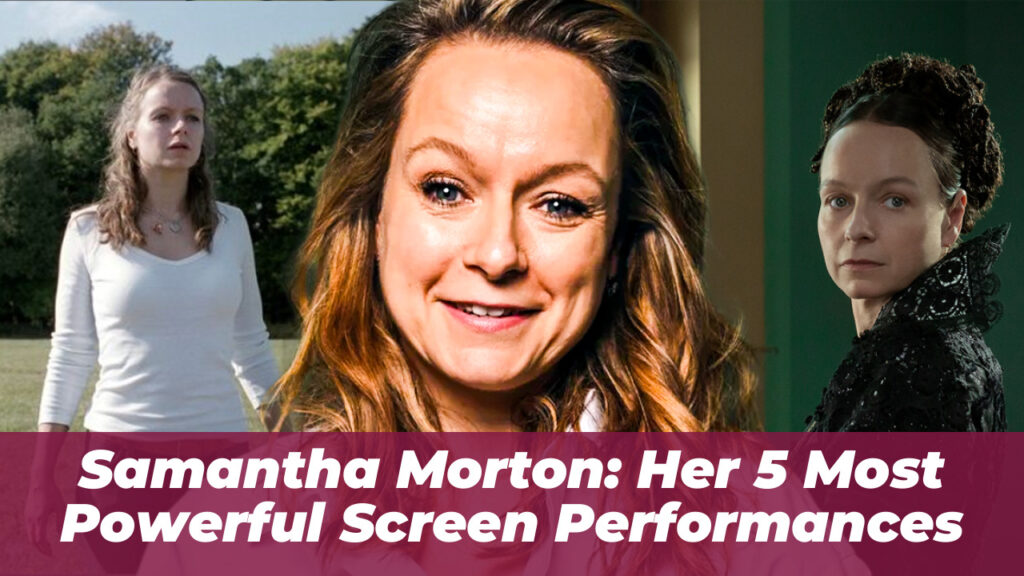
In an industry often obsessed with the “star turn,” Samantha Morton has carved out a career by doing the exact opposite. She does not merely play characters; she inhabits them with a haunting, granular intensity that makes the screen feel like a window into a private life. Whether she is navigating the high-stakes world of a science-fiction blockbuster or the gritty, historical grime of 18th-century London, Morton’s performances share a singular, unifying thread: a raw, unfiltered vulnerability that refuses to cater to the audience’s comfort.
The Anatomy of a Performance
What separates Morton from her contemporaries is her mastery of the unspoken. While many actors rely on dialogue to convey motivation, Morton operates in the spaces between words. Her work suggests a deep, almost clinical understanding of human grief and survival. She possesses a rare ability to signal complex psychological states estrangement, power, or quiet despair through a slight shift in her posture or the flicker of a gaze. This is not acting in the performative sense; it is a form of psychological excavation. Her characters often feel as though they are holding back profound secrets, inviting the audience to look closer.
The Silent Eloquence: Sweet and Lowdown (1999)
Perhaps no role better defines her career than Hattie in Woody Allen’s Sweet and Lowdown. Tasked with playing a mute character, Morton provided a masterclass in non-verbal communication. Without a single line of dialogue, she became the emotional heartbeat of the film. Her performance was a revelation, proving that she could command a scene through sheer presence, earning her an Academy Award nomination that cemented her status as a generational talent.
The Visceral Spiral: Morvern Callar (2002) & Under the Skin (1997)
Morton is arguably the finest practitioner of the “quiet breakdown” in modern cinema. In Morvern Callar, she portrays a woman navigating grief with a cold, nihilistic detachment that is as chilling as it is captivating. Similarly, her early turn in Under the Skin remains a benchmark for raw, visceral character study. She captures the jagged edges of a person losing their tether to reality, a theme she explores with a level of honesty that most performers are too guarded to attempt.
The Ethereal Anchor: Minority Report (2002)
While many actors struggle to ground themselves in the artificiality of big-budget science fiction, Morton did the inverse. As Agatha in Minority Report, she provided the film with its soul. Her portrayal of a “precog” a being burdened by the weight of future tragedies was ethereal and haunting. It demonstrated that her intensity could scale up to blockbuster proportions without losing its intimate, human core. Her performance remains a standout in sci-fi history for its ability to anchor high-concept spectacle in genuine human suffering.
The Modern Iconoclast: The Serpent Queen & Harlots
In recent years, Morton has pivoted toward television, proving that her range is as vast as her career is long. As Margaret Wells in Harlots, she balanced maternal ferocity with the pragmatism of a survivor. More recently, her turn as Catherine de’ Medici in The Serpent Queen showcases a new facet of her talent: the ability to wield power with a cold, calculated authority. She strips away the historical caricature, presenting a woman whose ruthlessness is born of necessity rather than malice.
The Actor’s Actor Reputation
It is telling that industry titans, including Christopher Nolan, have spoken of Morton with a reverence usually reserved for the greatest of all time. Comparisons to the late Heath Ledger regarding her total immersion on set are not hyperbolic. She is an “actor’s actor,” someone who prioritizes the truth of a scene over the vanity of the camera.
Conclusion
Samantha Morton’s filmography is not a collection of roles, but a map of human struggle. She has consistently chosen paths that challenge both the viewer and the medium itself. By shunning the spotlight in favor of psychological depth, she has secured a legacy built not on fame, but on the enduring power of her craft. In an era of disposable content, Morton’s performances remain essential a testament to the idea that the most powerful stories are often told in silence.