
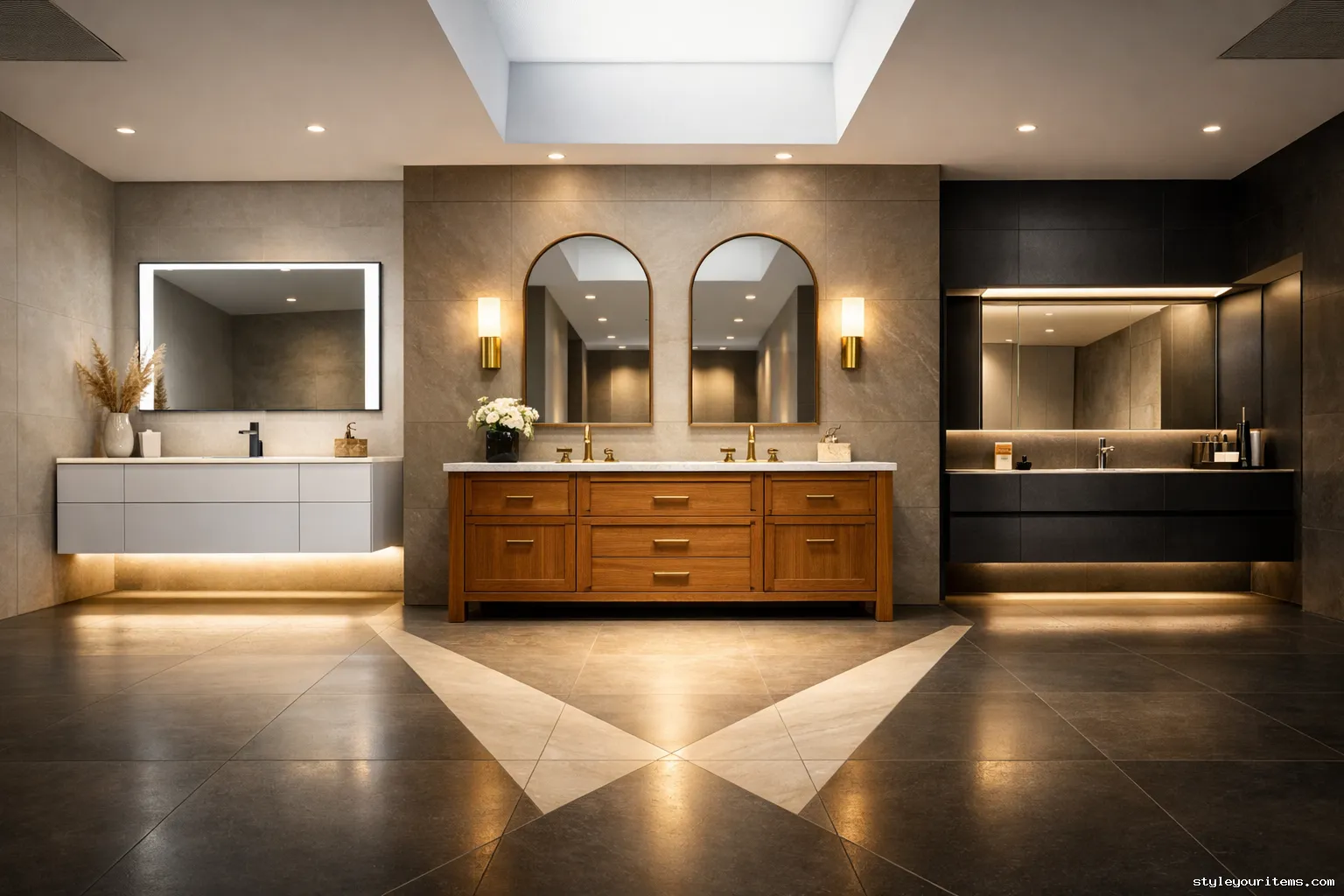
Is your bathroom driving you crazy? Or has that “builder-grade” boring look finally pushed you over the edge? Whether you’re dealing with a shoe-box sized apartment in New York or a suburban home in London, the centerpiece we all search for under bathroom vanity ideas is the real gamechanger. Even if you ignore the lighting and tiles, the vanity is the anchor piece that transforms the entire vibe of the room.
But here’s the thing: the market has so many options it makes your head spin. Floating or Freestanding? Is going Custom worth the investment or will a stock piece do the job? What’s actually trending in 2026 and what’s just a clever way to empty your wallet?
In this guide, we’re not showing you a messy collection of random pictures. We’re giving you the mindset of a top-tier designer. And more importantly, we’re giving you a specific, numbered list of ideas. We’ve broken down three major categories and within each, we’ve counted out the Top Ideas. By the time you finish reading, you’ll have more than just knowledge; you’ll have a solid action list of design concepts.
Part 1: Decoding the Bathroom Vanity Universe: More Than Just a Sink Stand

A vanity used to be just a cabinet with a sink and some space to hide toothpaste. Those days are long gone. Today, a well-chosen vanity can ease you into the morning and wind you down at night like a private spa.
2026’s Vanity Landscape: Where Function Meets Spa-Like Aesthetics
This year continues the rejection of that cold, sterile hospital look. Homeowners want warmth. They want texture. A bathroom should feel like part of the home, not a public restroom.
If you’re renovating now, keep these three things in mind:
- Warm Wood Tones Are Everywhere: White oak and walnut finishes are in high demand. Not the shiny orange wood from the 90s, but matte, natural textures that make a vanity look like actual furniture.
- Fluted Detailing (Striped Fronts): Flat panel doors are taking a backseat. Vertical lines (reeded or fluted) add depth and a tactile luxury that photos can’t fully capture.
- Integrated Tech: Hair dryer outlets inside drawers. Motion-sensor LED strips under the mirror. These small conveniences make daily routines feel seamless.
Expert Note: If budget is a concern, skip expensive stone and opt for high-quality Laminate or Fenix material. The finishing technology in 2026 is so advanced that most people won’t notice at a glance that it’s not solid oak. Save the cash, keep the style.
Part 2: Floating Vanities | The Modern Illusionist’s Tool for Open Space
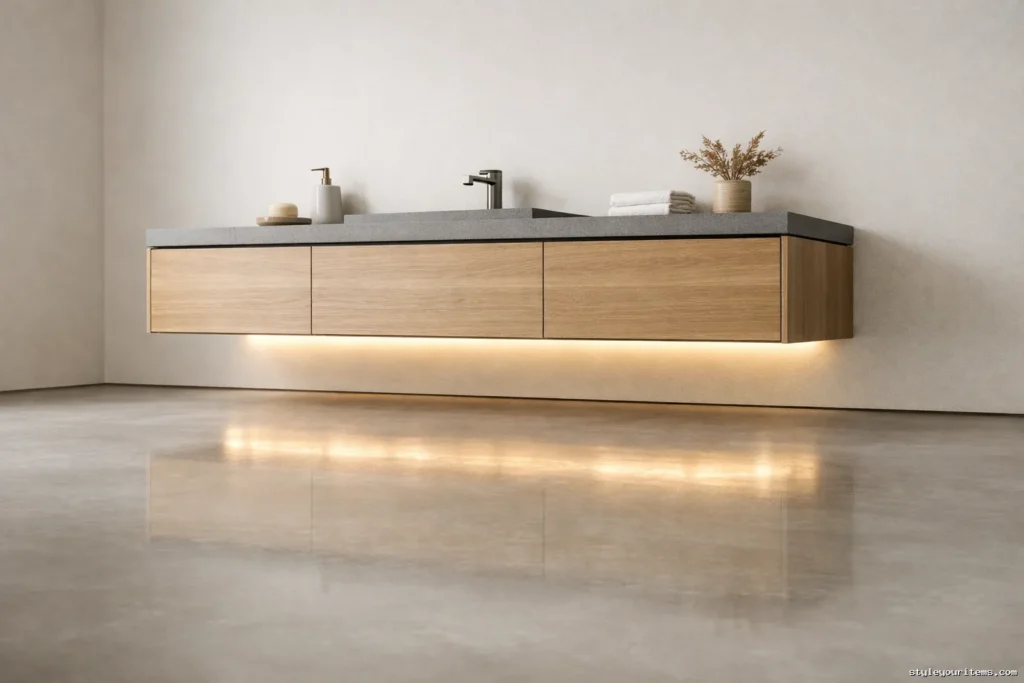
Time to focus on the most searched term out there: Floating Bathroom Vanity.
Some call it “wall-hung.” The appeal is straightforward: it’s lifted off the ground. But you shouldn’t install one just because it looks cool. Install one because it’s the right idea for your specific space.
The Core Appeal of Lifting Off the Floor
If your bathroom is on the smaller side, which is common in UK terraced houses and US city condos, a floating vanity works a visual trick. When your eye travels underneath all the way to the back wall, the floor area seems to expand. That’s how a 6×8 bathroom starts feeling like an 8×10.
And cleaning? Honestly, anyone who has tried to sweep behind freestanding vanity legs will appreciate this feature. Even a robot vacuum can glide right underneath without a fuss.
Those are the basics. Now for the Ideas you came for. Here are the Top 4 Designer Ideas for Floating Vanities.
Top 4 Floating Bathroom Vanity Ideas for 2026
Idea #1: The Minimalist Monolith (Seamless and Solid)
Imagine a solid block emerging from the wall. No handles, just push-to-open doors. A porcelain countertop with an integrated sink. On top, you place a single small succulent. Everything else stays hidden. This look suits people with a serious aversion to clutter.
Aesthetic Goal: Spa-like serenity.
Idea #2: The Warm Minimalist (Wood Veneers & Soft LED Glow)
If pure white feels too stark, try a 60-inch floating vanity in oak veneer. Install a concealed LED strip light underneath. At night, with the main lights off, this creates a soft glow on the floor, making the vanity appear to hover.
Pro Tip: Ensure the veneer is UV-resistant and marine-grade; bathroom humidity will wreck anything less within a few seasons.
Idea #3: The Space-Savvy Double Duty (Open Shelving Below)
Worried about losing storage? Add a 12-inch deep open shelf beneath the vanity. Place neatly rolled towels or an attractive basket on it. Fair warning: this only works if the towels are folded with care. If your household tends to leave things in a heap, that shelf will become an eyesore.
Idea #4: The Bold Statement Piece (Color-Drenched or Textured Finishes)
We’re not shying away from color in 2026. If the rest of the bathroom is neutral subway tile, you’ve got a clean backdrop for experimenting with bold bathroom vanity ideas. Consider a Deep Burgundy or Matte Charcoal finish on a floating unit. Brass fixtures will make it stand out nicely.
In a compact space, this draws the eye and communicates intentional design.
The Unspoken Truths About Floating Vanities (And How to Navigate Them)
Important: Installing a Floating Vanity is not a casual weekend project. You can’t just lean it against the wall like a bookshelf. Check these points beforehand:
- Wall Blocking: Does your wall have solid 2×6 or 2×8 lumber between the studs? If not, drywall will need to be opened to add blocking.
- Plumbing Rough-In: Is your plumber prepared to adjust pipes inside the wall? A visible P-trap coming from the floor kills the whole floating illusion.
- Storage Sacrifice: A 60-inch floating vanity might give you two small drawers. A 60-inch freestanding vanity can offer four large drawers plus cabinet space. Know what you’re willing to give up.
Part 3: Freestanding Vanities | The Versatile Chameleon for Any Style
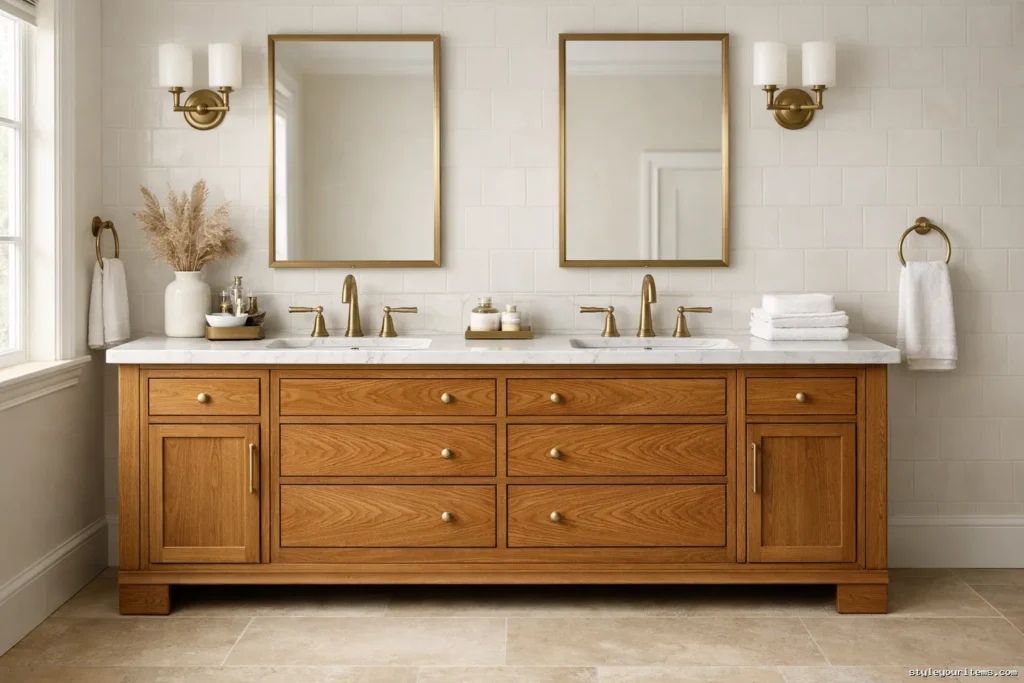
Now back down to solid ground. The Freestanding Bathroom Vanity is the timeless option that never fades from demand. In this section, we’re providing bathroom vanity ideas that will elevate a stock vanity from “Builder Grade” to “Bespoke Furniture.”
Why the Floor-Standing Classic Remains a Top Contender
The number one reason: Storage.
In a master bath shared by two people, a floating vanity often leads to territorial disputes. A freestanding vanity can absorb toothpaste, hair tools, spare shampoo bottles, and whatever else accumulates.
Second reason:
Installation. Compared to a floating unit, this is far more straightforward. It’s frequently a manageable DIY task.
Top 4 Freestanding Vanity Ideas That Defy the “Builder-Grade” Stereotype
Idea #1: The Furniture Look-Alike (Repurposed Dressers and Console Sinks)
If you enjoy a bit of creative hunting, find a vintage dresser on Facebook Marketplace. Have a carpenter modify the top to accommodate a sink. This is a brilliant alternative bathroom vanity idea for a freestanding double vanity for master bathroom. You end up with a one-of-a-kind piece. Just make sure it’s Solid Wood. Particle board will swell and disintegrate in bathroom humidity.
Idea #2: The Modern Heritage Piece (Warm Oak and Shaker Doors)
This look works equally well in London flats and American suburbs. Shaker style doors (simple frame and panel) with a warm stain possess a timeless appeal. It doesn’t look dated, nor does it scream temporary trend. A marble quartz countertop is the ideal partner here.
Idea #3: The Sculptural Statement (Freestanding Pedestal Basins)
Ideal for powder rooms where storage isn’t a priority. A graceful ceramic pedestal sink sits elegantly on the floor while keeping the space open. No cabinets, but if the room is only for guests washing hands, it delivers a definite “Wow” factor.
Idea #4: The High-Storage Hero (Double Sink Vanities with Ample Drawers)
When you search for freestanding double vanity for master bathroom, this is the practical champion idea. You get a 72-inch span with two sinks. The real win, though, lies in the drawers. Drawers beat cabinets. With cabinets, you’re bending down and rummaging in the dark. Drawers let you see everything at once. Set them up as “His & Hers” and call it a day.
The Freestanding Vanity Faux Pas: Common Pitfalls to Avoid
One notable drawback of freestanding vanities: Visual Weight. Placing a 48-inch-wide vanity on a 36-inch-wide wall will make the room feel cramped.
Styling Tip for tight spaces requiring a freestanding unit:
- Choose a vanity with legs (elevated base) rather than a solid block base. Visibility of the floor beneath matters.
- Opt for a thin countertop edge. Thick bullnose edges add unnecessary visual mass.
Part 4: Custom Vanity Designs | The Blueprint for a Truly Yours Space
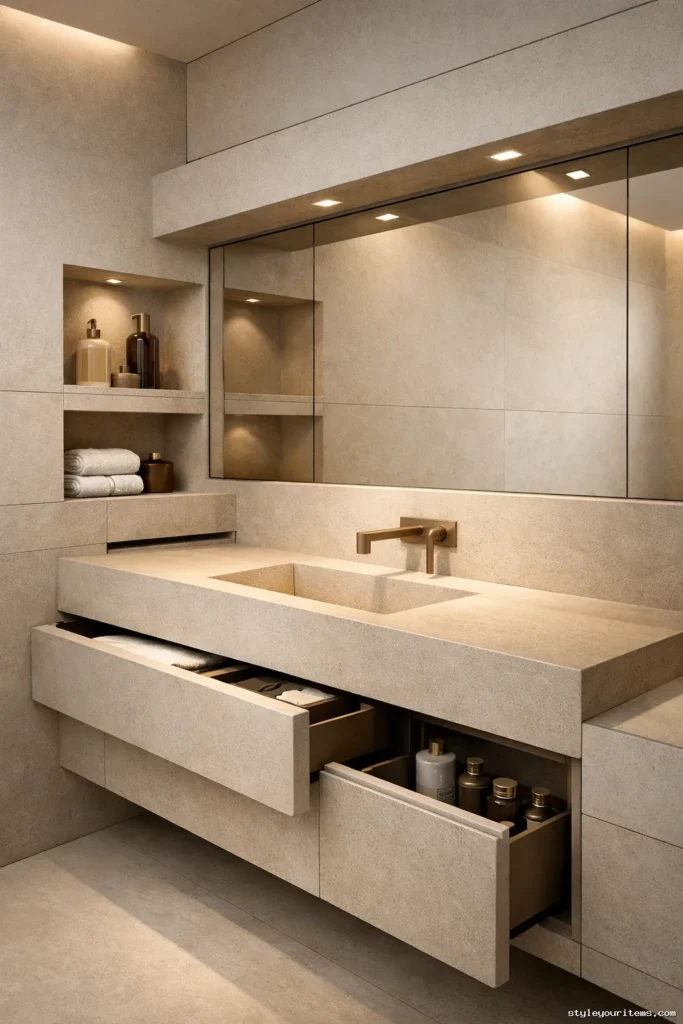
If off-the-shelf solutions aren’t cutting it, it’s time to explore custom built in vanity for small bathroom scenarios or uniquely shaped spaces. Custom Bathroom Vanity Designs aren’t exclusive to luxury budgets. Sometimes they’re the only logical choice. And these bespoke bathroom vanity ideas are exactly the kind that go viral on Pinterest.
When Off-the-Shelf Just Won’t Do: The Case for Going Custom
Got an awkward chimney breast cutting into your bathroom? An attic conversion with a slanted 45-degree wall? Or maybe you’re 6’4″ and the standard 32″ vanity height makes your back ache? Stock vanities come in limited dimensions: 24″, 30″, 36″, 48″, 60″. If your alcove measures 47.5 inches, you’re stuck with a 1.5-inch dust-collecting gap. Custom eliminates that gap.
Top 3 Custom Design Ideas That Maximize Every Last Inch
Idea #1: The Wall-to-Wall Solution (Seamless Integration for Unified Look)
Run a line from one wall to the other. A carpenter builds a frame that fits precisely. This creates an uninterrupted visual plane that makes the entire bathroom feel larger. This is the definitive approach for a custom built in vanity for small bathroom. No gaps, just smooth, continuous luxury.
Idea #2: Hidden Genius (Features You Can’t Find in a Catalog)
This is where custom work becomes genuinely enjoyable. You can request features that simply don’t exist in retail. Show this mini-list to your carpenter:
- Integrated Hamper: A drawer that reveals a laundry bag hanging inside.
- Pull-out Step Stool: A hidden stool tucked into the baseboard for little kids during tooth-brushing time.
- Appliance Garages: A flip-up door at counter height where hair dryers and straighteners stay plugged in, ready to use, wires completely hidden.
- Tall Bottle Storage: A slim pull-out cabinet on the side, perhaps just 6 inches wide, perfect for storing tall hair spray and lotion bottles vertically.
Idea #3: The Recessed Niche Effect (Built-in to Feel Architectural)
Similar to a recessed medicine cabinet, consider setting the vanity slightly into the wall cavity. This creates a shadow line and gives the impression that the vanity is part of the home’s original architecture rather than a store-bought addition. It’s a subtle move that signals thoughtful design.
Navigating the Realities of Custom Work: A Quick Cost & Timeline Reality Check
Expert Note: Custom does not mean fast. Lead times typically run 6 to 12 weeks. Cost-wise, a quality stock vanity might run $2,000 to $4,000. Custom cabinetry often starts around $5,000 and can climb to $15,000 or more (that’s just the cabinet box, not including the countertop).
Important: Specify materials clearly.
- Plywood (Marine Grade or Birch): The top choice. Resists moisture damage. Expect to pay more.
- MDF (Moisture Resistant): More affordable. But if an edge gets chipped and water penetrates, it swells dramatically. Best reserved for painted finishes in well-ventilated bathrooms.
Part 5: The Ultimate Matchup: A Clear-Headed Comparison for a Smart Choice
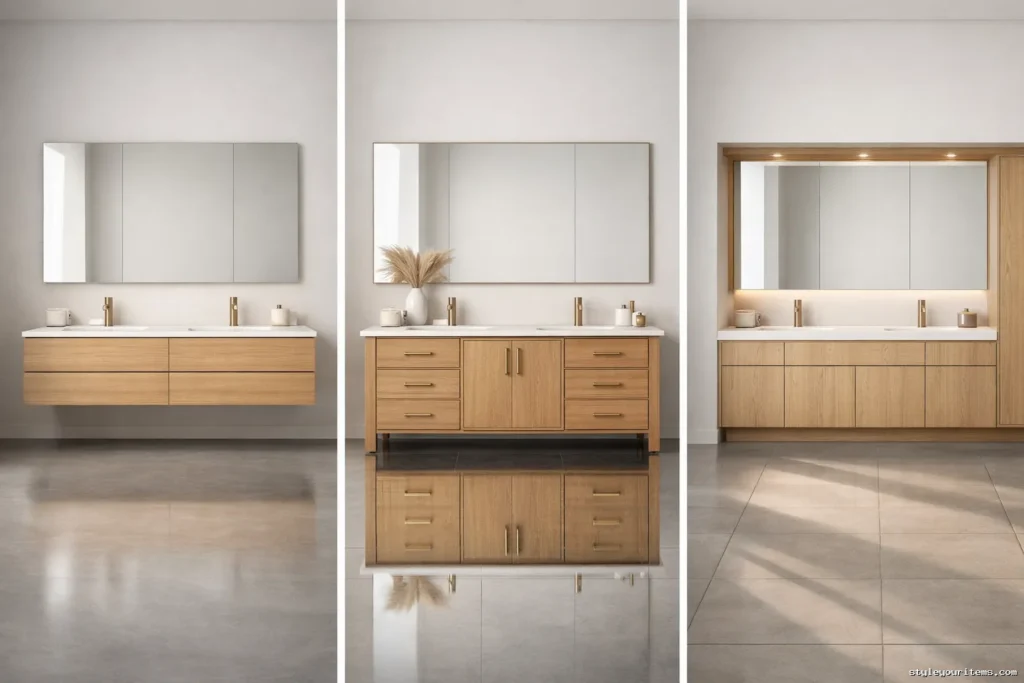
You’ve read about all three options. To settle the internal debate, here’s a head-to-head table that resolves the floating vanity vs freestanding pros and cons question at a glance.
Bookmark this, it’s useful.
| Feature | Floating Vanity | Freestanding Vanity | Custom Vanity |
|---|---|---|---|
| Best For… | Small bathrooms, Modern or Contemporary style lovers | All sizes, Traditional/Transitional style, Families with lots of stuff | Awkward corners, specific height needs, luxury bespoke look |
| Visual Weight | Very light and airy. Space appears larger | A bit heavier, feels grounded to the floor | Variable; Depends entirely on your design |
| Storage Capacity | Less. Drawers are efficient but depth is limited | High. You get both cabinets and drawers. Maximum storage | Unlimited. Every inch is utilized. From tall cabinets to hidden drawers |
| Installation | Difficult. Wall reinforcement and plumbing adjustments needed | Easy to Moderate. Can be a DIY project | Professional required. No room for error |
| Cleaning | Super easy. Broom and mop pass right underneath | Takes a bit longer. Hard to reach around legs and behind the base | Your choice. You design it enclosed or open based on preference |
| Cost (Approx Idea) | Mid to High ($800 – $3000+ for unit only) | Budget to High ($300 – $4000+ for unit only) | High to Luxury ($3500 – $10,000+ for cabinetry only) |
Part 6: Your Personalized Vanity Matchmaker: How to Choose the One That’s Right for You
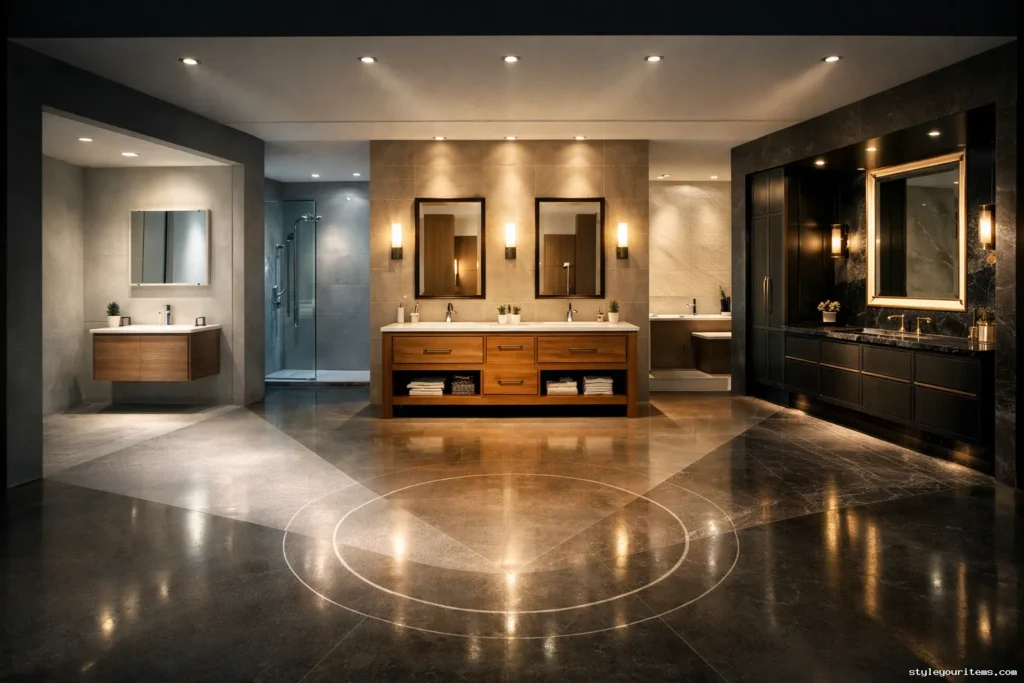
Enough background information. Time to get practical. Imagine you’re standing in a showroom or scrolling online listings. How do you actually make a decision?
Choose a Floating Vanity If…
- Your bathroom feels cramped and you need visual breathing room. Exposing the floor underneath makes a noticeable difference.
- You prefer a clean, minimalist aesthetic. A single soap dispenser on the counter is your ideal setup.
- You own a robot vacuum. (This combination works flawlessly.)
Choose a Freestanding Vanity If…
- Two people share the space and both need dedicated storage. Compromise isn’t an option.
- You’re handling the renovation yourself (DIY). Leveling a freestanding unit with shims is much simpler than framing inside a wall.
- You want a furniture-like presence that complements the rest of your home’s interior.
Choose a Custom Vanity If…
- You’ve ever muttered, “If this wall were just two inches wider, I could fit that cabinet.”
- You’re left-handed and want the drawer orientation to suit you, or you’re significantly taller than average and standard heights feel wrong.
- You’ve allocated the necessary budget and view this as a long-term investment and potential selling point.
Is a floating or freestanding vanity better for a small bathroom?
Clear answer: Floating. In a tight space, hiding the floor is a missed opportunity. A floating vanity makes a 5×7 bathroom feel significantly more open. A freestanding unit can appear bulky and heavy in a confined area.
Do floating vanities offer less storage space?
Yes, in terms of total cubic volume, it’s less. But that doesn’t mean it’s inefficient. A 36-inch floating vanity with two large drawers might actually be more organized than a 30-inch freestanding cabinet. The main limitation is you can’t store massive bulk items like 24 extra toilet paper rolls.
How much weight can a floating vanity hold?
If installed correctly, it can support heavy weight (200 kg+), but only if properly anchored to wall studs using steel brackets or a French cleat system. If the installer used drywall anchors, the unit will only safely hold the weight of a hand towel. Never rely on drywall anchors for a floating vanity.
How much more expensive is a custom bathroom vanity?
Typically, two to three times the cost of a stock unit. A nice 60″ double sink vanity might be $2,500 off the shelf. A custom version of the same footprint could run $6,000 to $8,000. The premium pays for superior material, an exact fit, and unique detailing.
What is the ideal height for a bathroom vanity?
Standard height is 32 inches (floor to countertop). This works for children and average-height adults. “Comfort Height” is 36 inches, similar to a kitchen counter. If bending over to wash your face causes back strain, opt for comfort height. Just keep in mind that 36″ might be a stretch for young children.
Can I install a floating vanity by myself?
Unless you have prior experience cutting tile and relocating plumbing lines, this is not a beginner-friendly weekend project. Accurate leveling, stud location, and recessing pipes are required. A mistake here can lead to floor damage and water leaks. Hiring a professional is the safer route.
What are the most durable materials for a bathroom vanity?
For the Base: Marine Grade Plywood. There’s really no better alternative for wet environments.
For the Countertop: Quartz (Engineered Stone). It’s non-porous. Spill red wine or hair dye and it won’t leave a mark. No sealing ever required. Porcelain slabs are also excellent. Natural Marble is stunning but demands attention. If you’re not prepared to seal it every 6 to 12 months (depending on use) and wipe spills immediately, Marble is probably not your best bet.
The Bottom Line: Matching the Vanity to Your Reality
Choosing between these options ultimately comes down to your daily life, not just the aesthetic. If floor space and a modern, airy feel are your priorities, a floating vanity is the smart move. If you need maximum storage and a more traditional, furniture-like anchor for the room, a freestanding vanity is the practical choice.
And if your space has unusual dimensions, specific accessibility needs, or you’re seeking truly bespoke features that off-the-shelf units simply can’t provide, then investing in a custom vanity is the only way to get exactly what you want. Now you’ve got the ideas and the framework. Go make that bathroom a place you actually enjoy being in.