
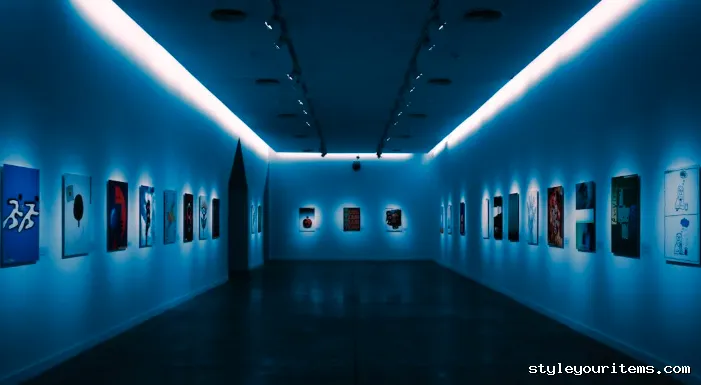
Not a filler print. Not something picked to match the cushions. Something chosen with actual thought behind it. People have grown tired of interiors that play it safe. Walls that say nothing. Spaces decorated by committee rather than by conviction. What is happening across residential and commercial design right now is a genuine departure from that. Art is no longer the last decision. For a lot of people, it is the first one.
Why Contemporary Art Is Redefining Modern Interior Design
There was a long period where decorating a room meant finishing the room. Sofa, rug, lighting. Then, somewhere near the end of the process, something goes on the walls. Whatever fits. Whatever fills the gap.
That approach looks dated now. Not because trends demanded a change but because people’s relationship with visual culture shifted underneath it. Years of scrolling through carefully assembled interiors trained a generation to notice the difference between art that activates a space and art that simply occupies it. That awareness crept into purchasing behavior gradually, then all at once.
The market responded. Independent artists who once relied entirely on gallery representation found direct access to buyers through online platforms. Shipping improved. Digital fairs removed geography from the equation almost entirely. A buyer sitting anywhere in the world can now own work by someone operating on the opposite side of it, with no middleman and no meaningful delay. That access changed what ends up on residential walls in ways the industry is still catching up to.
Top 7 Art Styles Dominating Home Interiors in 2026
Abstract expressionism refuses to leave, mostly because nothing else handles minimal interiors quite as well. A large gestural canvas in a clean, sparse room does something structural. The energy of the work fills the visual quiet that the design intentionally leaves open. However, this kind of pairing is not accidental.
For you see, plant-based illustrations like these has quite a handful of loyal dedication and a following. It brings something organic into spaces that might otherwise feel cold without requiring a full commitment to layered maximalism. It works in modern apartments. It works in older homes with characters already built in.
Sculptural wall art is gaining ground fast. Three-dimensional works in cast resin, formed ceramic or worked metal respond to light across the day. The piece at seven in the morning reads nothing like the same piece at five in the afternoon. That kind of life is hard to get from a flat surface.
Documentary photography is back in serious conversation. Buyers are gravitating toward images that capture something real rather than something constructed for commercial purposes. A genuine moment holds different weight. People feel the difference even when they cannot articulate it.
African art canvas prints are doing significant work in curated interiors this year. The geometric layering, the rich earth tones, the symbolism that carries the weight of generations behind it. At scale on canvas, these works do not simply decorate a room. They anchor it. For buyers who want something on their walls that actually means something rather than just filling space, this category keeps delivering in ways that more generic options cannot touch.
- Maximalist Collage
Maximalist collage holds its dedicated corner of the market. Painted surfaces layered with typography, photographic fragments, torn material. Works that give more each time someone looks. The opposite of immediate and exhausted.
- Monochromatic Line Art
Monochromatic line art closes the list. Single color, precise, minimal. Translates into almost any interior style without resistance. Does not date the way trend-chasing pieces tend to.
- Organic Abstract
Organic abstract does not try to be anything. Shapes that almost resemble something but stop short of committing. Colors bleed into each other the way watercolor does when you are not being careful. There is no sharp edge, no clean answer. People who say they know nothing about art tend to stand in front of these the longest.
- Sculptural Wall Relief
A flat wall is a wasted wall. Sculptural relief work fixes that. Plaster built up, wood carved back, metal pressed into something worth looking at twice. The piece changes depending on where the light is coming from. Morning looks different from evening. That kind of depth is hard to fake and impossible to scroll past.
- Folk-Rooted Pattern Work
Someone’s grandmother knew how to do this. That is the feeling folk-rooted pattern work carries into a room. Repeated marks, hand-drawn lines that wobble just slightly, colors that came from somewhere specific. It does not feel designed. It feels remembered. Interiors that take themselves too seriously tend to loosen up around it.
- Raw Texture Studies
No story, no metaphor. Just paint stacked thick, canvas left with rough edges, something that makes you want to run a finger across the surface before you catch yourself. Raw texture studies are not interested in being understood. They are interested in being felt. That is a different ask and most rooms are better for it.
- Narrative Portrait Work
Nobody frames a face anymore just to prove someone existed. The portraits landing in interiors right now are catching people in the middle of something. A glance cut short. A thought not quite finished. Paint layered and then second-guessed, which somehow ends up being the most honest thing about them. They do not perform. In fact, they all just feel too real while sitting there which makes the room feel livelier than ever, it goes beyond just aesthetics.
How to Incorporate Abstract and Mixed Media Art
Most hesitation around abstract art comes from the same false premise: that a piece needs to be understood before it earns wall space. That a buyer should be able to explain what it means before they are allowed to want it. That is a strange standard that nobody applies to music or food but keeps applying to visual art.
The more useful frame is simpler. Forget interpretation. Ask what the room feels like with the piece in it. That question has an answer most people can find quickly without any background in art theory.
Mixed media is producing some of the most interesting residential work right now. Artists who combine paint with raw fabric, layered paper, found objects or digital processes create something with genuine physical presence. In rooms where texture already matters through upholstery, timber grain, natural stone, that added dimension reads as intentional. It belongs.
Scale is where most first-time buyers get surprised. Something that photographs beautifully at small size often disappears entirely against a large wall. The habit worth building before any purchase: tape paper to the wall at the intended dimensions. Sit with it for a full day. Come back the next morning. That one step has saved a remarkable number of people from expensive decisions they would have regretted.
Building a gallery wall from smaller works offers flexibility that a single large purchase cannot. Individual pieces rotate in and out as taste develops. Nothing feels permanent or locked in.
The Rise of Cultural and Heritage Art in Contemporary Interiors
Not long ago, culturally specific art sat in a niche that mainstream interior design mostly ignored. It was considered a specialist interest. Something for collectors with a particular background or focus. That has shifted substantially.
West African geometric traditions, Japanese woodblock-influenced work, Latin American muralist references, South Asian miniature techniques. These are appearing in residential interiors with real regularity now. Not as a novelty. Not as a style experiment.
How to Stay Current with Art Trends Without Overspending
Trying to keep pace with every trend as it moves is expensive. It is also a losing game because trends move faster than budgets do. The smarter play is building a small foundation of work with long-term visual staying power, then keeping flexibility at the edges through lower-cost rotating pieces.
Art rental services have found their footing, particularly in commercial environments. Rotating a collection on subscription terms keeps spaces fresh without the permanence of full acquisition. For offices, restaurants, hospitality spaces, the model is practical in ways that outright purchasing often is not.
Following working curators and independent designers rather than mainstream shelter publications gives earlier signal on what is building real momentum. The gap between something emerging and that same thing becoming saturated is usually long enough to act on if the signal arrives early enough.
Following working curators and independent designers rather than mainstream shelter publications gives earlier signal on what is building real momentum. The gap between something emerging and that same thing becoming saturated is usually long enough to act on if the signal arrives early enough.
Conclusion
Safe choices are losing ground in 2026. The spaces people actually remember are built around art that carries real conviction behind it. Abstract energy, cultural roots, tactile mixed media. The thread connecting all of it is the same: someone made a decision that meant something rather than defaulting to whatever felt inoffensive. In fact, your particular trends are worth to be aware about and they are a reasonable starting point.