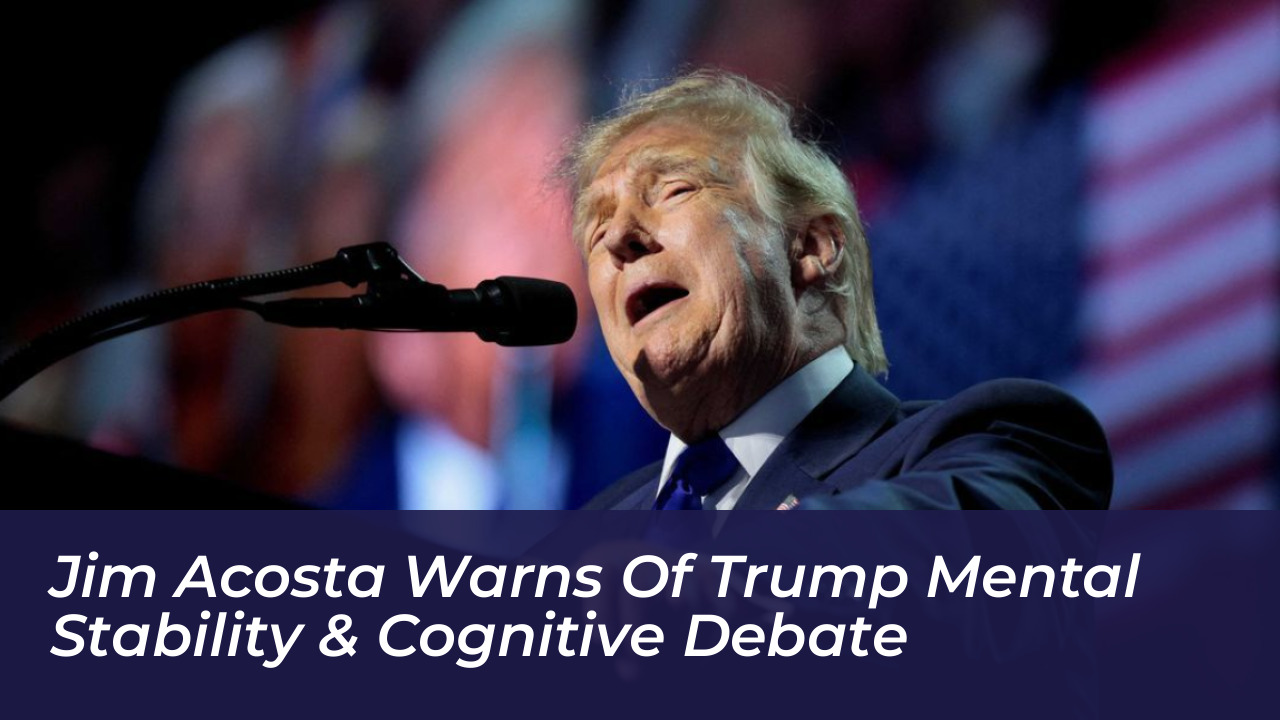
The intense public scrutiny surrounding the cognitive endurance and mental fitness of high-profile political leaders remains a defining characteristic of modern electoral cycles. Questions regarding stamina, psychological stability, and executive focus dominate headlines as voters demand absolute transparency from those seeking the highest offices in the land. Veteran journalist Jim Acosta recently joined this high-stakes debate during an appearance on Molly Jong-Fast’s podcast, voicing deep concern regarding Donald Trump and his public statements about national monuments, military presence, and international diplomacy. This discussion opens up a much broader examination of how political figures age in the public eye, how cognitive screenings are understood, where medical ethics intersect with media commentary, and whether corporate broadcasting networks exercise self-censorship when reporting on the cognitive health of presidential candidates.
- Jim Acosta and the Debate Over Political Stability
- Analyzing Unconventional Public Statements
- The Broader National Dialogue on Aging Leadership
- Understanding the Montreal Cognitive Assessment
- What the MoCA Actually Measures
- Jim Acosta Takes the MoCA Live
- Comparison of Cognitive Metrics
- Medical Ethics and Remote Behavioral Assessments
- The Goldwater Rule and Distant Evaluations
- Observable Indicators of Cognitive Strain
- Corporate Media Self-Censorship and Fear of Litigation
- Double Standards in Political Health Reporting
- The Impact of Legal Pressure on Investigative Journalism
- Conclusion
- Frequently Asked Questions
- What is the Montreal Cognitive Assessment?
- Does passing the MoCA prove high intelligence?
- Why do medical professionals hesitate to diagnose public figures?
- How has media coverage of political health changed?
Jim Acosta and the Debate Over Political Stability
Analyzing Unconventional Public Statements
Jim Acosta’s critique of Donald Trump centers on a pattern of remarks that deviate significantly from traditional political strategy. During various campaign rallies and media appearances, public policy proposals regarding national monuments and military positioning often take unexpected turns. Rather than following established diplomatic or legislative frameworks, these statements rely heavily on personal grievances, tangential anecdotes, and sudden shifts in tone.
Acosta argues that this unpredictability goes beyond a mere populist communication style. Instead, he characterizes these moments as indicators of a leader struggling to maintain logical continuity under pressure. When a public figure presents policy ideas that bypass standard governmental channels and ignore geopolitical realities, political analysts must ask whether this behavior stems from a deliberate disruption strategy or an underlying cognitive strain.
The Broader National Dialogue on Aging Leadership
The conversation involving Jim Acosta mirrors a wider national dialogue about how the aging process impacts performance in demanding executive offices. Modern political history features leaders well into their seventies and eighties navigating global crises, yet the physical and mental toll of this responsibility cannot be ignored. Critics and supporters frequently interpret verbal slips, rambling speeches, and unfinished thoughts through deeply partisan lenses.
Determining the thin line between an unconventional political style and actual cognitive decline proves exceedingly difficult. While supporters view improvisation and repetition as signs of authenticity and energy, detractors point to the exact same behaviors as evidence of mental fatigue. This polarization prevents a unified public understanding of political fitness, leaving voters to rely on selective media reporting and personal observation.
Understanding the Montreal Cognitive Assessment
What the MoCA Actually Measures
Much of the public discourse surrounding political cognitive health focuses on the Montreal Cognitive Assessment, a tool that Donald Trump frequently mentions to defend his mental sharpness. Trump often speaks of his performance on the exam as proof of superior intelligence, highlighting basic tasks like identifying drawings of animals or recalling simple spatial orientation. However, medical experts emphasize a fundamental misunderstanding in this public framing.
The Montreal Cognitive Assessment is not an intelligence quotient test, nor does it measure cognitive brilliance, strategic aptitude, or leadership capability. Instead, it serves as a rapid screening instrument designed to detect mild cognitive impairment and early signs of dementia. The test evaluates basic neurological function, checking whether an individual can manage short-term memory, clock drawing, and verbal fluency.
Jim Acosta Takes the MoCA Live
To demonstrate the actual mechanics and limits of the test, Jim Acosta completed the Montreal Cognitive Assessment live on his show with Dr. Rob Davidson, executive director of the Committee to Protect Health Care. Acosta achieved a perfect score of 30 out of 30, despite a minor recall hiccup regarding the word daisy. Dr. Davidson used the demonstration to clarify an essential medical truth: brilliant individuals, including professional musicians, scientists, and Rhodes scholars, can still suffer from neurodegenerative diseases that lower their scores over time.
Achieving a high score on the Montreal Cognitive Assessment simply indicates that an individual does not show signs of severe cognitive impairment at the exact moment of testing. It proves baseline neurological health, not exceptional genius. Bragging about passing a basic screening test demonstrates a profound misunderstanding of the test’s clinical purpose.
Comparison of Cognitive Metrics
| Feature | Montreal Cognitive Assessment (MoCA) | Intelligence Quotient (IQ) Test |
|---|---|---|
| Primary Purpose | Screens for mild cognitive impairment, dementia, and neurological decline. | Measures general cognitive ability, problem-solving, and logical reasoning. |
| Target Audience | Adults showing signs of memory loss or neurological symptoms. | Individuals across various demographics for educational or occupational placement. |
| Scoring Metric | Out of 30 points (scores below 26 typically indicate potential impairment). | Standardized deviation scale centered around an average score of 100. |
| Task Complexity | Basic memory recall, clock drawing, naming animals, and orientation. | Complex mathematical reasoning, spatial rotation, and verbal comprehension. |
Medical Ethics and Remote Behavioral Assessments
The Goldwater Rule and Distant Evaluations
A central ethical debate in political journalism involves diagnosing public figures from afar. The American Psychiatric Association enforces the Goldwater Rule, which explicitly prohibits medical professionals from offering professional diagnoses to public figures they have not personally examined. This guideline protects the integrity of the psychiatric profession and prevents politically motivated misuse of medical authority.
Despite these clear boundaries, political commentators and practicing physicians frequently evaluate observable public behavior during media appearances. Medical guests often walk a fine line during broadcast interviews. They avoid issuing formal diagnoses while still noting that repeated patterns of speech, fixation on minor details, and confusion regarding basic facts warrant closer scrutiny by qualified professionals.
Observable Indicators of Cognitive Strain
When assessing public behavior, experts look for specific, recurring indicators rather than isolated verbal slips. These observable markers help inform the public debate without crossing into unethical remote diagnoses:
- Verbal Disjointedness: Public figures occasionally struggle to complete complex multi-clause sentences, frequently trailing off or pivoting to unrelated grievances before finishing a thought.
- Perseveration on Basic Tasks: Spending excessive time boasting about passing a basic neurological screen like the Montreal Cognitive Assessment suggests a fundamental lack of awareness regarding what the test actually evaluates.
- Behavioral Volatility: Sudden, unexplained shifts in foreign policy announcements or domestic proposals are frequently cited by critics as signs of an unstable decision-making process.
Corporate Media Self-Censorship and Fear of Litigation
Double Standards in Political Health Reporting
Jim Acosta has repeatedly criticized corporate media networks for what he views as a glaring double standard in political health reporting. He argues that while major broadcast networks spent months aggressively analyzing every pause, stutter, and hesitation from President Joe Biden, they often shy away from applying the same intense scrutiny to Donald Trump.
This inconsistency frustrates media critics who expect uniform standards of accountability regardless of political affiliation. When newsrooms apply different editorial thresholds based on the candidate, public trust in journalism erodes. Viewers are left questioning whether network coverage is driven by objective news values or corporate self-preservation.
The Impact of Legal Pressure on Investigative Journalism
Media executives operate under intense fear of litigation, regulatory pressure, and hostile corporate takeovers. Fearing expensive defamation lawsuits or retaliation from politically connected billionaires, mainstream news outlets often default to sanitized summaries rather than deep investigative reporting on aging leadership.
This self-censorship creates a significant gap in public understanding. As traditional broadcast networks handle stories of political health with extreme caution, independent digital platforms and podcasts step in to fill the void. These independent outlets provide the unvarnished analysis that corporate newsrooms avoid due to legal and financial pressures.
Conclusion
The ongoing debate surrounding political cognitive fitness, medical screening realities, and media transparency highlights the complex relationship between leaders and the electorate. When journalists like Jim Acosta question the mental stability and public statements of figures like Donald Trump, the discussion goes far beyond partisan politics. It touches directly on institutional stability and national security. Without transparent, rigorous medical evaluations enforced by independent boards, voters must rely on observable behavior, expert medical commentary, and ongoing media analysis to gauge the fitness of those seeking ultimate executive power.
Frequently Asked Questions
What is the Montreal Cognitive Assessment?
The Montreal Cognitive Assessment is a brief 30-question screening tool used by healthcare professionals to detect mild cognitive impairment and early signs of neurological decline. It evaluates memory, attention, language, and executive functions rather than measuring general intelligence.
Does passing the MoCA prove high intelligence?
Passing the Montreal Cognitive Assessment does not prove high intelligence, strategic capability, or leadership brilliance. A high score simply indicates an absence of significant cognitive impairment at the exact time of testing.
Why do medical professionals hesitate to diagnose public figures?
Medical professionals adhere to ethical guidelines such as the Goldwater Rule, which explicitly prohibits psychiatrists and physicians from offering professional clinical diagnoses to public figures they have not personally examined.
How has media coverage of political health changed?
Media coverage of political health faces challenges due to corporate self-censorship, fear of defamation lawsuits, and inconsistent scrutiny across different political figures, leading many voters to seek analysis from independent digital platforms.