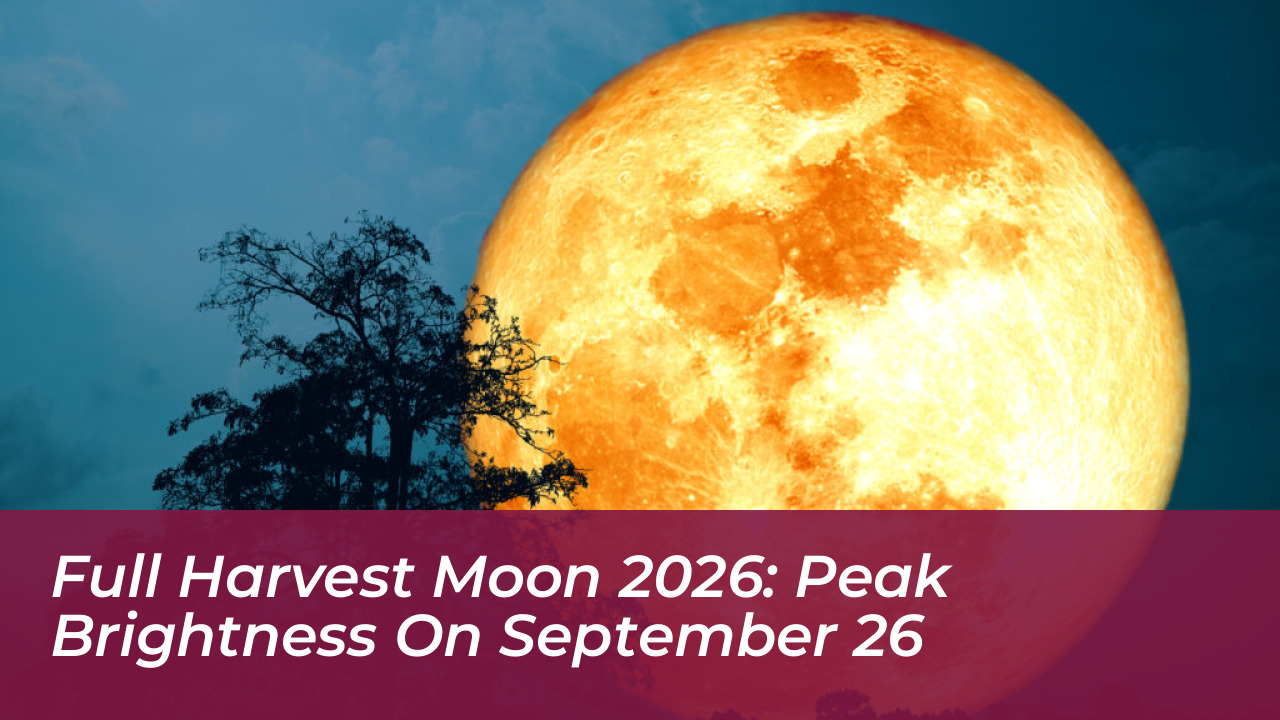
Skywatchers and cultural observers across the globe will mark the arrival of the annual Harvest Moon on Saturday, September 26, 2026. This prominent astronomical event reaches its fullest point just days after the autumn equinox, delivering an exceptional viewing experience across the Northern Hemisphere.
- Astronomical Timing and Peak Illumination
- Exact Peak Time and Visibility
- The Autumn Equinox Connection
- Why It Is Called the Harvest Moon
- Agricultural History
- The Mechanics Behind the Compressed Moonrise Delay
- Global Cultural Names and Traditions
- European and Indigenous Monikers
- International Celebrations
- Planetary Alignments Accompanying the 2026 Harvest Moon
- Saturn and Deep Sky Neighbors
- Constellations and Neighboring Planets
- The Science of the Moon Illusion and Amber Tones
- The Moon Illusion
- Rayleigh Scattering
- Best Practices for Skywatching on September 26
- Optimal Timing and Dark Skies
- Equipment and Night Vision Preservation
- Supermoon Status Clarified
- Looking Ahead: The Full Moon Calendar
- Frequently Asked Questions
- When is the peak of the 2026 Harvest Moon?
- Why does the Harvest Moon appear for multiple nights?
- Is the September 2026 full moon a supermoon?
- What planets are visible near the Harvest Moon?
Astronomical Timing and Peak Illumination
Exact Peak Time and Visibility
According to astronomical data from the Royal Observatory Greenwich and major almanacs, the moon reaches its peak full phase at 17:49 BST (12:49 p.m. ET) on September 26, 2026. While the moon sits below the horizon in parts of the UK and eastern North America at the exact moment of peak fullness, it rises shortly after local sunset and remains visible throughout the entire night.
Because the peak happens during daylight hours in Western time zones, observers do not need to target that exact minute. The moon will appear fully illuminated and exceptionally bright on the nights of September 25, September 26, and September 27.
The Autumn Equinox Connection
The autumn equinox occurred on September 22, placing this year’s full moon four days later. This precise timing ensures that the lunar cycle aligns tightly with the seasonal shift, creating ideal conditions for evening skywatching.
Astronomers track this relationship closely because the equinox dictates the geometry of the Earth and moon relative to the sun. This geometry directly controls the apparent speed of the moon across consecutive nights.
Why It Is Called the Harvest Moon
Agricultural History
The event takes the name Harvest Moon because it is the full moon occurring closest to the autumn equinox. Unlike most full moon names that correspond to a fixed calendar month, the Harvest Moon designation is strictly tied to the seasonal transition.
Historically, the extra illumination provided by the low-rising moon after sunset allowed farmers to continue gathering crops before winter frosts arrived. Before the widespread adoption of electric lighting, this compressed window of evening light played a critical role in agricultural productivity.
The Mechanics Behind the Compressed Moonrise Delay
Most months, the moon rises about 50 minutes later each successive night as it moves along its orbit around Earth. However, around the time of the autumn equinox, the moon’s orbital path runs at a shallow angle to the eastern horizon.
This shallow angle causes the moon to rise only 20 to 30 minutes later each night for several consecutive evenings. The result is a prolonged bridge of bright twilight and moonlight immediately following sunset, creating the optical impression that the full moon lasts for multiple nights in a row.
Global Cultural Names and Traditions
European and Indigenous Monikers
Aside from the Harvest Moon, the September full moon carries distinct traditional names across various cultures, reflecting seasonal shifts in nature. European traditions mark the final stages of grain collection with names like Corn Moon and Barley Moon. Wine Moon is associated with the timing of grape harvests in wine-producing regions.
Multiple Indigenous North American traditions use names such as Falling Leaves Moon, Autumn Moon, and Yellow Leaf Moon to highlight the changing foliage and cooling temperatures.
International Celebrations
Internationally, the September full moon aligns with major cultural celebrations. In China and parts of East Asia, it coincides with the Mid-Autumn Festival, where families gather to light lanterns and share mooncakes.
In Hindu traditions, it marks the commencement of Pitru Paksha, a sacred period dedicated to honoring ancestors and performing remembrance rituals.
Planetary Alignments Accompanying the 2026 Harvest Moon
Saturn and Deep Sky Neighbors
The Harvest Moon shares the night sky with other notable celestial bodies in late September 2026. Approximately one hour after moonrise on September 26, the planet Saturn will appear less than 10 degrees below the lunar disk.
Observers using binoculars or small telescopes can spot Saturn’s ring system alongside several of its largest moons, including Titan and Rhea, creating a rare dual observation target.
Constellations and Neighboring Planets
Additionally, the Great Square of Pegasus will dominate the post-sunset sky, providing a reliable celestial anchor for stargazers. Early morning observers will find Jupiter and Mars positioned near the constellations Cancer and Gemini.
These planetary pairings offer astrophotographers an ideal opportunity to capture wide-field images of the inner solar system alongside the illuminated lunar surface.
The Science of the Moon Illusion and Amber Tones
The Moon Illusion
When the Harvest Moon rises in the east near sunset, it often appears unusually large and takes on a warm golden-orange hue. This phenomenon is largely psychological. The brain compares the lunar disk against familiar terrestrial objects on the horizon, such as trees and buildings, making the moon look massive.
Once the moon climbs higher into the dark sky, it loses these visual reference points and returns to its normal perceived scale.
Rayleigh Scattering
The amber color stems from atmospheric physics rather than lunar changes. When the moon sits low, its light travels through a much thicker layer of Earth’s atmosphere.
This atmosphere scatters shorter blue wavelengths in all directions while allowing longer red and orange wavelengths to reach the human eye, mirroring the physics of a dramatic sunset.
Best Practices for Skywatching on September 26
Optimal Timing and Dark Skies
Amateur astronomers and casual observers can maximize their viewing experience by heading outside roughly 20 to 30 minutes after local sunset on September 26 or 27 to catch the moon low on the eastern horizon.
While the Harvest Moon is bright enough to cut through suburban light pollution, traveling to a designated dark-sky location enhances contrast and reveals background stars.
Equipment and Night Vision Preservation
The naked eye provides a stunning panoramic view without any optical aids. Binoculars or a small entry-level telescope with a 70mm aperture will help resolve lunar craters and maria without requiring complex setups.
Limit exposure to bright smartphone screens for at least 20 minutes before viewing to allow eyes to fully adjust to ambient moonlight and dark conditions.
Supermoon Status Clarified
Despite generating widespread anticipation, the September 26, 2026 full moon does not qualify as a supermoon. The moon sits at a standard orbital distance from Earth rather than coinciding with a close perigee.
Its visual impact stems entirely from its optimal position near the horizon, the unique multi-night rising schedule, and the psychological impact of the moon illusion.
Looking Ahead: The Full Moon Calendar
The September Harvest Moon serves as the ninth full moon of 2026. Following this autumn display, the lunar cycle continues into October.
The next full moon, traditionally known as the Hunter’s Moon, will reach peak illumination on Monday, October 26, 2026, at 12:15 a.m. ET, offering yet another brilliant night for skywatchers.
Frequently Asked Questions
When is the peak of the 2026 Harvest Moon?
The moon reaches its absolute peak fullness at 17:49 BST on September 26, 2026.
Why does the Harvest Moon appear for multiple nights?
The shallow angle of the lunar orbit near the equinox creates shorter moonrise delays for consecutive evenings.
Is the September 2026 full moon a supermoon?
No, it occupies a standard orbital distance rather than a close perigee position.
What planets are visible near the Harvest Moon?
Saturn shines brightly near the lunar disk during the peak viewing nights.