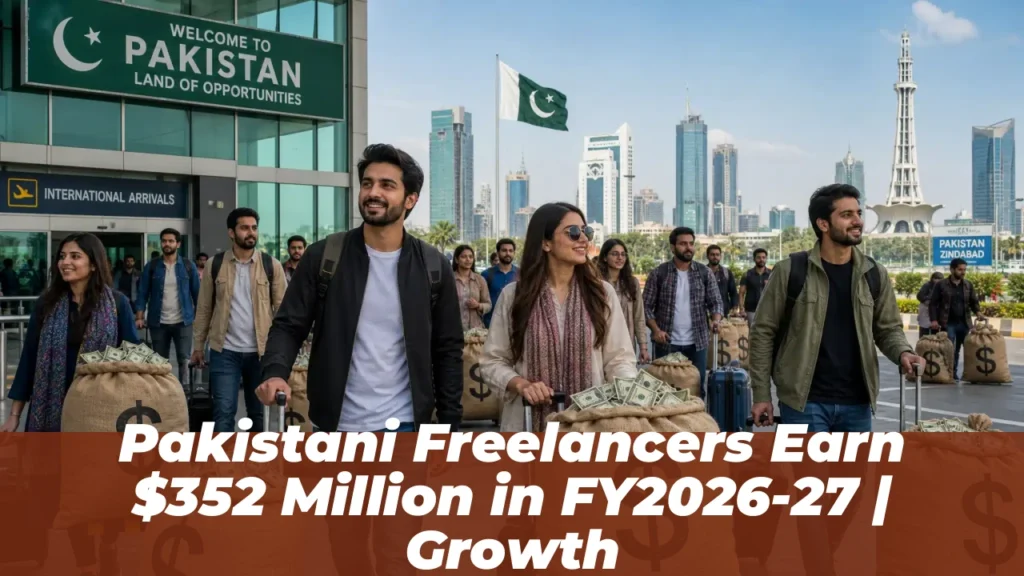
Pakistani Freelancers Hit $352 Million Milestone: A New Era for Digital Exports (FY2026-27)
The digital landscape in Pakistan is undergoing a significant transformation. According to the latest data released by the State Bank of Pakistan (SBP), the country’s freelance community has generated a remarkable $352 million in just the first two months (July-August) of the fiscal year 2026-27. This reflects a robust 44% year-on-year growth compared to the $244 million recorded during the same period in 2025.
This achievement is a testament to the resilience and adaptability of Pakistan’s young workforce. As the global demand for remote digital expertise intensifies, Pakistani professionals are no longer just participating in the gig economy; they are emerging as key players in the global digital supply chain.
The Breakdown: How $352 Million Was Generated
The growth is spread across various sectors, demonstrating that the diversification of skills is yielding tangible economic results. The data reflects a healthy balance between high-end technical prowess and creative service delivery.
| Category | Earnings (USD) |
|---|---|
| IT Services | $212 Million |
| Non-IT Services | $139 Million |
| Total | $352 Million |

The dominance of IT services highlights a growing proficiency in high-value domains such as cloud architecture, full-stack development, and AI-driven automation. Simultaneously, the $139 million generated by non-IT sectors spanning creative design, digital marketing, and specialized virtual assistance confirms that the broader service economy is scaling effectively.
Why the Surge? The AI and Agency Revolution
The 44% surge in earnings is driven by two primary shifts in the professional landscape:
- AI-Powered Productivity: Freelancers are increasingly working with higher efficiency. By integrating advanced AI tools into their workflows, developers and creatives are delivering complex projects in significantly shorter timeframes, allowing them to scale their client base without compromising output quality.
- The Shift to Agency Models: We are witnessing a strategic transition from solo freelancing to micro-agency models. By forming specialized, collaborative teams, freelancers are pooling resources to bid on larger, high-ticket enterprise contracts, which has substantially increased the average project value.
Government Policy: Empowering the Digital Workforce
The government’s proactive stance has been instrumental in formalizing these earnings. For freelancers registered with the Pakistan Software Export Board (PSEB), the regulatory environment in 2026 offers distinct advantages:
- Tax Incentives: The 0.25% concessional tax rate continues to encourage freelancers to utilize formal banking channels, effectively reducing reliance on informal, grey-market money transfers.
- Financial Flexibility: Streamlined access to foreign currency accounts allows professionals to manage their earnings more efficiently, providing a necessary buffer against currency volatility and facilitating smoother international B2B transactions.
Looking Ahead: The $2.5 Billion Target for FY2026-27
With $352 million secured in the first two months, the trajectory for the remainder of FY2026-27 remains highly optimistic. Industry analysts and government projections now firmly target an annual export milestone of $2.5 billion.
As initiatives like DigiSkills 3.0 continue to sharpen the workforce’s expertise in UI/UX and Python-based AI development, Pakistan is well-positioned to cement its status as a global hub for digital talent. The focus is now shifting from volume to value, ensuring that Pakistani freelancers remain competitive in an increasingly AI-centric global market.
Pros and Cons of the Current Freelance Boom
Pros:
- Substantial contribution to national foreign exchange reserves.
- Reduced dependency on traditional employment sectors.
- Rapid development of high-skill tech talent across the country.
Cons:
- Need for consistent, high-speed internet infrastructure in underserved regions.
- Intensifying competition from other emerging markets in the AI-service space.
- Ongoing challenges in seamless local banking integration for smaller startups.

Specifications of the Growth Trend
| Feature | |
|---|---|
| Growth Rate | 44% YoY |
| Primary Driver | AI Integration & Micro-Agencies |
| Key Export Markets | USA, UK, UAE, and EU |
| Primary Skillsets | Python, AI/ML, UI/UX, Content Strategy |
Conclusion
The $352 million milestone achieved in just two months is a clear indicator that Pakistan’s digital economy has reached a new level of maturity. By embracing AI and collaborative agency structures, Pakistani freelancers are proving their ability to compete on the global stage. If this trajectory is maintained, the $2.5 billion target for FY2026-27 is an achievable reality that will redefine the nation’s economic future.