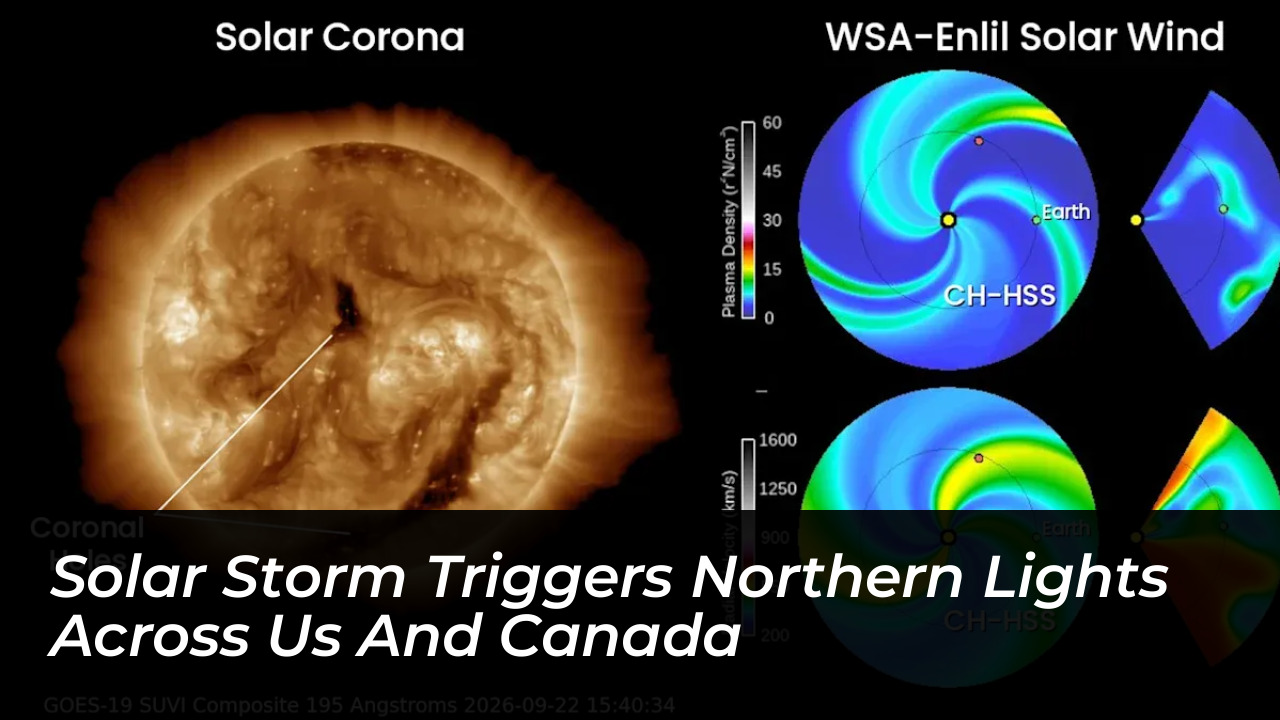
A fast-moving stream of solar wind flowing directly from two prominent coronal holes on the sun recently sparked a minor geomagnetic storm across Earth. This solar activity created favorable conditions for vivid auroral displays across parts of Canada and the northern United States. Space weather forecasters at the National Oceanic and Atmospheric Administration Space Weather Prediction Center issued official watches as the high-speed particle stream reached the outer boundaries of Earth’s magnetosphere. Geomagnetic activity remained elevated, providing exceptional skywatching opportunities throughout high-latitude regions. Observers positioned near the international border between the United States and Canada, northern Michigan, Maine, and the central Prairies in Manitoba, Saskatchewan, and Alberta reported notable visibility. Understanding the mechanics behind these solar outbursts helps enthusiasts predict when and where the next celestial light show will occur.
- Understanding the Mechanics of Coronal Holes and Solar Wind
- The Impact on Earth’s Magnetosphere
- Geomagnetic Storm Classifications Explained
- Prime Viewing Locations Across the United States
- Prime Viewing Locations Across Canada
- Coronal Holes Versus Coronal Mass Ejections
- Essential Tips for Photographing the Northern Lights
- How Urban Light Pollution Affects Aurora Viewing
- Future Outlook for Solar Cycle 25
- Frequently Asked Questions
- What causes the different colors in the northern lights?
- Can I see the northern lights without a camera?
- How far south can the northern lights travel?
Understanding the Mechanics of Coronal Holes and Solar Wind
The primary driver behind this event is a pair of coronal holes on the sun. Coronal holes are cooler, less dense regions in the solar corona where the sun’s magnetic field opens up freely into interplanetary space. This magnetic configuration allows solar wind to escape at speeds much higher than normal.
Normal solar wind travels at an average baseline speed of roughly 325 kilometers per second. High-speed streams emerging from coronal holes can accelerate these particle flows to velocities exceeding 700 kilometers per second. As this rapid stream travels through space, it overtakes slower-moving solar wind particles ahead of it, creating a compressed boundary layer known as a co-rotating interaction region.
The Impact on Earth’s Magnetosphere
When a co-rotating interaction region slams into Earth’s invisible magnetic field, it compresses the magnetosphere on the dayside and stretches it on the nightside. This sudden compression destabilizes trapped plasma within the outer radiation belts. Charged protons and electrons cascade down magnetic field lines toward the polar regions.
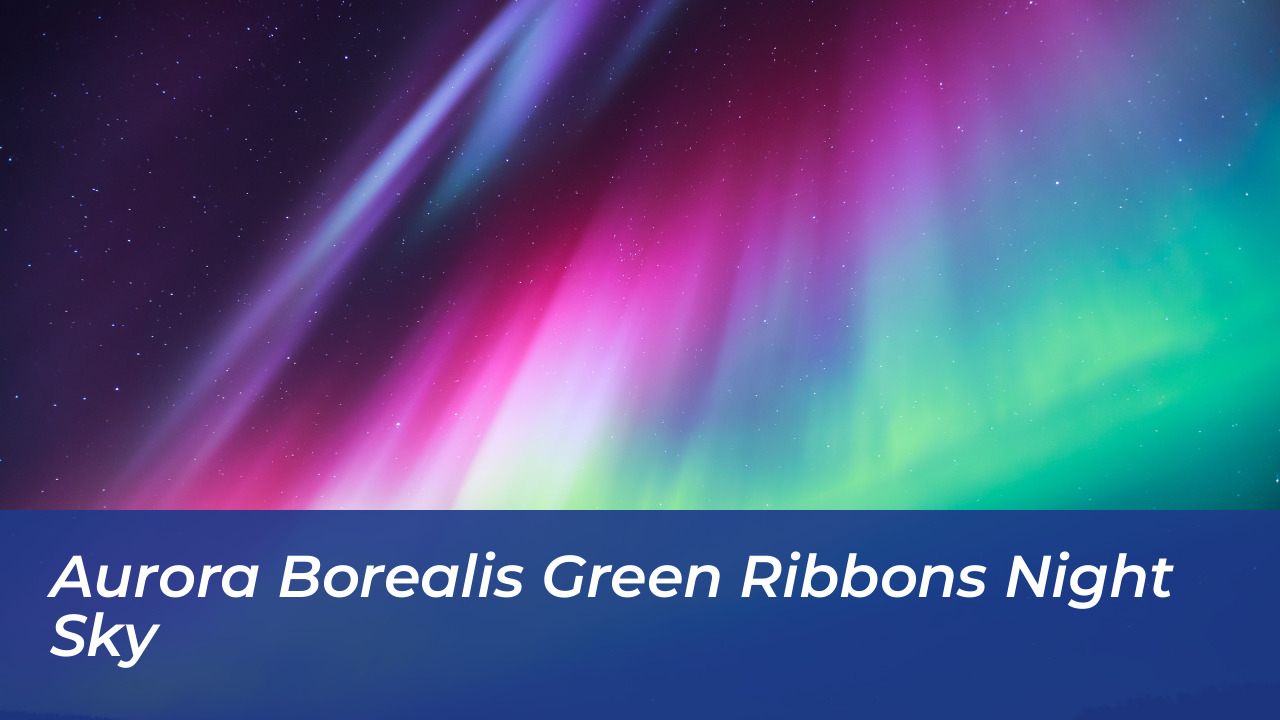
As these energetic charged particles collide with atoms and molecules in Earth’s upper atmosphere, primarily nitrogen and oxygen, they transfer energy. This energy transfer releases photons of light, resulting in the glowing ribbons and arcs known as the northern lights, or aurora borealis. The intensity and color of the display depend heavily on the density of the solar wind and the specific atmospheric gases involved.
Geomagnetic Storm Classifications Explained
Space weather experts categorize geomagnetic disturbances using the NOAA G-scale, which ranges from G1 minor to G5 extreme. The recent solar activity registered at a G1 minor geomagnetic storm level, occasionally fluctuating into moderate thresholds depending on the interplanetary magnetic field orientation.
G1 Minor involves weak power grid fluctuations, minor impact on satellite operations, and auroras visible at high latitudes such as northern Michigan and Maine. G2 Moderate brings high-latitude power system voltage alarms and auroras visible down to northern states. G3 Strong requires voltage corrections for power grids and brings intermittent satellite navigation problems. G4 Severe creates widespread voltage control problems and southern visibility. G5 Extreme triggers complete high-frequency radio blackouts and widespread auroras spanning deep into mid-latitudes.
Prime Viewing Locations Across the United States
Skywatchers situated in the northern tier of the United States experienced the highest probability of spotting the auroras. Favorable viewing conditions concentrated in states sharing a border with Canada or positioned along high magnetic latitudes.
In the Pacific Northwest, northern Washington and parts of Idaho offered clear horizons looking north. Across the Midwest, observers in Minnesota, North Dakota, Wisconsin, and northern Michigan caught distinct glimpses of glowing green arcs. In the Northeast, Maine, northern New Hampshire, Vermont, and upstate New York provided favorable dark-sky vantage points away from heavy urban light pollution.
Prime Viewing Locations Across Canada
Canada experienced the most intense displays due to its proximity to the magnetic north pole. Enhanced auroral activity lit up the skies across northern and central territories.
Residents in Whitehorse, Yellowknife, Churchill, Edmonton, Calgary, Saskatoon, and Regina enjoyed vibrant overhead displays. Southern population centers, including parts of British Columbia, southern Alberta, Saskatchewan, Manitoba, and rural Ontario, also recorded visible light shows when local cloud cover cooperated.
Coronal Holes Versus Coronal Mass Ejections
A common point of confusion among casual stargazers involves the difference between coronal holes and coronal mass ejections. Both trigger auroras, but their origins and warning timelines differ significantly.
| Feature | Coronal Holes | Coronal Mass Ejections (CMEs) |
|---|---|---|
| Origin | Open magnetic field lines in the corona | Explosive solar flares and magnetic field snaps |
| Speed | Fast streams exceeding 700 kilometers per second | Variable, reaching Earth in 24 to 72 hours |
| Advance Warning | Multiple days via solar rotation tracking | Shorter notice, tracked via coronagraph imagery |
| Storm Severity | Typically G1 minor to G2 moderate | Can scale from G1 minor to G5 extreme |
Coronal holes provide a steady, predictable stream of high-speed solar wind. CMEs represent sudden, explosive ejections of plasma that can deliver much stronger geomagnetic impacts on short notice.
Essential Tips for Photographing the Northern Lights
Modern smartphones and digital cameras capture auroras far better than the naked eye because their sensors gather light over extended exposure times. Implementing specific settings transforms a faint gray haze in the sky into a vibrant green and purple photograph.
Use a sturdy tripod to eliminate camera shake during long exposures. Switch your camera or phone to manual mode to maintain total control over exposure settings. Set the focus manually to infinity or focus on a bright star on the horizon. Adjust the shutter speed between two and ten seconds depending on how fast the aurora is moving. Keep the ISO setting between 800 and 3200 to balance light sensitivity with digital noise.
How Urban Light Pollution Affects Aurora Viewing
Light pollution remains the single greatest obstacle for backyard astronomy and aurora chasers. Streetlights, commercial signage, and suburban glow wash out faint celestial phenomena on the horizon.
To maximize your chances of seeing subtle G1-class displays, travel away from city centers into designated dark-sky preserves or rural state parks. Face your view toward the northern horizon, allow your eyes twenty minutes to dark-adapt, and avoid looking at bright smartphone screens while waiting for the activity to surge.
Future Outlook for Solar Cycle 25
Solar activity rises and falls in predictable cycles lasting approximately eleven years. Earth is currently progressing through Solar Cycle 25, which began in December 2019.
As the solar cycle approaches and maintains its peak solar maximum phase, sunspots and coronal holes become much more frequent. This heightened solar activity guarantees that skywatchers across the northern United States and Canada will enjoy many more opportunities to witness vibrant auroral displays in the coming months and years.
Frequently Asked Questions
What causes the different colors in the northern lights?
The colors depend on which gas molecules are colliding with solar wind particles and at what altitude. Oxygen collisions at lower altitudes produce bright green light, while higher altitude oxygen results in rare red displays. Nitrogen collisions create purple, blue, and pink hues.
Can I see the northern lights without a camera?
Yes, though naked-eye visibility depends on the strength of the geomagnetic storm. During G1 minor storms, the lights often appear as a faint whitish or gray arc. Stronger storms reveal vivid greens, pinks, and dancing vertical pillars clearly without camera assistance.
How far south can the northern lights travel?
During extreme G5 geomagnetic storms, auroras have been sighted as far south as Hawaii, Texas, and southern Europe. However, storms of that magnitude are rare, and typical sightings for mid-latitudes usually occur during G3 or G4 events.