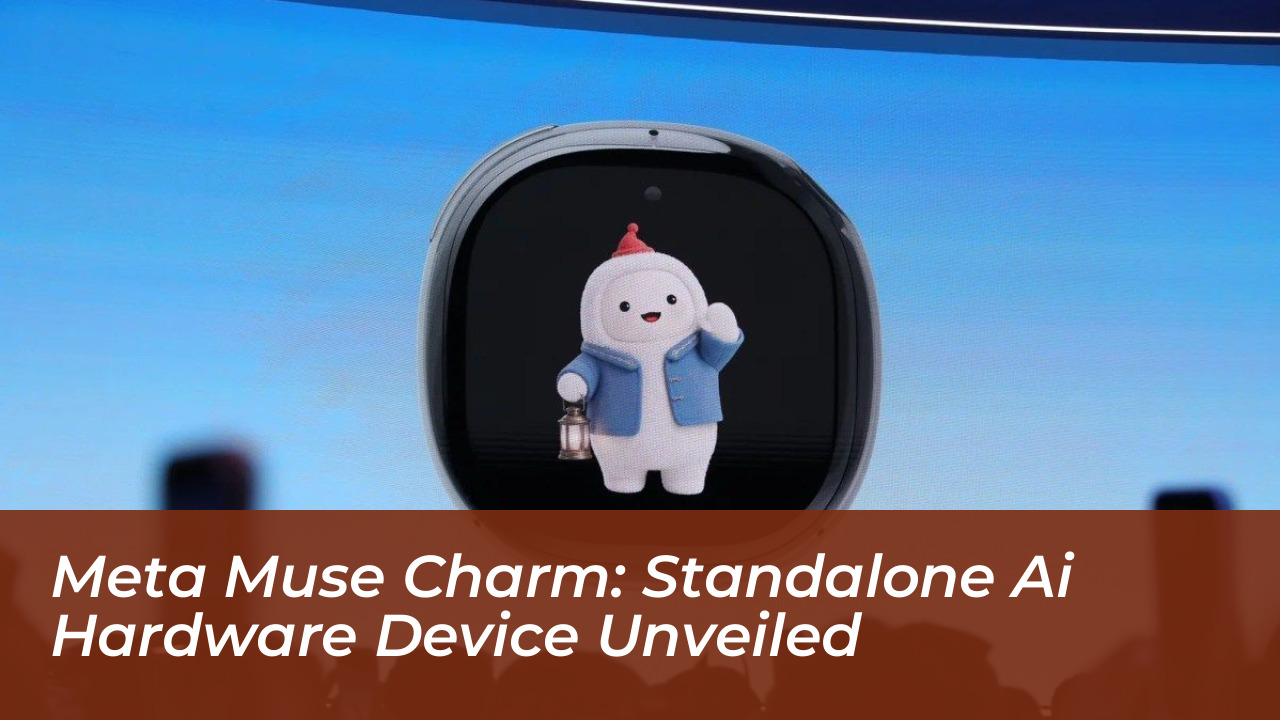
Meta introduced the Meta Muse Charm AI Hardware Device during the keynote presentation, marking a fresh phase in ambient artificial intelligence hardware. Unlike traditional screen-bound mobile devices or general-purpose smartwatches, this standalone gadget operates entirely independently from smartphones. Designed to house the company proprietary Muse AI agent, the device focuses on lowering friction for real-time, voice-first interactions. The hardware arrives as consumer technology companies search for form factors that surpass the utility of standard smartphones. By packaging the real-time voice and avatar stack into a pocket-sized chassis, Meta tests consumer demand for dedicated conversational hardware. Production schedules point toward a targeted release ahead of the December holiday season, despite manufacturing remaining in preliminary prototype phases.
- Physical Design and Hardware Specifications
- Under the Hood: The Muse AI Agent Ecosystem
- Comparative Analysis: Muse Charm Versus Early AI Wearables
- Production Status and Holiday Release Roadmap
- Strategic Implications for Meta Hardware Division
- Frequently Asked Questions
- Does the Muse Charm require a smartphone to function?
- How do you activate voice commands on the device?
- What materials are used in the construction of the Muse Charm?
- When will the Muse Charm be available for purchase?
Physical Design and Hardware Specifications
The physical construction of the Meta Muse Charm AI Hardware Device resembles a thick smartwatch detached from its wrist strap. It features a prominent display paired with a built-in lanyard for portability around the neck or wrist. The chassis incorporates several distinct input and output mechanisms to facilitate rapid interaction without unlocking a companion device or launching an application. Engineers designed the outer shell to catch attention while remaining lightweight enough for all-day wear.
A fingerprint sensor positioned on the top-right corner doubles as a physical activation button to initiate voice commands securely. Three front-facing microphone ports capture audio input cleanly for the speech recognition engine, minimizing background noise interference. An integrated optical sensor allows the device to capture visual data of the user immediate environment. Prototypes showcase an elevated hacker aesthetic with a semi-transparent exterior that displays internal circuit components proudly.
Despite the physical layout emphasizing compact utility, official documentation lacks clarity regarding backend networking protocols. Meta executives did not disclose the exact cellular or Wi-Fi mechanics the device uses to communicate with cloud infrastructure during the initial unveiling. This leaves open questions about how the hardware maintains continuous connectivity when users are away from known wireless networks.
Under the Hood: The Muse AI Agent Ecosystem
The hardware functions as an external shell for the broader Muse ecosystem, acting as a proactive personal assistant running on a dedicated virtual machine architecture. Introduced as an intelligent companion, Muse runs on the Muse Secure VM, which isolates user data to maintain strict privacy standards. The software utilizes the advanced Muse Spark model to manage complex background tasks efficiently.
The agent operates across multiple platforms, including iOS, Android, and web interfaces, before syncing with dedicated hardware like the Muse Charm. Capabilities extend beyond simple conversational queries to autonomous task execution. The software can manage calendars, draft emails, and coordinate schedules without manual user intervention. For financial transactions, integration with Stripe Link generates single-use virtual cards to protect consumer payment credentials during automated checkouts.
| Feature Component | Specification and Capability |
|---|---|
| Processing Core | Powered by Muse Spark model via Muse Secure VM |
| Primary Input | Top-right fingerprint sensor and triple-microphone array |
| Connectivity Requirement | Standalone operation with no smartphone pairing required |
| Transaction Security | Stripe-powered virtual single-use payment tokens |
Comparative Analysis: Muse Charm Versus Early AI Wearables
The artificial intelligence hardware landscape has witnessed numerous experimental failures, most notably the Rabbit R1 and various pin-based assistants. These early market entries struggled with sluggish response times, limited agent autonomy, and heavy dependence on companion smartphone applications for basic network tasks. Consumers quickly grew frustrated by devices that required an existing phone just to function properly.
The Meta Muse Charm AI Hardware Device attempts to correct these architectural flaws through direct server integration and an always-available voice stack. Unlike screenless pendants that force users to rely entirely on blind audio feedback, the Muse Charm pairs an integrated visual display with multimodal context capture. The presence of an onboard camera allows the agent to process physical surroundings immediately, mirroring the ambient intelligence goals of advanced smart glasses without requiring eyewear.
Production Status and Holiday Release Roadmap
Meta faces a compressed timeline to transition the hardware from prototype status to commercial retail shelves ahead of the upcoming shopping rush. During the unveiling, company leadership confirmed that only a small batch of physical units existed. Engineers continue to refine finishing materials and optimize internal component layouts to ensure durability.
Executives maintain an aggressive distribution schedule, pointing to a launch window ahead of the December holiday shopping season. Meeting this target requires rapid scaling of manufacturing supply chains, especially given the custom requirements of the translucent housing and biometric sensor placement. Price points and international distribution tiers remain unconfirmed as final hardware specifications undergo factory validation.
Strategic Implications for Meta Hardware Division
The introduction of the Meta Muse Charm AI Hardware Device highlights Meta shifting hardware strategy. By diversifying beyond virtual reality headsets and smart glasses, the company explores modular form factors that can capture user intent in varied environments. Integrating the Muse agent directly into operating systems across hardware classes positions the company to compete directly against established mobile platform ecosystems.
Adoption rates will depend heavily on real-world battery performance, network latency, and the utility of autonomous agent actions. If the hardware proves reliable outside of controlled demonstration settings, it could establish a blueprint for dedicated artificial intelligence companions. Conversely, supply chain delays or software limitations risk repeating the commercial missteps seen across early-generation consumer artificial intelligence hardware.
Frequently Asked Questions
Does the Muse Charm require a smartphone to function?
No. The device operates as a standalone piece of hardware, eliminating the need for a Bluetooth pairing connection or a companion mobile application.
How do you activate voice commands on the device?
Users press the dedicated fingerprint sensor located on the top-right corner of the chassis to instantly wake the agent and begin speaking.
What materials are used in the construction of the Muse Charm?
Prototypes feature a chunky smartwatch-style form factor with a lanyard and an elevated hacker aesthetic that incorporates a translucent exterior displaying internal circuits.
When will the Muse Charm be available for purchase?
Meta targets a commercial release ahead of the December holiday season, though production remains in early prototype stages and schedules might shift.