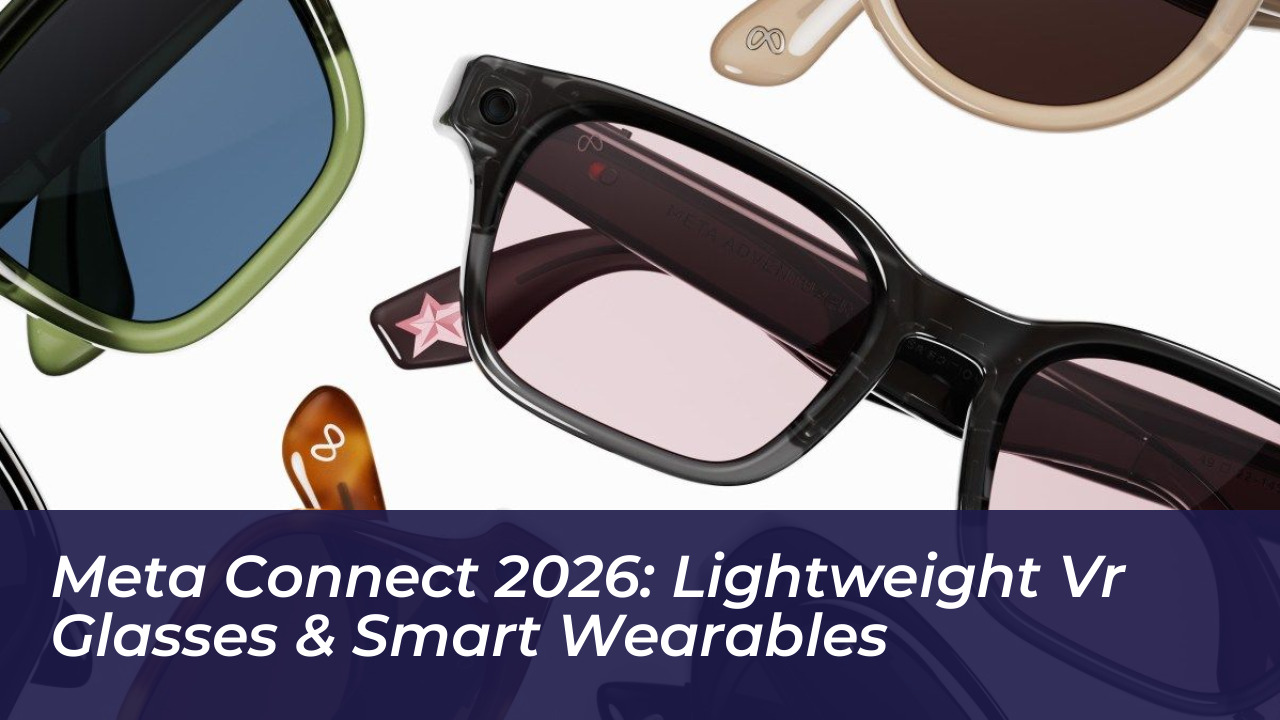
Meta unveiled its most ambitious hardware roadmap to date at the annual Meta Connect showcase in Menlo Park, California. The announcements center on closing the gap between bulky virtual reality headsets and everyday fashion eyewear. By separating the computing architecture from the display optics, engineers have engineered hardware that challenges the dominance of premium mixed-reality competitors while addressing mounting industry privacy concerns. The headline announcement introduces a revolutionary 100-gram virtual reality device designed to rival high-end enterprise displays. Alongside this ultra-lightweight headset, Meta expanded its collaboration with EssilorLuxottica, rolling out new Ray-Ban smart glasses variations that directly target privacy backlash through camera-free audio designs.
- Introduction to Meta Connect 2026 Announcements
- Engineering the 100-Gram Meta VR Glasses
- Decoupling Compute Power from Optical Frames
- Hardware Specifications and Performance Metrics
- IMAX Enhanced Certification and Ergonomic Design
- Productivity and Entertainment Ecosystem
- Multi-Monitor Workspaces and Virtual Desks
- Cinematic Immersion and Disney Partnerships
- Photorealistic Digital Avatar Generators
- Ray-Ban Smart Glasses Portfolio Expansion
- Addressing Public Privacy Concerns
- Ray-Ban Meta Audio AI Variant
- Hardware Security and Tamper Detection
- Smart Wearable Pricing and Availability Matrix
- Market Positioning and Strategic Gaps
- Enterprise and Consumer Impact
- Ergonomic Shifts and Neck Strain Reduction
- Corporate and Educational Privacy Compliance
- Backward Compatibility with Quest Libraries
Introduction to Meta Connect 2026 Announcements
The annual gathering in Menlo Park marked a turning point for the spatial computing industry. For years, manufacturers chased standalone power by packing every processor, fan, and battery directly onto the user face. Meta chose a different path for 2026, shifting focus toward lightweight wearable tech that mimics standard fashion frames. This strategy closes the physical gap between heavy immersive headsets and the glasses people wear on the street every single day.
Industry analysts point out that social acceptance remains the biggest hurdle for spatial computing. By shrinking the optical frames down to a featherlight profile, Meta successfully removes the stigma of wearing awkward technology in public spaces. The shift redefines what consumers expect from wearable displays, setting a new benchmark for ergonomics and all-day comfort.
Engineering the 100-Gram Meta VR Glasses
Decoupling Compute Power from Optical Frames
Traditional virtual reality headsets force users to balance heavy batteries and processing chips directly on their faces. Meta dismantled this design paradigm by shifting the heavy computing components into a separate, pocketable compute puck weighing 300 grams. This tethered puck houses a high-performance processor and a dedicated three-hour battery pack, leaving the facial interface remarkably light and balanced.
The tethered cable connecting the puck to the glasses is thin, flexible, and virtually unnoticeable during standard movement. This physical separation prevents thermal heat buildup against the skin, solving a major complaint from early virtual reality adopters. Users can slip the compute puck into a jacket pocket or briefcase while experiencing full spatial computing power.
Hardware Specifications and Performance Metrics
The optical frame weighs a mere 100 grams while delivering enterprise-grade performance. Inside the compute puck sits a high-performance Qualcomm Snapdragon Reality Elite processor paired with 12GB of RAM and 128GB of internal storage. Visuals are powered by dual 5K micro-OLED displays that deliver an impressive 37 pixels per degree.
Display clarity is further elevated by a smooth 120Hz refresh rate, which eliminates motion blur during fast-paced interactions. The magnesium alloy frame relies on transparent optical pass-through technology. This allows wearers to maintain situational awareness while viewing crisp virtual workspace windows overlaid on the physical room.
IMAX Enhanced Certification and Ergonomic Design
The hardware earns distinction as the first IMAX Enhanced certified virtual reality device on the market. This certification guarantees color accuracy, high dynamic range, and acoustic alignment that matches commercial cinema standards. The magnesium alloy frame provides structural integrity without adding unnecessary mass.
Engineers paid close attention to weight distribution and facial pressure points. Because the heavy batteries reside in the pocketable puck, the optical frame rests comfortably on the nose and ears without causing red marks or tension headaches. Users can wear the device for hours without experiencing physical fatigue.
Productivity and Entertainment Ecosystem
Multi-Monitor Workspaces and Virtual Desks
Professional users can connect the hardware directly to Windows or Mac laptops, transforming the device into a sprawling multi-monitor virtual workspace. Integrated eye-tracking and advanced hand-gesture controls eliminate the need for physical controllers during standard productivity tasks.
Typing is supported by a virtual desk keyboard projection feature. Users simply look at a physical desk surface, and a responsive virtual keyboard tracks finger movements for rapid data entry without requiring external hardware peripherals.

Cinematic Immersion and Disney Partnerships
Entertainment takes center stage with support for high-resolution 3D movie streaming and live sports broadcasting. A strategic partnership with Disney brings custom immersive environments to the platform at launch. These dynamic landscapes surround a virtual theater screen, letting viewers watch blockbusters from inside iconic cinematic universes.
Spatial audio drivers built directly into the temple arms deliver directional sound without blocking out ambient room noise. This acoustic transparency ensures users stay connected to their immediate environment while enjoying cinematic soundtracks.
Photorealistic Digital Avatar Generators
Remote communication receives a massive upgrade through real-time holographic face renders. The onboard sensors capture facial expressions and eye movements, generating photorealistic digital avatars for professional video conferences and virtual meetings.
These avatars bypass the cartoonish look of older social virtual reality platforms. Colleagues see accurate micro-expressions and natural eye contact, making remote collaboration feel remarkably personal and engaging.
Ray-Ban Smart Glasses Portfolio Expansion
Addressing Public Privacy Concerns
Public scrutiny surrounding recording devices in public spaces has slowed mainstream adoption for smart eyewear. People worry about unauthorized video capture in restaurants, locker rooms, and private offices. Meta responded by diversifying its wearable lineup to include privacy-first audio variants.
This hardware pivot secures mainstream adoption by giving consumers options that respect the social boundaries of those around them. Removing cameras from specific models eliminates surveillance anxiety entirely.
Ray-Ban Meta Audio AI Variant
The Ray-Ban Meta Audio AI glasses omit the camera entirely, relying strictly on open-ear directional speakers and microphone arrays. Users can make phone calls, listen to music, and interact with the onboard Meta AI assistant without a single lens recording the room.
Battery life benefits significantly from the absence of power-hungry camera sensors, delivering up to 12 hours of continuous audio playback and assistant queries on a single charge.
Hardware Security and Tamper Detection
For models that retain cameras, Meta implemented stricter physical safeguards. Brighter LED warning indicators flash persistently during active recordings and live-streaming sessions to alert nearby individuals.
Enhanced tampering detection firmware automatically disables capture functions if users attempt to tape over or physically obstruct the warning indicator light. This proactive approach builds trust with the public and regulatory bodies alike.
Smart Wearable Pricing and Availability Matrix
Meta structured its pricing strategy to appeal to casual tech buyers and enterprise professionals alike. The hardware rollout spans multiple tiers, balancing advanced AI features with accessible price points.
- Ray-Ban Meta Audio AI: Camera-free audio and assistant functionality, up to 12 hours battery life, estimated at $350 to $400.
- Ray-Ban Meta Gen 3: Integrated camera system with Dolby Atmos audio, up to 9 hours battery life, estimated at $450 to $500.
- Meta Ray-Ban Display: Built-in virtual display in the right lens for standard day use, priced at $950 and expanding to the UK, Canada, and Europe.
Market Positioning and Strategic Gaps
While competitors focus on standalone untethered headsets suffering from severe thermal and weight constraints, Meta chose a modular tethered approach to achieve an industry-leading weight reduction. Priced at $1,299.99 with a scheduled release window of spring 2027, the lightweight virtual reality glasses occupy a strategic middle ground.
This placement targets the gap between casual consumer gaming gear and expensive enterprise spatial computing systems like the Apple Vision Pro. By avoiding the heavy cost and facial bulk of standalone processors, Meta opens spatial computing to a much broader audience.
Enterprise and Consumer Impact
Ergonomic Shifts and Neck Strain Reduction
Removing the battery and processor from the facial interface successfully eliminates neck strain during extended work sessions. Office workers and creative professionals can use the displays all day without experiencing the fatigue associated with first-generation headsets.
Corporate and Educational Privacy Compliance
Offering camera-free audio smart eyewear opens doors to corporate environments and schools that strictly ban recording devices. Employees can wear the audio-assisted frames in sensitive meeting rooms without triggering compliance violations.
Backward Compatibility with Quest Libraries
Developers maintain seamless transitions thanks to full backward compatibility with existing Quest software libraries. Teams do not need to rewrite applications from scratch to support the new optical format, ensuring a robust library of apps available on day one.