Meta unveiled quest VR glasses and camera free smart spectacles during a major keynote presentation at Menlo Park, California, marking a massive turning point for personal computing hardware. Industry leaders and technology enthusiasts tuned in as the company laid out solutions to chronic consumer complaints regarding heavy headsets, clunky form factors, and growing privacy anxieties in public spaces.
- Introduction to Meta Connect 2026 Hardware Announcements
- Engineering the Next Evolution of Virtual Reality
- Magnesium Alloy Frame and Ultra-Lightweight Goggle Design
- Visual Fidelity via 5K Micro-OLED Displays
- Pocketable Compute Puck Architecture
- Immersive Entertainment and Productivity Features
- Cinematic Partnerships and IMAX Enhanced Certification
- Spatial Workspaces and Cloud Gaming Support
- Addressing Privacy Backlash with Camera-Free Smart Glasses
- Ray-Ban Meta Audio Smart Glasses
- Extended Battery Life and Public Space Utility
- Third-Generation Ray-Ban Meta and Display Expansions
- Upgraded Camera Frames and Dolby Atmos Audio
- Ray-Ban Meta Display Rollout
- Competitive Landscape in the Wearable Tech Sector
- Market Dominance and IDC Shipment Data
- Rival Strategies from Apple, Google, Samsung, and Snap
Introduction to Meta Connect 2026 Hardware Announcements
Mark Zuckerberg took the stage on September 23, 2026, to introduce a radical shift in consumer tech engineering. Meta revealed a refreshed product suite designed to tackle the physical strain of extended virtual reality sessions and the societal backlash surrounding camera-equipped wearables. This strategy splits into ultra-lightweight virtual reality gear and privacy-conscious audio glasses.
The announcements come at a pivotal turning point for the wearable technology market. Rival tech giants are aggressively jockeying for market share as spatial computing becomes mainstream. Meta aims to solidify its position as the global market leader by addressing core user friction points directly through hardware redesigns and software integrations.
Engineering the Next Evolution of Virtual Reality
Magnesium Alloy Frame and Ultra-Lightweight Goggle Design
The standout hardware announcement is the new Meta VR Glasses, priced at $1,299.99 with a North America, Europe, and Asia release scheduled for spring 2027. Moving away from the plastic, front-heavy construction of legacy headsets, this new iteration uses a sturdy yet minimal magnesium alloy frame. Weighing roughly 100 grams, the goggle form factor rests comfortably on the bridge of the nose, eliminating the need for a top headstrap entirely.
This design choice transforms how users interact with extended reality by removing physical neck fatigue. Wearers can engage in hours of immersive experiences without feeling the pull of heavy front visors. The streamlined profile makes packing and traveling with enterprise-grade spatial hardware easier than ever before.
Visual Fidelity via 5K Micro-OLED Displays
Visual fidelity gets a major upgrade through internal dual micro-OLED displays. Each eye receives a crisp resolution of 2412 x 2288 pixels, achieving an impressive 37 pixels per degree. This optical clarity dramatically reduces screen-door effects and renders crisp text that easily rivals expensive enterprise headsets.
Engineers focused heavily on sharpness to make long reading and coding sessions viable inside virtual environments. Text remains legible even at small font sizes, opening up new avenues for professional workflows. The panels deliver deep contrast ratios and vibrant color reproduction for both gaming and cinema applications.
Pocketable Compute Puck Architecture
To maintain this ultra-light weight on the face, engineers offloaded all heavy computing hardware, storage, and the battery pack into a pocketable 300-gram compute puck. Connected by a discreet cable, the puck provides approximately three hours of continuous use on a single charge while keeping thermal heat away from the user’s face.
This separation of processing power and display optics represents a major engineering breakthrough for mobile computing. Users simply slip the puck into a jacket pocket or clip it to a waistband. The hardware architecture successfully balances high-end performance with ergonomic comfort.
Immersive Entertainment and Productivity Features
Cinematic Partnerships and IMAX Enhanced Certification
While fully compatible with the vast existing Quest software catalog, the new VR glasses lean heavily into productivity and cinematic entertainment. Meta secured a high-profile partnership with Disney+ to launch an immersive viewing experience. Users can watch movies surrounded by 3D virtual landscapes drawn from popular franchises on what the company claims is the first IMAX Enhanced-certified virtual reality device.
The cinematic mode replicates the grandeur of a commercial movie theater inside a personal living room. Spatial audio integration ensures sound moves dynamically around the viewer. Blockbuster films gain a new depth that standard flat screens simply cannot replicate.
Spatial Workspaces and Cloud Gaming Support
For remote work, the device projects multiple virtual windows into the physical workspace. Users can connect their Mac or PC to mirror displays, utilize eye-tracking, and execute hand-gesture controls smoothly. Physical desks and tables transform into virtual keyboards via spatial tracking, though traditional Bluetooth accessories and Microsoft Xbox Cloud Gaming remain fully supported for entertainment.
Remote teams can collaborate inside shared virtual offices as if they sat across the same physical table. Latency remains exceptionally low thanks to advanced Wi-Fi and processing protocols inside the compute puck. Gamers also benefit from high frame rates when streaming titles directly from cloud servers.
Addressing Privacy Backlash with Camera-Free Smart Glasses
Ray-Ban Meta Audio Smart Glasses
Smart glasses face mounting public scrutiny and regulatory hurdles over surreptitious video recording. Critics frequently label camera-equipped wearables as spy glasses, prompting various municipalities and businesses to restrict their use. Meta directly addresses this consumer anxiety by introducing the Ray-Ban Meta Audio smart glasses.
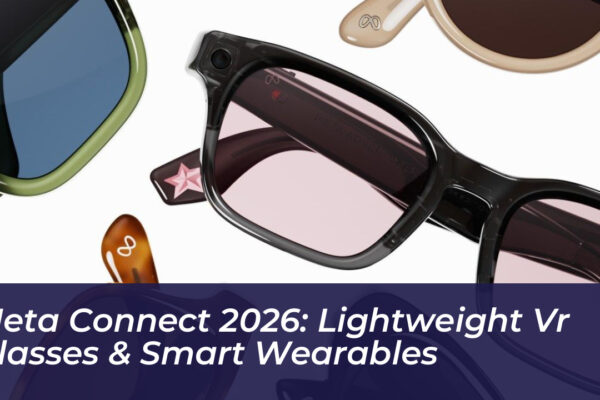
Priced at £319 (€349 / approximately $349), these spectacles remove the camera entirely. Built using classic Clubmaster and Burbank styles, the audio-only frames feature discrete microphones and open-ear speakers for phone calls, music playback, and interacting with the new Muse AI agent without capturing visual media.
Extended Battery Life and Public Space Utility
Eliminating camera hardware slims the chassis and extends battery life up to 12 hours on a single charge. Users can enjoy continuous audio and voice assistance without triggering privacy alarms in public spaces or violating venue restrictions. This audio-focused approach opens up markets where camera wearables face strict bans.
The frames remain indistinguishable from traditional designer eyewear. Wearers can listen to podcasts, take phone calls, and talk to AI assistants while walking down busy streets. The lack of lenses that record video puts skeptical onlookers completely at ease.
Third-Generation Ray-Ban Meta and Display Expansions
Upgraded Camera Frames and Dolby Atmos Audio
Meta is not abandoning camera technology completely. The company also debuted the third-generation Ray-Ban Meta glasses, retailing at £409 (€449 / approximately $449) for users wanting integrated optics. These upgraded camera frames feature enhanced microphone arrays, Dolby Atmos audio support, and a longer battery life of up to nine hours.
, Meta improved its LED recording indicator lights and tamper-detection algorithms to prevent users from masking recording lights during live streams. These security measures help maintain public trust while satisfying content creators who rely on POV recording tools.
Ray-Ban Meta Display Rollout
The Ray-Ban Meta Display smart glasses, which feature a virtual heads-up display embedded directly in the right lens, launched in the UK and Canada for £749 (CA$1,149). European rollouts across France, Germany, and Italy follow shortly at €899, bringing ambient visual notifications directly into everyday eyewear.
Users can view turn-by-turn directions, read incoming text messages, and check calendar alerts without pulling out a smartphone. The heads-up display remains invisible to outside observers. This discreet notification system keeps wearers connected to their digital lives while staying present in the physical world.
Competitive Landscape in the Wearable Tech Sector
Market Dominance and IDC Shipment Data
Market data from the International Data Corporation (IDC) highlights Meta as the dominant player in smart glasses, commanding 68.7 percent of global shipments in the second quarter of 2026. However, competition intensifies as rival tech giants enter the space.
| Device Name | Estimated Price | Core Feature | Target Release |
|---|---|---|---|
| Meta VR Glasses | $1,299.99 | 5K Micro-OLED, 100g goggle design, compute puck | Spring 2027 |
| Ray-Ban Meta Audio | $349.00 | Camera-free, 12-hour battery, Muse AI agent | Available Now |
| Ray-Ban Meta Gen 3 | $449.00 | Upgraded cameras, Dolby Atmos, 9-hour battery | Available Now |
Rival Strategies from Apple, Google, Samsung, and Snap
Samsung and Google are preparing to launch competing hardware running Android XR, utilizing frames designed by fashion brands like Warby Parker and Gentle Monster. Meanwhile, Snap continues marketing its expensive Specs AR glasses, and Apple reportedly prepares a lightweight smart eyewear release for late 2027.
Meta’s dual-pronged hardware strategy, targeting lightweight spatial computing for productivity on one side and privacy-first audio glasses on the other, positions the company to defend its market dominance against upcoming enterprise challenges. The wearable tech sector enters a fierce battleground where comfort, fashion, and privacy dictate consumer loyalty.