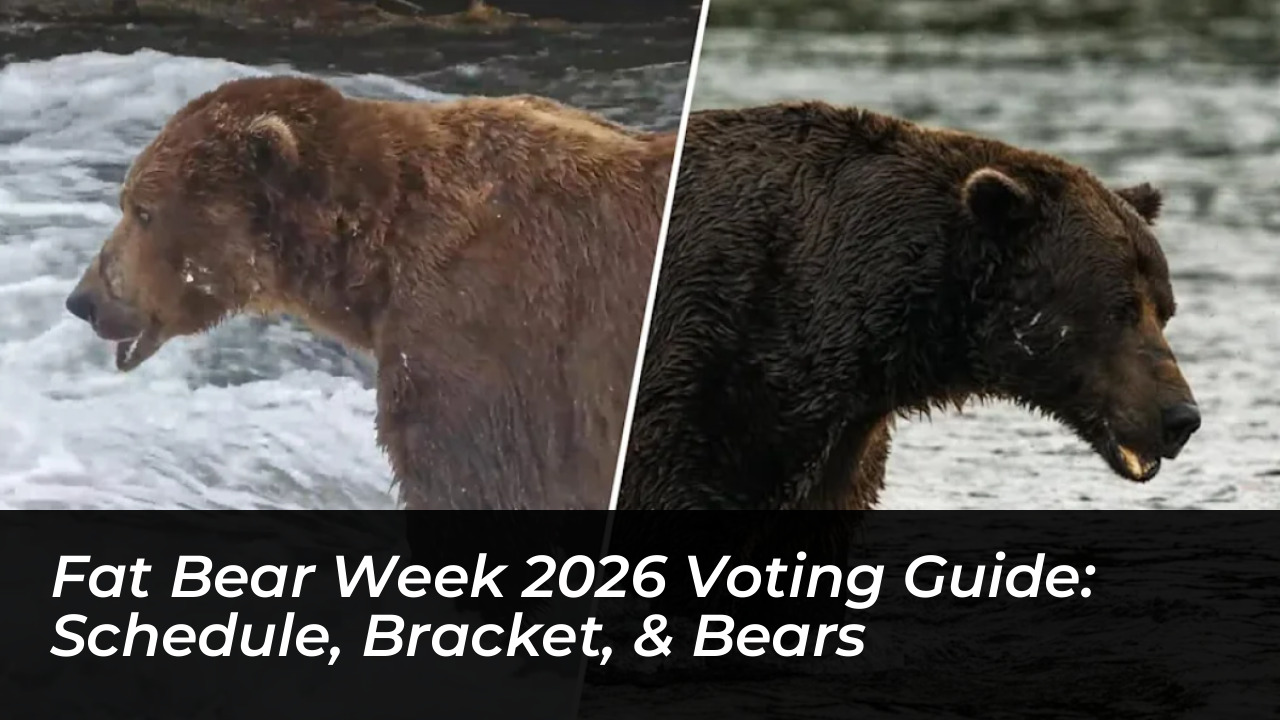
Katmai National Park and Preserve in Alaska officially kicked off Fat Bear Week 2026 on Tuesday, September 22. This annual celebration of ursine girth and survival resilience expands its single-elimination tournament to a robust field of 16 brown bears. Organizers extended first-round voting through Wednesday, September 23, following overwhelming online traffic that temporarily crashed the official voting system. This high-volume digital surge pushed second-part matchups to Thursday, September 24.
- The 2026 Tournament Bracket and Schedule Adjustments
- Opening Day Technical Glitches and Server Fixes
- Official 2026 Voting Timeline
- Meet the Top Contenders of 2026
- Defending Champion 32 Chunk
- Bear 132 and Family Brackets
- Subadults and Rising Rivals
- The Science of Survival: Why Bears Must Bulk Up
- Sockeye Salmon Runs and Caloric Intake
- Physiological Transformations During Hibernation
- Understanding Ursine Hyperphagia and River Dominance
- Interactive Fan Engagement and Conservation Support
- Live Cams and Tournament Bingo
- The Otis Fund and Conservation Donations
- Frequently Asked Questions About Fat Bear Week 2026
- Where can I vote for Fat Bear Week 2026?
- Why was voting delayed on opening day?
- How do brown bears gain so much weight?
- Are mother bears allowed to compete with their cubs?
- What happens after the winner is crowned?
Millions of wildlife enthusiasts globally tune in to evaluate before and after transformations, turning a localized park initiative into a worldwide phenomenon. The National Park Service established the event in 2014 as a single-day showcase to educate the public on local wildlife dynamics. By 2025, the tournament drew more than 1.7 million votes from over 100 countries. Media partner Explore.org hosts live webcams allowing the public to monitor the animals along Brooks Falls as online voting continues daily through September 29, 2026.
The 2026 Tournament Bracket and Schedule Adjustments
The 2026 competition introduces a larger, more competitive bracket featuring 16 individual entries, including family groups competing together for the first time. Katmai National Park counted a record 37 cubs across 19 bear families this summer, with five of those families making the final tournament cut. Polls remain open daily from noon to 9 p.m. Eastern time, corresponding to 9 a.m. to 6 p.m. Pacific time and 8 a.m. to 5 p.m. in Alaska.
The tournament format relies on public participation through online brackets. Voters compare photographic evidence of physical changes from early summer to late autumn to decide which bear best mastered the art of hyperphagia.
Opening Day Technical Glitches and Server Fixes
- A massive global traffic surge on September 22 temporarily overwhelmed the voting servers, drawing international attention to the sheer popularity of the event.
- Explore.org quickly transitioned to a high-capacity platform and extended first-round voting through September 23 to accommodate all eager voters.
Official 2026 Voting Timeline
- September 22 and 23: First-round matchups, featuring rescheduled initial votes due to system crashes.
- September 24: Second-part first-round matchups conclude.
- September 25: All four quarterfinal matches take place.
- September 26 and 27: Weekend pause with no active voting.
- September 28: Semifinal round, determining the Final Fat Four.
- September 29: The championship match, known as Fat Bear Tuesday, crowning the winner at 5 p.m. Alaska time.
Meet the Top Contenders of 2026
The 2026 field highlights the rich biological diversity of Katmai National Park, home to an estimated 2,200 brown bears across its 4.2 million acres. Voters evaluate contenders based on physical transformation, survival challenges, and individual life histories. Each bear faces distinct hurdles in securing the calories needed for winter.
The competition brings fan favorites back to the riverbanks alongside new challengers. Observers track these animals closely via live webcams all summer long.
Defending Champion 32 Chunk
The reigning 2025 champion is a massive adult male weighing in excess of 1,200 pounds. Chunk secured his previous victory despite recovering from a broken jaw, cementing his status as a dominant force along Brooks River.
Bear 132 and Family Brackets
At 21 years old, Bear 132 ranks among the oldest competitors. She successfully raised three cubs while still packing on enough personal mass to compete. For the first time, mother bears and their offspring share spotlight brackets, showcasing maternal resilience in an ecosystem where rearing cubs requires immense caloric expenditure.
Subadults and Rising Rivals
Contenders like 151 Walker leverage pear-shaped builds to navigate the river hierarchy. Meanwhile, younger bears like 164 Bucky capitalize on prime fishing locations near the waterfall plunge pool to secure sockeye salmon leaping upstream.
The Science of Survival: Why Bears Must Bulk Up
Fat Bear Week is far more than a popular internet poll. It serves as an educational outreach tool for the National Park Service and the Katmai Conservancy. The underlying biology involves extreme physiological adaptation and survival mechanics.
Without successful fat accumulation, bears cannot survive the harsh winter months. The ecosystem of Katmai provides the exact resources these animals need to achieve extreme mass.
Sockeye Salmon Runs and Caloric Intake
- Brown bears in Katmai consume up to 30 fish per day during peak sockeye salmon runs.
- Bears supplement their heavy fish diet with berries, sedges, and other high-energy foods found throughout the park.
Physiological Transformations During Hibernation
- An adult male brown bear typically weighs between 600 and 900 pounds in midsummer, climbing to over 1,000 to 1,200 pounds by late autumn.
- During the four-to-six-month hibernation period, bears neither eat nor drink, losing roughly one-third of their total body weight.
Understanding Ursine Hyperphagia and River Dominance
Hyperphagia triggers an insatiable feeding drive in brown bears during the late summer and autumn months. Bears dedicate nearly every waking hour to hunting salmon and foraging across tundra landscapes. River dominance dictates which bears secure the prime fishing spots along Brooks Falls. Larger adult males typically claim the best waterfall ledges, forcing subordinates to fish in less optimal downstream locations. Despite social hierarchies, even younger bears manage to consume massive amounts of protein. This seasonal feeding frenzy represents an evolutionary necessity for winter survival.
Interactive Fan Engagement and Conservation Support
Beyond casting ballots at the official site, enthusiasts engage with the event through immersive companion activities. Fans print out tournament brackets to predict winners, tracking their accuracy as matchups progress.
Explore.org provides live-cam bingo cards where viewers watch live streams of Brooks River and check off specific wildlife behaviors. These activities foster a global community dedicated to wildlife appreciation and park stewardship.
Live Cams and Tournament Bingo
- Media partner Explore.org hosts live webcams allowing the public to monitor the animals along Brooks Falls continuously.
- Viewers use live-cam bingo cards to track behaviors like salmon-stealing, cub-training, and aggressive posturing.
The Otis Fund and Conservation Donations
Through October 3, Explore.org matches public donations directed toward the Katmai Conservancy’s Otis Fund, named in honor of the legendary bear 480 Otis. These funds directly support park research and education initiatives.
Frequently Asked Questions About Fat Bear Week 2026
Where can I vote for Fat Bear Week 2026?
Official voting takes place daily through September 29, 2026, at fatbearweek.org. Voters review before-and-after photographs and select the bear that best represents successful weight gain and winter preparation.
Why was voting delayed on opening day?
An unprecedented surge of global online traffic temporarily overwhelmed the voting servers on Tuesday, September 22. Organizers extended first-round voting through Wednesday, September 23, and shifted to a high-capacity platform to ensure uninterrupted balloting.
How do brown bears gain so much weight?
Katmai National Park features some of the largest sockeye salmon runs in the world. Bears gorge themselves on migrating fish, consuming massive quantities of calories daily to build thick fat layers necessary for months of winter hibernation.
Are mother bears allowed to compete with their cubs?
Yes. The 2026 tournament features family brackets for the first time, allowing mother bears and their spring cubs to compete as a unit, highlighting the unique dual challenge of maternal rearing and personal weight gain.
What happens after the winner is crowned?
Following the championship reveal on September 29, winning bears retreat to upland dens to begin their multi-month hibernation. Park rangers continue monitoring local wilderness areas to protect resting wildlife.