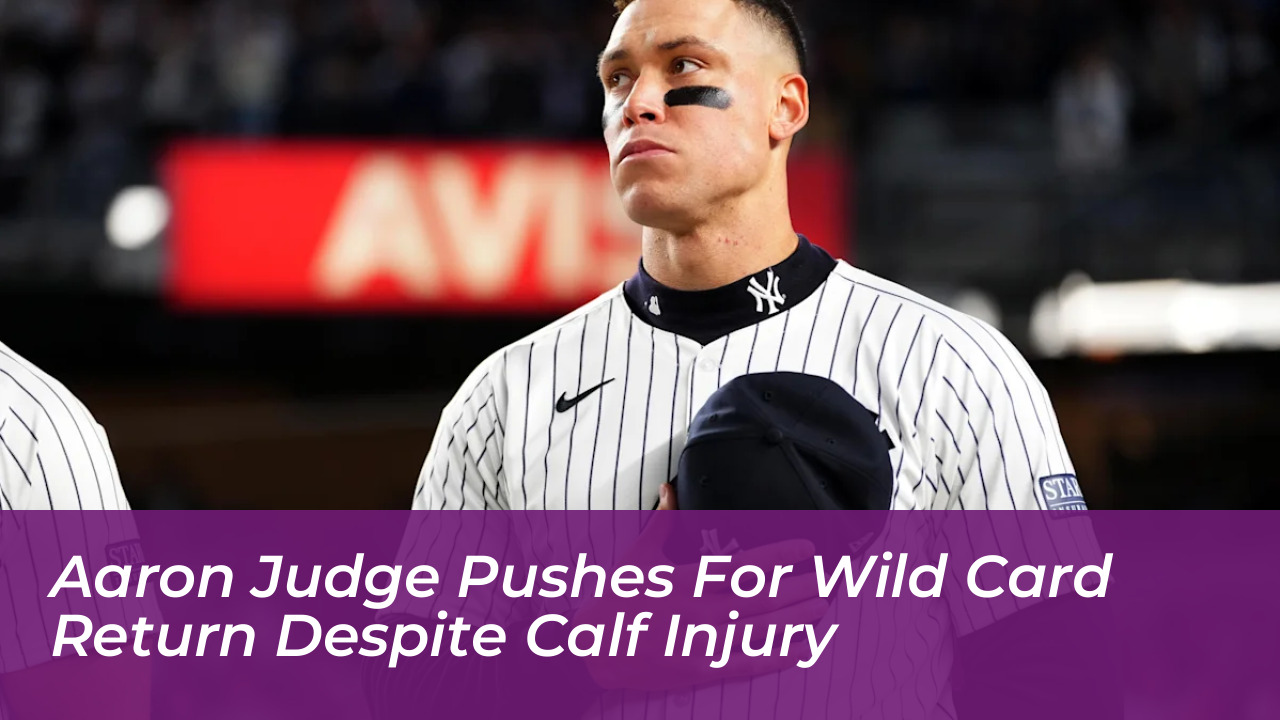
New York Yankees captain Aaron Judge is pushing back against organizational caution as the postseason approaches rapidly. Following a right calf strain that landed him on the Injured List, the superstar outfielder stated his clear intention to play in the American League Wild Card Series. This stance puts him at odds with manager Aaron Boone, who previously cast doubt on the slugger’s availability for the opening round at Yankee Stadium. The disagreement creates notable tension within the clubhouse as the Yankees prepare for high-stakes October baseball, forcing the medical staff to weigh competitive urgency against severe physical risks.
- The Anatomy of Aaron Judge’s Calf Injury
- Understanding the Soleus Muscle Strain
- Conflicting Recovery Timelines
- Medical Risks and Biomechanical Realities
- Clash of Perspectives: Captain Versus Management
- Aaron Judge Resists the Spectator Role
- Navigating Clubhouse Tension
- High-Stakes Roster Implications for the Yankees
- The Cost of Accelerated Return and Roster Rules
- Testing Depth After an Injury-Plagued Season
- Frequently Asked Questions
- What specific injury sidelined Aaron Judge?
- Why is Aaron Boone’s timeline different from Aaron Judge’s?
- What medical treatment did Aaron Judge receive?
- Can Aaron Judge play in the Wild Card round if he misses Game 1?
The Anatomy of Aaron Judge’s Calf Injury
Understanding the Soleus Muscle Strain
Judge sustained the right calf strain during a game in Minnesota, forcing him back to the sidelines shortly after returning from a lengthy absence due to a fractured rib. An MRI revealed a strain in the soleus muscle, which is a critical lower-calf component required for explosive movements. Baseball players rely heavily on the soleus for sprinting down the line, rounding bases, and tracking fly balls in the outfield.

Without full functionality in this specific muscle, a player loses the primary propulsion needed for maximum acceleration. Lower-body mechanics depend on the calf complex to absorb force upon landing and transfer power during rotation. When this area is compromised, the entire swing plane and running stride suffer noticeable alterations.
Conflicting Recovery Timelines
Manager Aaron Boone described the injury as moderate, noting that the organization was planning to operate without their captain for the start of the postseason. Traditional sports medicine timelines for a moderate soleus strain typically range from two to six weeks of rest, rehabilitation, and gradual progression. This creates an immediate chasm between the dugout leadership and the player.
Standard protocols dictate conservative rehabilitation to prevent scar tissue buildup and chronic weakness. Boone must plan a roster based on worst-case medical scenarios, while Judge views the recovery timeline as a flexible target rather than a strict boundary. This friction shapes daily dugout strategy.
Medical Risks and Biomechanical Realities
Medical experts warn about the high risks of rushing back from a soleus muscle strain. Dr. Robert Trasolini of Northwell Health explained the mechanical risks to media outlets, noting that a player who cannot run effectively becomes an offensive and defensive liability. If a player returns too soon without full lower-body functionality, the risk of a severe setback increases significantly.

A minor tear can easily transform into a complete rupture if subjected to the explosive torque of major league competition. The front office understands that a compromised Judge provides less value than a healthy replacement player operating at full capacity. Managing these physical strains requires careful evaluation.
Clash of Perspectives: Captain Versus Management
Aaron Judge Resists the Spectator Role
Despite medical warnings and Boone’s public caution, Judge operates on a different internal timeline. Speaking to reporters at Yankee Stadium, the three-time MVP expressed confidence in his recovery trajectory following a Platelet-Poor Plasma injection administered to accelerate soft tissue healing. His primary objective centers entirely on returning for Game 1, regardless of standard recovery windows.
When informed that moderate strains require weeks of healing, Judge remarked that every player’s definition of moderate differs. He refuses to accept a spectator role for the opening series. The slugger draws parallels to teammate Giancarlo Stanton’s past struggles with lower-body strains, noting that sheer willpower often supersedes conventional recovery metrics in playoff environments.
Navigating Clubhouse Tension
Judge defended Boone’s public statements while maintaining his personal competitive drive, emphasizing that player and manager simply view the situation from different vantage points. This dynamic creates a delicate balancing act inside the clubhouse. The team feeds off the energy and leadership of their captain, making his presence on the field an emotional catalyst.
Coaching staff members must manage the psychological impact of his potential absence while keeping the active roster focused on immediate game execution. Open communication channels prevent friction from turning into distraction. Ultimately, both parties share the same ultimate goal of winning a championship, even if they disagree on the safest path to the starting lineup.
High-Stakes Roster Implications for the Yankees
The Cost of Accelerated Return and Roster Rules
Major League Baseball postseason roster regulations dictate that if a player misses the Wild Card round due to injury, they remain ineligible until the Division Series. This rule forces a hard deadline on the medical evaluation process. If Judge cannot prove his fitness before the submission window closes, the Yankees must commit to playing the entire short series without him.
This stark regulatory framework fuels Judge’s urgency to beat the medical odds. The front office faces a delicate decision regarding risk management. While the allure of having the team’s offensive engine on the field for Game 1 is undeniable, pushing a player through a soleus strain risks a complete tear that sidelines him for the remainder of October.
Testing Depth After an Injury-Plagued Season
The timing of the injury tests the depth of a Yankees roster that spent a significant portion of the season navigating major absences. Judge returned from his rib fracture directly into major league action without a minor league rehab assignment, appearing in a handful of games before going down in Minnesota. In those brief plate appearances, he collected four hits in 23 at-bats with one home run and 13 strikeouts.
Reserves and bench players must step into elevated roles if the captain cannot beat the clock. The organization built its postseason depth precisely for scenarios involving key injuries, but replacing an elite bat remains an impossible task for any single substitute. The collective lineup must compensate for the potential loss of production.
Frequently Asked Questions
What specific injury sidelined Aaron Judge?
Aaron Judge suffered a strain in the soleus muscle, located in the lower portion of his right calf, during a game in mid-September. This injury severely impacts sprinting and rotational power.
Why is Aaron Boone’s timeline different from Aaron Judge’s?
Manager Aaron Boone labeled the injury as moderate and noted the team was planning to start the Wild Card Series without him, aligning with standard two to six week recovery windows. Judge insists he is healing quickly and aims to defy that timeline.
What medical treatment did Aaron Judge receive?
Judge received a Platelet-Poor Plasma injection in his right calf to accelerate the natural healing process of the strained muscle tissue.
Can Aaron Judge play in the Wild Card round if he misses Game 1?
If Judge is left off the initial Wild Card roster due to injury status, league rules prevent him from participating in that round entirely, meaning he must wait until the ALDS if the team advances.