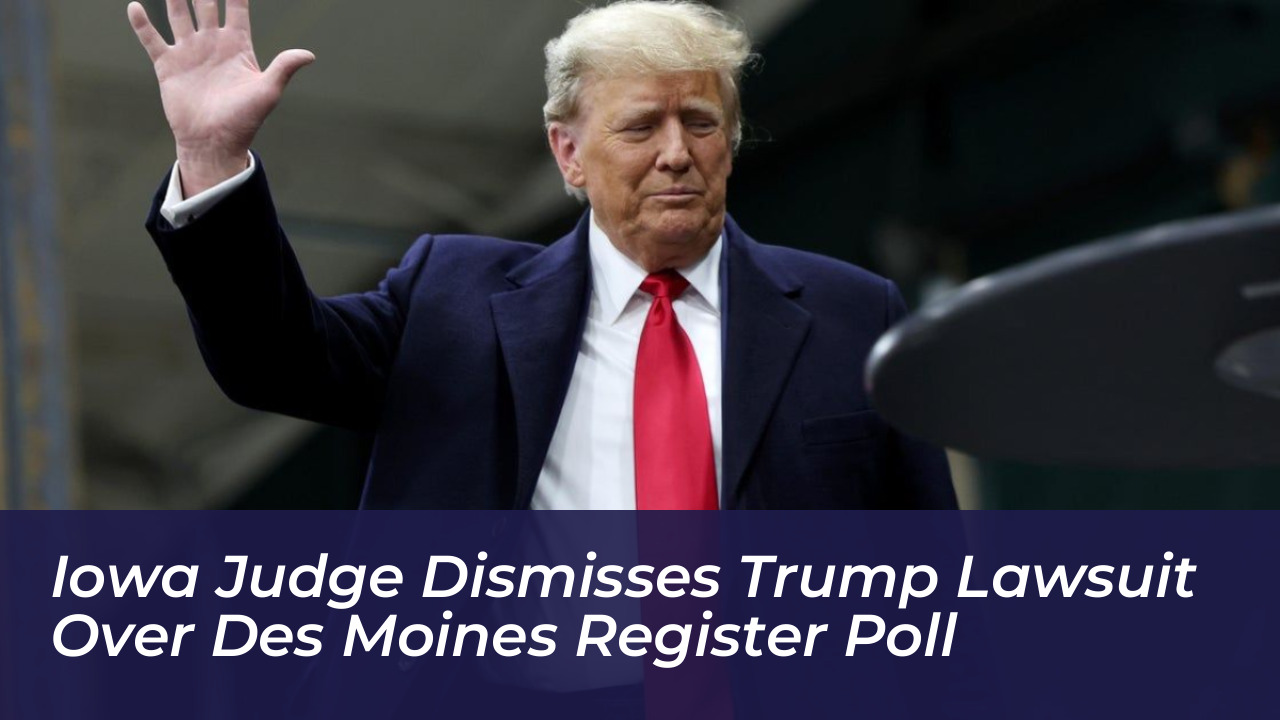
An Iowa district judge dismissed a high-profile lawsuit brought by Donald Trump against the Des Moines Register and former pollster J. Ann Selzer on September 23, 2026. This legal battle began after an October 2024 Iowa Poll showed unexpected political shifts in the state just before the presidential election. District Court Judge Scott J. Beattie threw out the case with prejudice, establishing that pre-election polling coverage and political surveys enjoy the highest category of First Amendment protection.
- Introduction
- Background of the Controversy
- The October 2024 Iowa Poll
- The Legal Challenge
- Core Rulings by Judge Scott J. Beattie
- Dismissal With Prejudice
- First Amendment Protections for Journalism
- Dismantling the Iowa Consumer Fraud Act Claims
- Absence of Commercial Transaction
- Lack of Reliance and Methodological Realities
- Broader Implications for Press Freedom
- Reactions from Defense Counsel and Publishers
- Precedents for Future Political and Media Litigation
- Conclusion
Introduction
The dismissal of the lawsuit marks a definitive chapter in a year-long dispute over the boundaries of free speech and media accountability. When the Des Moines Register published its final pre-election survey in October 2024, the results sent shockwaves across the political landscape by showing Vice President Kamala Harris leading Donald Trump in Iowa. The public pushback from the Trump campaign and allied politicians was immediate, leading directly to the filing of a civil lawsuit.

District Judge Scott J. Beattie firmly protected journalistic freedom by ruling that pre-election polling constitutes core protected speech. The court’s decision closes the door on attempts to weaponize consumer protection statutes against news organizations. By analyzing the intersection of journalism, statistics, and constitutional law, the court delivered a strong defense of independent reporting in modern politics.
Background of the Controversy
The October 2024 Iowa Poll
The controversy centers on the final pre-election survey published by the Des Moines Register and conducted by veteran pollster J. Ann Selzer. For decades, the Iowa Poll maintained a reputation for remarkable accuracy, often capturing late-breaking shifts in voter sentiment that other surveys missed. The October 2024 iteration showed Harris leading Trump by three percentage points among likely voters, a result that directly contradicted most other public and private polling aggregates at the time.
The publication of these numbers generated intense national debate. Supporters of the Trump campaign viewed the numbers as an outlier designed to influence voter behavior and dampen fundraising momentum. Alongside Donald Trump, co-plaintiffs U.S. Representative Mariannette Miller-Meeks and former state Senator Brad Zaun joined the public outcry, arguing that the survey distorted the electoral playing field and harmed their respective political standing.
The Legal Challenge
Following the election, the plaintiffs formalized their grievances by filing a lawsuit alleging fraud and intentional manipulation of voter behavior. The legal complaint argued that the poll functioned as a faulty commercial product that damaged fundraising capabilities and campaign standing. Attorneys for the plaintiffs sought to hold the newspaper and the pollster liable under state consumer protection laws for publishing data they claimed was knowingly inaccurate.
Before reaching the final merits, the case underwent lengthy jurisdictional battles. Attorneys spent nearly a year contesting whether the matter belonged in state or federal court. Once the litigation landed in front of Judge Beattie in Iowa state court, the legal teams prepared for a thorough examination of how consumer fraud statutes apply to journalism and public opinion research.
Core Rulings by Judge Scott J. Beattie
Dismissal With Prejudice
Judge Beattie issued a decisive ruling by throwing out the lawsuit with prejudice under Iowa law. A dismissal with prejudice carries significant legal weight because it permanently bars the plaintiffs from refiling identical claims based on the same set of facts. This legal step brings a definitive end to the litigation, sparing the defendants from enduring years of prolonged appeals and discovery.
The court’s decision to dismiss the case with prejudice signals zero judicial tolerance for meritless lawsuits targeting the press. By ending the dispute definitively, the court reinforced the principle that legal channels cannot be used to penalize publishers for reporting unpopular or unexpected information.
First Amendment Protections for Journalism
At the heart of Judge Beattie’s opinion is the clear ruling that public opinion polling constitutes core protected speech under the First Amendment. The court emphasized that stretching state fraud statutes to penalize publishing organizations creates a dangerous legal precedent. Allowing such claims to advance would introduce a severe chilling effect, discouraging independent reporting and open debate on matters of vital public interest.
Journalism relies on the freedom to gather, analyze, and publish data without the constant threat of litigation from powerful political figures. Judge Beattie affirmed that holding pollsters and newspapers liable for statistical predictions would effectively destroy the ability of the press to inform the public about elections.
Dismantling the Iowa Consumer Fraud Act Claims
Absence of Commercial Transaction
The plaintiffs asserted that the defendants violated the Iowa Consumer Fraud Act by fraudulently publishing inaccurate pre-election results. However, the court quickly dismantled this assertion by examining the fundamental definition of a commercial transaction. Judge Beattie established that no plaintiff purchased the poll, subscribed to the newspaper specifically because of the survey, or exchanged anything of value with the defendants for the polling data.
News reporting and public opinion surveys do not constitute consumer merchandise under state law. Because no commercial transaction occurred between the litigants, the Iowa Consumer Fraud Act remained entirely inapplicable to the case, stripping the plaintiffs of their primary statutory weapon.
Lack of Reliance and Methodological Realities
The court also pointed out a fatal flaw regarding the requirement of legal reliance. Public records showed that Donald Trump publicly denounced the poll as a fake within seventy-two hours of its release, confirming that the plaintiffs never relied upon the information. You cannot claim fraudulent harm from a product that you immediately and publicly rejected as false.
Even when evaluating the case under the hypothetical assumption that the survey methodology was intentionally flawed, Judge Beattie concluded that the lawsuit still failed to meet the basic legal requirements for fraud. J. Ann Selzer defended her work by noting that polling is a social science rather than clairvoyance. No responsible pollster can guarantee an election outcome, and statistical models always carry margins of error.
Broader Implications for Press Freedom
Reactions from Defense Counsel and Publishers
The judicial ruling brought swift reactions from legal defense organizations and publishing executives who championed the decision as a critical victory for freedom of the press. Polly Grunfeld Sack, chief legal counsel for USA Today Co. as the parent company of the Des Moines Register, stated that the lawsuit represented an alarming effort to punish news organizations for reporting unfavorable data.
Bob Corn-Revere, chief counsel for the Foundation for Individual Rights and Expression (FIRE), which represented Selzer pro bono, noted that the litigation aimed to intimidate critics into silence through costly legal defense burdens. By securing a swift dismissal, the legal defense team prevented a prolonged war of attrition designed to exhaust independent media outlets.
Precedents for Future Political and Media Litigation
This ruling establishes a vital precedent for future political and media litigation across the United States. Independent pollsters and newsrooms now have renewed judicial backing against politically motivated lawsuits designed to suppress uncomfortable findings. The decision reassures media outlets that courts will protect them when they report controversial public opinion data.
As campaigns become increasingly litigious, judicial pushback against weaponized lawsuits is essential. Judge Beattie’s decision ensures that the courts remain a forum for legitimate grievances rather than a tool for political intimidation.
Conclusion
The dismissal of the lawsuit over the 2024 Des Moines Register poll stands as a landmark victory for free speech and journalistic independence in Iowa. By firmly rejecting the application of consumer fraud statutes to news reporting, the court protected the fundamental right of the press to gather and share information without fear of political retaliation.
Independent journalism and social science polling remain resilient pillars of a free society. This ruling ensures that pollsters can continue to measure public opinion honestly and report their findings, keeping the public informed regardless of political pressure.